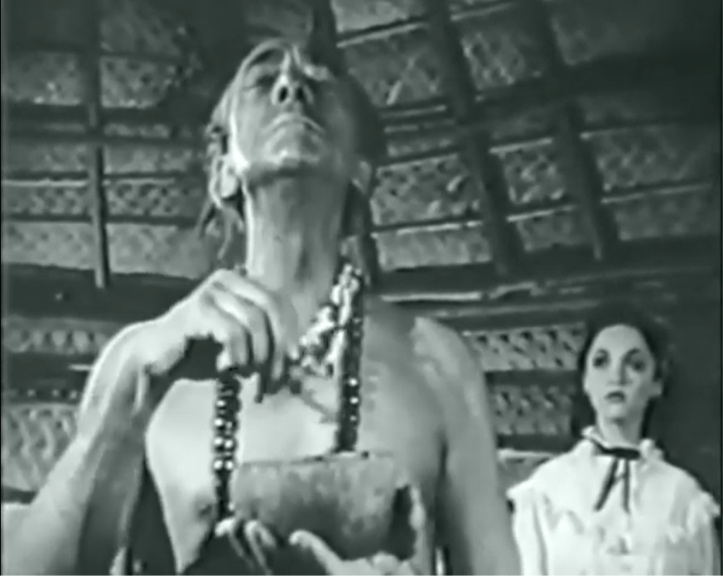
“Now on the surface the water looks smooth and calm. But underneath there are strange and dangerous things happening.”

Sitting Duck’s rating: Zero out of two black pearls used as eyes in a shark god idol
Sitting Duck’s review: When it comes to theme weeks, my instinct is to pick something that’s a little off kilter. For instance, back when we did John Carpenter Week, I went with a production where he was only the story writer. For a John Hughes Week that was considered but ultimately fizzled out, I contemplated using this Yugoslavian-produced biopic about Nicola Tesla for which he allegedly co-wrote the English language script (though some sources claim it was a pseudonym used by historical fiction author Dee Brown). And when it comes to reviewing movies for Christmas, I lean into the underused tradition of telling ghost stories, even when they have little or no connection to the holiday.
So when Justin announced that we would be doing Mutant Shark Week, I knew that whatever film I ended up reviewing, it wouldn’t involve a fish kind of shark. The movie I settled on was released in the 1940s and features the idol of a Polynesian shark god as its McGuffin. Reading that, you’re probably convinced that this will involve a hinderload of Unfortunate Implications. And you wouldn’t be entirely wrong. But neither would you be entirely right. If you want to know what I’m talking about, you’ll just have to continue.
Captain Roger Guy (Trevor Bardette) is making a return voyage to the island of Tahiti. During his last visit, he had encountered an idol of a shark god of the Omoo tribe that had featured two exquisite black pearls for the eyes. Naturally, he had decided to swipe the pearls, which he intended to pawn at first opportunity. However, circumstances had forced him to leave the pearls behind, though not before hiding them where they couldn’t be found.
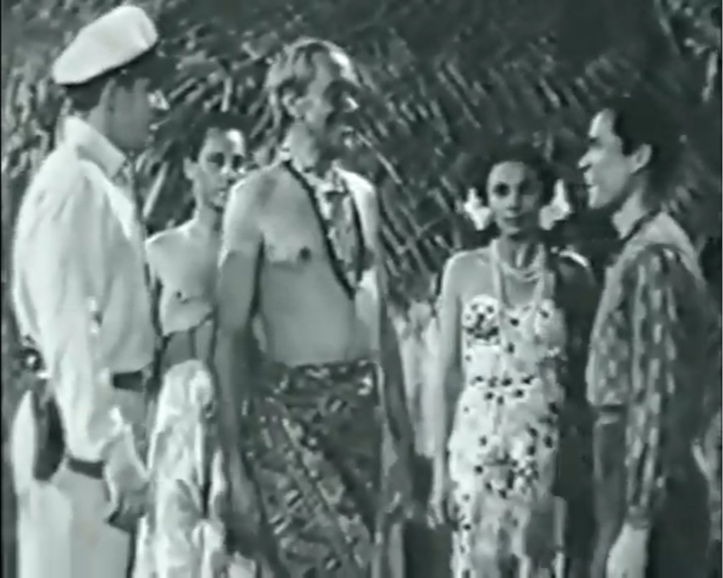
Ever since then, the captain has been gradually afflicted by a mysterious illness that defies medical explanation. Of course, we the viewers recognize his desecration of idol as having caused this. But he believes it more likely that the ship’s doctor (George Meeker) is a washed-up quack. FRather than owe up to his blasphemy and restore the pearls to their rightful place, the purpose of his return is to retrieve them so that can be sold like he originally planned. However, several of the less scrupulous crewmembers have gotten wind of this and are thinking of ways to get a cut of the action. Meanwhile, the Omoo tribe just want the eyes for their idol back so that their current string of misfortune will come to an end.
Omoo Omoo the Shark God is alleged to be an adaptation of the Herman Melville novel Omoo. I say “alleged” because I suspect that it’s an adaptation in the same way Who Framed Roger Rabbit? is an adaptation of Who Censored Roger Rabbit? (that is to say it takes a few character names and a line or two of dialogue from the source material and fabricates a completely different story).
And what they do present is pretty thin material. It’s more or less your bog-standard Western Explorers Encounter Isolated Tribe storyline that was used with some frequency at the time. And it presents many of the outdated conventions prevalent in this sort of narrative. But credit where credit is due. The Omoo are not infantilized, at least not to the extent commonly employed in this genre. Compare it to something like Jungle Goddess, and the contrast is quite stark. Even so, it’s a pretty low bar to clear.
Also not helping is how there is an excessive amount of narration. I’m willing to tolerate a few paragraphs at the beginning to set things up. If I’m in a generous mood, I will only quietly groan at a few sentences that amount to “And they lived happily ever after,” just before the end credits roll. However, seemingly every other scene opens with a voiceover from George Meeker’s character. It’s like Robot Holocaust all over again! All it does is indicate that the writers had no confidence in their ability to convey exposition in a convincing manner.
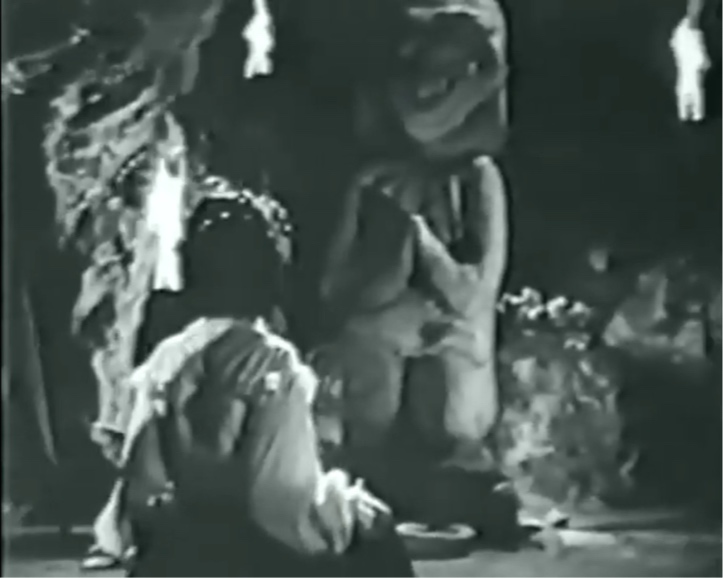
Despite the fact that this movie fails to crack a full hour, it still manages to feel padded. If some of the more random scenes were excised, you could probably pass it off as a badly preserved episode from a TV anthology series of the 1950s (the print I saw was pretty rough). The worst of the lot is this sequence featuring marine life stock footage that centers around an octopus (supposedly two of the characters are observing this scene from the ship, I’m skeptical). It’s almost as if Ed Wood was an uncredited second unit director.
Then there’s the editing. This sort of thing is something that I (and likely a majority of audience members) rarely notice on a conscious level. On the occasions when I do notice the editing, most of the time it’s because the person responsible screwed up. And hoo boy did they ever. All too often direct cuts get used for scene changes, which are quite jarring compared to something like a dissolve or a fade. Then there are a couple of scenes which involve one character discretely trailing another. These feature a series of cutaways between the two characters. However, the way the shots are put together give no sense that there is any connection between the two.
When a movie of a genre notorious for employing obsolete tropes manages to reign in the worst excesses, that’s an accomplishment of a sort. Even so, without substance beyond that, it’ll still wind up being a pretty sorry offering.
Part of