
“You’ll own nothing and be happy.”
This phrase, which originated by Danish politician Ida Auken in 2016, became the chilling prophecy of a reality that came upon us when we weren’t looking. The pivot from physical media to the digital age generated all sorts of excitement in the early 2000s, so it wasn’t hard to pivot yet again from digital ownership to subscription-based streaming.
Netflix first launched its streaming service in 2007, with Spotify coming along a year later. Both of these kicked off a massively popular trend toward streaming — featuring movies and music, respectively — and were embraced by the public for convenience and one low price.
But the utopia of media access quickly became a dystopia. Everyone wanted to get into the streaming business, and that fractured the one-site-for-all convenience of Netflix. Streaming (including music and games) got more expensive, less convenient, and more spread out all over the place. In 2025, Variety reported that the average US household spent $69 a month for streaming services — including those that were supported by ads.
Listen, you probably stream something, and I’m not here to tell you that you’re a bad person for doing so. I get why people do it. I see the convenience. But I also see the mounting frustration over rising costs, scattered media, unsearchable menus, insane algorithms, and declining quality. People may use streaming, but I rarely bump into anyone happy about it. It’s not a joy. It’s a burden.
It gets worse, because streaming services show that they do not have the user’s best interests at heart. They have all the control, and we have nothing. So companies can remove films, censor or outright delete “objectionable” TV episodes, insert different recordings of songs, and force us to continue to pay to keep access to stuff that we thought we were buying.
Just this past month, Sony announced that it was going to stop making physical discs for its PlayStation in a year or so — oh, and it deleted over 500 movies that users purchased through its store. For some, this was the wake-up call of their lack of personal control.
In short, we own nothing and we’re unhappy about it. That’s what I want to talk about, because there’s something happening that all of the studios and game companies and recording labels didn’t anticipate. They thought they had successfully corralled all of us docile sheep into pens for the full control, but now the sheep are waking up. We’re kicking and busting out. And we’ve found a way forward… by going back to the past.

There’s a real guerrilla war happening in the consumer landscape as people are rejecting streaming in favor of physical media. What’s wild here is that the biggest proponents of this aren’t us older Gen X and millennials (although we’re among them) but the younger Gen Z crowd that grew up in the digital age and are now sick of it.
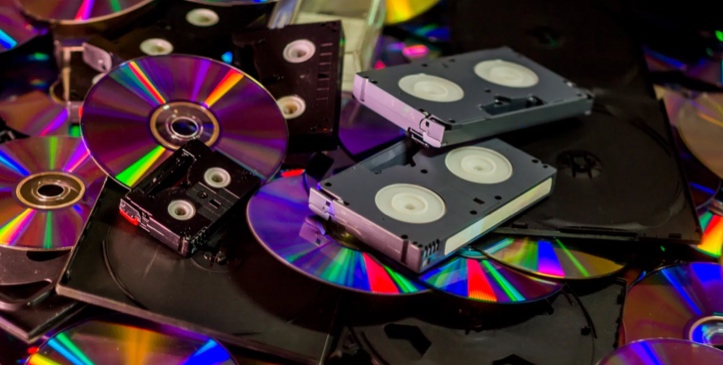
Tons of people are gobbling up physical media: VHS, DVDs, Blu-Rays, CDs, vinyl, cassettes, game cartridges, you name it. It’s not some sort of flash-in-the-pan fad; this has been happening at an increasing scale for the past decade. More and more, consumers are rejecting streaming and demanding that they own their entertainment.
It was almost too late for this revolution to take place. Cars had phased out CD players, most households ditched their DVD players and stereos, and all of that old media was thrown out or carted off to thrift stores. In 2015, everyone was predicting that the era of DVDs and CDs was finally over. Companies figured that they could start shoving whatever they wanted in your face, guiding you with the algorithms and making up “content” with AI, and we’d go along.
But then we started fighting back by going to those thrift stores and yard sales and eBay and Facebook Marketplace. People bought old game systems and stereos and TVs that still worked because they were built before forced obsolescence became a thing. The conversation around physical media — and here, I include hardware like iPods that handled media offline — grew louder and more pronounced. Vinyl sales trended up year-over-year for a decade straight. Average people opened up VHS rental stores in their neighborhoods. Little lending libraries encouraged reading physical books. Retro gaming took off like crazy. Stores grudgingly started stocking movies and music again after taking them out years prior.
I started re-collecting CDs back in 2023 just as this movement was really taking off. A lot of my friends thought I was a little loopy, going archaic in our present age. Yet I’d point out to them the benefits of a collection, such as the pristine sound quality of a CD, the actual ownership, the physicality of it, liner notes, the joy of owning a visible collection, the thrill of hunting through stores for good finds, and the encouragement it gave to listening through albums start to finish. That’s not even to mention how it turned out to be a great avenue for music discovery — and I wasn’t influenced by the algorithm!
I haven’t subscribed to a movie or music streaming service save for free trials here and there (or free sites like Tubi). Rather, I’ve basked in the freedom that comes with curating my own collection of digital and physical media and enjoying it when I want to without any ads or additional price tags. My iPods and stereo give me more music satisfaction than Spotify ever could. And when I want to turn to movies, I’ve been digitizing all my old DVDs (and some new ones!) and throwing them all on an iPad or a spare Plex hard drive for comfort viewings.
Again, if you like streaming, this isn’t to shame you or to crow about how one way is better than another. Streaming’s not going away, I know. But there is a counter-revolution in process, and it’s not the flight of some internet guy’s imagination. Just type “physical media” into news sites, YouTube, or Reddit and see the flood of articles and videos on the subject. Consumers are reclaiming this corner of their entertainment lifestyle, and some companies are responding positively to this demand by making new hardware, putting out more movies on discs (such as Vinegar Syndrome and Shout! Factory), and producing new digital audio players, stereos, turntables, and game emulators.
It’s going to be an interesting ride down the slope of the remaining 2020s in this regard, and hopefully we’ll end the decade with physical media taking more of a prominence than where it was going into it.
There’s another slogan that’s become a greater rallying cry in 2026: “Physical media matters.” Each piece of old tech and old media purchased and repurposed for modern entertainment is a blow against corps that would rather have you subscribe forever. May the revolution only grow.


I hope that physical media sticks around for those that enjoy it, but IMO too much is being made of it. Physical media degrades. The Babylon 5 boxed sets I bought back in the early 2000s? At least one disc in each set went bad in a period of five or six years. It wasn’t just the Babylon 5 DVDs either. Warner Bros. DVDs were notoriously bad quality and easily degraded. Physical media still has DRM. Sure, that PlayStation 3 game is on disc, but good luck making a backup or playing it on a reformatted PS3 after the PS3 store goes offline next year and the game needs a patch.
The real issue is DRM, IMO. I buy most of my games on GOG, which is entirely DRM free. They can be stored easily on multiple external SSD drives for backup. For music, I use a Tidal subscription to sample new music. Whatever I like I buy on either Qobuz or Bandcamp in lossless quality that can be downloaded, backed up, and transcoded to lossy codecs for easier storage and playback on my smartphone. In their lossless format they sound just as good as CDs, if not better. For books and audiobooks, there are DRM-free ebook and audiobook stores. As a middle-aged man whose eyesight was never that good to begin with, being able to choose my own font sizes to read books with on ereaders is a God-send.
Physical media is nice, but it has its own issues that can be rectified by digital. Just digital (and even physical media games), can be encumbered by DRM. The one real pain point for me is movies and television, but I’ve mostly just stopped watching movies and television and spend my free time reading, playing games, and listening to music instead.
YMMV.
I’m all for digital when you own and control it! The new Xteink X4 e-reader is making huge waves this summer due to its portability and being able to mod it right out of the box. GOG is great to own your games, DRM-free. There are a lot of options out there, we just gotta guard against subscriptions encroaching on them. A company can’t do that to my DVD or iPod.
“Both?”
“Both.”
“Both is good.”
The Road To El Dorado
My point being, variety can create + maintain resilience. So can ingenuity. Repair instead of replacing, when possible. Don’t know how? Skills can be learned. Still unable? Find people who can. Ask people in vinyl record + audio casette tape circles. They were doing it before the internet even really took flight. Heck, there are folks who collect + use wax cylinders + players — I’ve seen an antique Edison player in a shop window! Yes it worked, no it was not for sale (according to the card).
I have been able to take care of VHS tapes that I had since the 1990s when I was a kid and music CDs.
“Average people opened up VHS rental stores in their neighborhoods.”
Really? Cool! Where?
I’m 34 and one of the rare people that never got rid of my VHS tapes or DVDs. Still have a VCR and DVD player. Since 2007 I have been buying movies at thrift stores including VHS and DVDs. I do not use netflix. I still continue to buy music CDs. My current car is a 2015 Nissan Versa which thankfully has a CD player. I have a very large collection of physical media, including TV shows on DVD like Miami Vice and Magnum PI
I still have all my media. I know friends look at me like I’m a conspiracy theorist, but I like having something that is harder to take away on a whim.
A lot of my neighbors are surprised that I still have physical media. And I’m 10 years younger than some of them. Still have my VHS tapes even