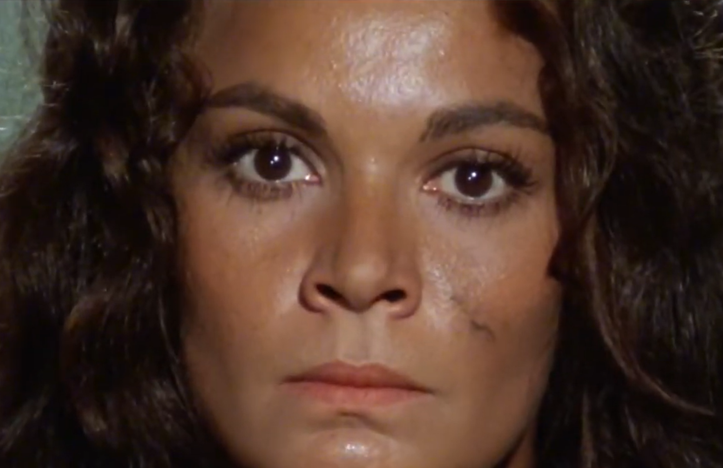
“Just, sometimes you get suspicious of everyone.”

Drake’s rating: No ducklings were harmed in the making of this film
Drake’s review: Lucio Fulci is a name well known to horror fans. After all, the Italian director was behind the camera for films like Zombi 2 and City of the Living Dead, and that’s the type of film many American fans associate his name with. But Fulci worked in a variety of genres, including comedies, crime dramas, Westerns and of course that uniquely Italian murder-mystery known as the giallo.
In fact, Fulci was rather active in the giallo scene for a few years, and turned out some very effective thrillers such as Double Face and One on Top of the Other. But it was this film, Don’t Torture a Duckling, that not only stood out as one of the best in Fulci’s lengthy filmography, but also foreshadowed his gorier work a few years later.
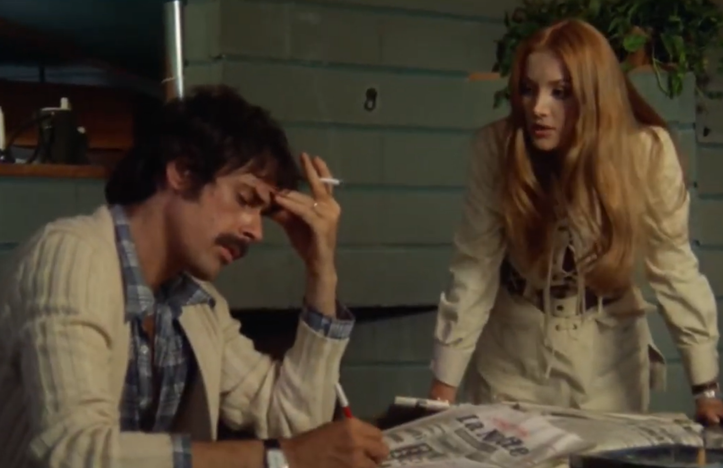
In a small, rural town in southern Italy, all is seemingly quiet. But that’s only on the surface, since this village has more going on than Peyton Place. Patrizia (Barbara Bouchet, The Red Queen Kills Seven Times), a reporter from the city, is using the town to lay low for awhile after a drug scandal derailed her career.
She’s living in a house owned by her father, a man of some wealth who’s moved on from the area, and bides her time sunbathing in the nude and being all kinds of inappropriate with the local boys who run around and create small pockets of havoc on their own. In fact, the three boys spy on some of the local men, who wait for the sex workers of the big city to come into town, and then bedevil a local man named Giuseppe for doing the exact same thing.
Meanwhile, on the outskirts of town lurks Maciara (Florinda Bolkan, who had played the lead role in Fulci’s A Lizard in a Woman’s Skin the year before), who lives a frantic existence as a haunted outsider. She digs up an infant’s remains at the film’s beginning, and then secretly engages in her own sorcerous rituals as she sticks pins in three small handmade dolls, all the while muttering about vengeance. And all of this happens in the shadow of the new highway overpass that borders the little town, its huge concrete pillars at odds with the small, more traditional buildings below.
But the village soon becomes a hot spot of its own rather than just a dot on a tourism map as one of the three boys disappears. The police suddenly have their hands full when reporters flock to the area and one of them, Andea (Tomas Milian, Traffic), instantly recognizes Patrizia. As they form a tentative friendship, the other boys start to show up dead as well, murdered by an unknown assailant. Giuseppe is an obvious and early suspect, but then of course police attention turns to Maciara. As an obvious outsider the local villagers view her with great suspicion, and her frantic demeanor only adds to that impression.
And of course Patrizia is an outsider as well, and one that has had her own bizarre interactions with the boys. She might be calm and collected on the outside, especially compared to Maciara’s wild-eyed demeanor, but she also has secrets that she would rather keep hidden away from both the police and the locals.
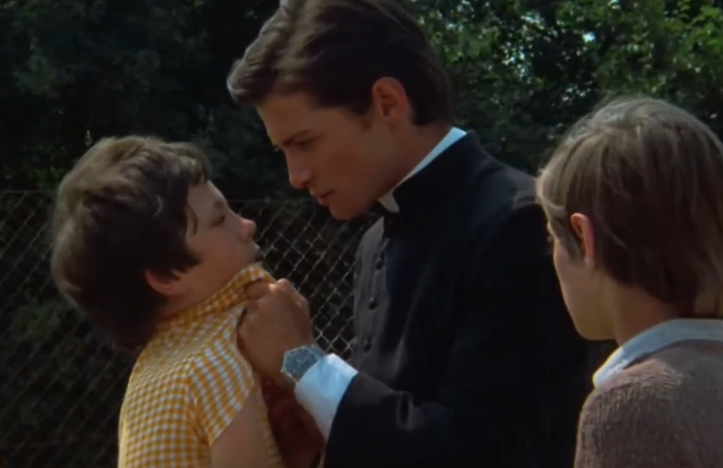
Don’t Torture a Duckling is a rather unique giallo. For one thing, Fulci keeps the action very local, focusing entirely on the small village rather than having the action take place in a larger city or in another country. Gialli were very often a metropolitan affair, with large buildings and long shadows for the always-mysterious killer to lurk in, and the open fields and rustic landscape of Southern Italy provide a very different tone to the film. The bodies aren’t found in dark alleyways or abandoned buildings — they’re found in pastoral fields and otherwise pleasant creeks.
Which of course brings us to that fact that the victims here are children, which is another factor that sets Don’t Torture a Duckling apart from most gialli. Way, way apart. Fulci is completely unapologetic here, presenting the boys as miniature versions of their unenlightened elders. Although they are the victims, they are mostly spared from the gore effects that the director happily inflicts on the adult members of the cast.
Fulci considered Don’t Torture a Duckling his best film, and it’s easy to see why. It’s a singularly fascinating look at small town Italy through a distinctly giallo-tinted lens, and it has the director’s distinctive fingerprints all over it. His distrust of authority and sympathy for the outsider is practically stamped onto every frame of the movie, but Fulci stops short of beating the viewer over the head with his positions. Even the killer is revealed to have a motive that is not unsympathetic relative to their own twisted point of view, although that never detracts from the horror of their crimes.
Don’t Torture a Duckling is a very well-made film with a stellar cast that not everyone will enjoy. That was true in 1972, when it received some harsh criticism and backlash for its subject matter, and it’s still true today. That’s kind of the nature of gialli in general, of course, but it’s particularly true for this one, which bends the rules of the genre to a certain degree. But if you’re interested in giallo films, or you’re a fan of Lucio Fulci, then it’s practically required viewing.
It’s just too bad Disney quashed the original title translation. Don’t Torture Donald Duck just has a certain ring to it.
Intermission!
- This film got Fulci in hot water with a number of groups, including the censors. He had to do some serious persuasion to convince them that a young actor and a naked Barbara Bouchet were not in a scene together, and that the boy was doubled by a small adult. It was probably not the first time Fulci had to defend one of his movies, and it certainly wasn’t the last.
- Special effects artist Carlo Rambaldi did some uncredited work on this film. He later had an incredibly successful career in Hollywood, winning Academy Awards for his work on Alien, E.T. the Extra-Terrestrial, and the 1976 version of King Kong.
- While the film is filled with great performances from some top European talent of the time, the biggest low-key casting coup might have been that of Irene Pappas, who plays Dona Aurelia Avallone. Pappas was a Greek actress who became known for her roles in classic Greek tragedies, including playing Helen of Troy the year before in The Trojan Women. She was living outside of Greece at the time, however, due to her criticisms of the Greek military government, and was fortunately available to work with Fulci.


“No ducklings were harmed in the making of this film.”
Seeing as how this is an Italian movie from the 1970s, I’m skeptical. 😛
Well, a toy duck does get decapitated… But I’m sure it was just an accident.