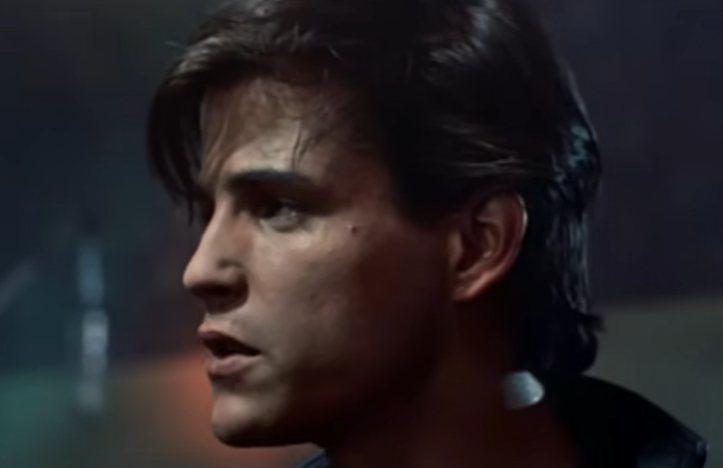
“You don’t understand. The night Eddie died, the Cruisers died with him.”

Drake’s rating: I don’t care what people say, rock-and-roll is here to stay
Drake’s review: In 1963, Eddie Wilson was on the rise. A rock & roll singer fronting a band called the Cruisers, his songs were on the radio and hitting the charts, and a successful debut album saw him signed to Satin Records on a new contract that was set to make him a star.
But on March 15, 1964, his car was pulled out of a New Jersey bay and the saga of Eddie Wilson came to a close. His body was never found, but he was soon declared dead and the Cruisers’ music quickly faded away.
Eighteen years later, however, Satin Records re-releases the debut album to an audience that eats it up. Television reporter Maggie Foley (Ellen Barkin, Drop Dead Gorgeous) thinks that there’s a big story here, not just with Eddie’s disappearance and presumed death, but with the fact that the band made a second album, one that was supposed to be far more experimental than their previous work. The only problem is, that album, “A Season in Hell,” was never released, and, in fact, the tapes went missing about the time Eddie died.
Foley wants to know what happened to those tapes, and that means she’s going to have to find the remaining Cruisers, who all went their separate ways back in 1964.
Foley soon finds a man named Frank Ridgeway (Tom Berenger, Platoon), a high school English teacher* who was once a Cruiser himself. In fact, he was known as the Wordman, as he was the one writing the lyrics to all of their songs. Frank is guarded around Foley, but her questions soon send him off on his own journey as he tracks down the other Cruisers, looking for some answers to questions that he thought had died 18 years before.
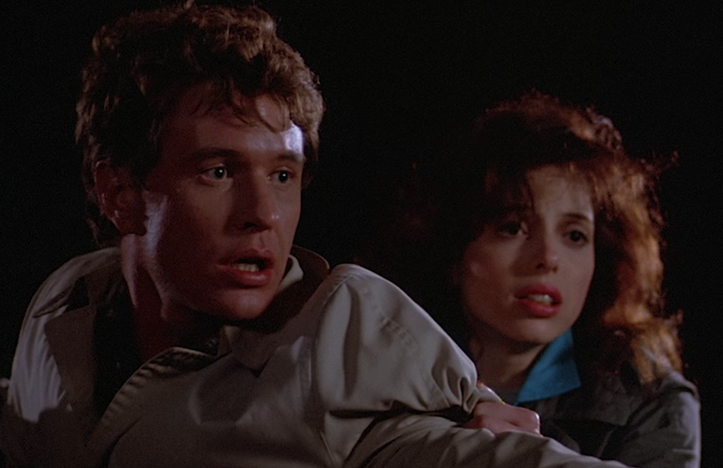
That’s the basic gist of Eddie and the Cruisers, a 1980s drama that was plagued by distribution and release date problems, jerked from the theaters after an abbreviated three-week run in the fall of 1983. And that’s a shame, because this flick deserved a wider audience.
The movie alternates between the past and the present as Frank finds the others, so we see how he met Eddie (Michael Paré, Streets of Fire) and the other Cruisers when they were working bars in the early Sixties. Eddie appreciates Frank’s love of language, and before long the young man who was sweeping floors after hours is a Cruiser himself, touring with the band. It’s not all sunshine and roses and the band hits some rough patches, and none is rougher than the fight over “A Season in Hell,” an album deemed unreleasable by the executives at Satin Records.
But Frank still tracks everyone down, since he’s curious about the tapes as well. Doc, the band’s manager, is now a DJ for a third-rate radio station, drummer Kenny “Just a Phase” Hopkins is dealing blackjack at a casino in Atlantic City and bassist Sal is doing the lounge circuit with “Eddie and the Cruisers featuring Sal Amato,” a Cruisers cover band with an Eddie lookalike.
Hey, at least he’s still in the music biz, right?
Eddie’s girl Joann never really moved on after his death, and she tells Frank that something weird is going on because she’s been getting these strange phone calls and she swears she’s seen Eddie’s ‘57 Chevy Bel Air outside her house…
So, yeah, the movie leans pretty hard into the “is he or isn’t he” trope, teasing the fact that Eddie may have just faked his death and cruelly abandoned his friends and bandmates just because he was in a snit over a record deal gone sour. But surely a rock star could never be that petulant, right?
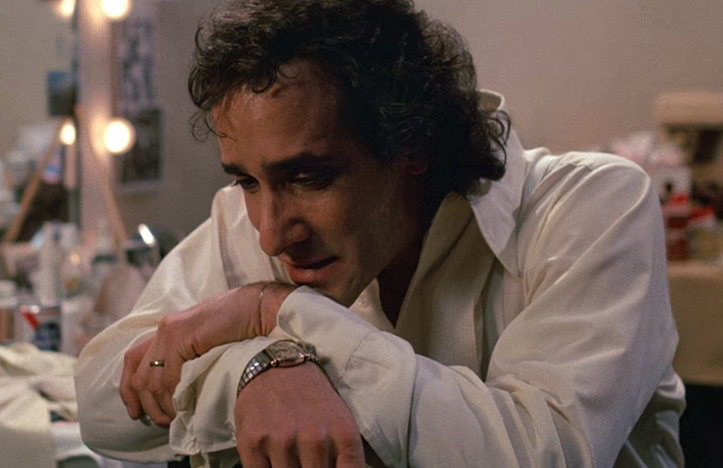
Eddie and the Cruisers is honestly a lot of fun, with an above-average cast that makes it feel like a bigger movie than it really is. Berenger is the solid center of the film, playing his younger self with wide-eyed innocence and occasional pretentiousness (he carries his book of poems everywhere), while his older self is worn down and still haunted by the life he never had. Joe Pantoliano (The Fugitive) is all twitchy energy and constant gab as Doc, keeping the band moving forward in the ‘60s and still looking for a big break nearly two decades later.
Sal, as played by Matthew Laurance (St. Elmo’s Fire), is an almost tragic figure. He was Eddie’s oldest friend and the Cruisers were his ticket to a better life. He loved Eddie then, he sometimes hates Eddie now, but he can never get past 1963 because he didn’t have the talent to make it on his own, and now he’s stuck in a musical purgatory, playing the same songs over and over again night after night.
Joann (singer Helen Schneider) is a choreographer in the ‘80s, but her younger self is more fleshed out than her mature version. Still, she’s as haunted by the past as everyone else. She knew Eddie well, but in many ways he was a mystery even to her, and with him long dead it’s one she can never solve.
She also serves as the not-so-latent love interest for Frank, who has been infatuated with Joann since his first glimpse of her back in 1962.
Poor saxophonist Wendell Newton (real life musician Michael Antunes) never gets to see the 1980s, as he died of a heart attack before Eddie’s car crash. Or at least that’s the story that Frank’s always been told.
The music here is central to the movie, of course, and it’s a strong soundtrack grounded by John Cafferty and the Beaver Brown Band serving as the true musicians behind the Cruisers. I have to say, though, that as much as I do like the music, it feels like a distinct anachronism for 1963. The Crystals were at the top of the charts with hits like “Da Doo Ron Ron” and “Then he Kissed Me” with the Chiffons’ “He’s So Fine” right on their heels, and Jan and Dean, the Surfaris and Sam Cooke were all making noise of their own, and none of it sounded even remotely like the work of Cafferty & Co.
And when we finally get to hear a single track from the fabled “A Season in Hell” album, it’s very close to what you might expect to hear Blue Öyster Cult performing in the late ‘70s. But as interesting as it is, it’s nothing that would even have been conceptualized in 1964.
Still, the songs are a lot of fun and Paré is entirely convincing as the front man belting them out in Jersey coast bars. So feel free to ignore my foray into musical criticism and bop right along to “On the Dark Side” because it’s one heck of a song.
And this is one heck of a movie as well. But if you watch it, do yourself a favor and stop there. Don’t look for a sequel, because nothing good can come of it. Trust me. Look into my eyes and repeat after me…
“There is no sequel.”
“There is no sequel.”
*A full-time teacher, not The Substitute.
Intermission!
- Eddie and the Cruisers is based on a novel of the same name by P.F. Kluge. If you can ever dig up a copy, which is unfortunately very difficult to do, you’re going to find quite a few similarities in both theme and dialogue, but the novel is much darker. There’s some violence that wasn’t in the film, and Sal in particular is an even more pathetic figure, with his version of the Cruisers creating new music that absolutely no one wants to listen to. There’s also some depth and backstory here that don’t make it into the movie.
- OK, OK, yes, there is a sequel, but it’s bad. B-A-D. How bad? Well, in his introduction to the 2008 printing of Kluge’s novel, acclaimed writer Sherman Alexie called it “one of the most inert and awful films ever made.” Seriously, avoid it at all costs.


“Beaver Brown Band”
A big brown beaver, perhaps, in the company of a woman named Winona?
I was honestly not expecting a Primus-related comment today!
Reels of Justice put this one on trial.
https://reelsofjustice.buzzsprout.com/1154249/episodes/17518989-roj-506-the-people-vs-eddie-and-the-cruisers-with-clif-campbell
I’ll give that a listen, and I’m curious what their verdict is.
Granted, if it were the sequel, I’d expect nothing less than “GUILTY!”