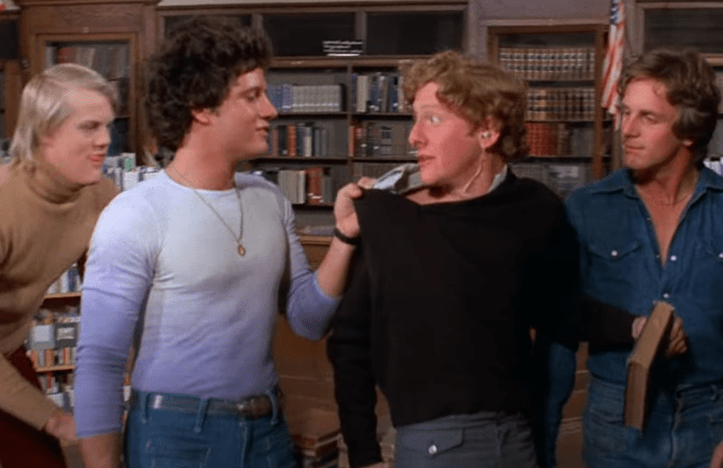
“When I came to that school they weren’t people, they were scared mice.”

Drake’s rating: An A for effort
Drake’s review: “Power tends to corrupt, and absolute power corrupts absolutely,” wrote Lord Acton in 1887, but the theme itself is as old as the act of storytelling. In ancient Greek mythology the Titan Cronus overthrew his father Uranus and became the tyrannical ruler he had rebelled against. The Olympians in turn defeated the Titans, only to take their place as the domineering rulers of mankind. In Rene Daalder’s Massacre at Central High that theme is front and center, with a California high school standing in for the fabled halls of Olympus.
It’s a natural setting for such a tale. The Olympians, like high school kids, were often shown to be malicious and capricious, letting their emotions dictate their actions and taking what they wanted with little or no thought of the consequences. Their authority rested solely on their power to control humanity, and defying that authority could get you chained to a rock with an eagle snacking away on your liver until Steve Reeves showed up to save the day.
Massacre at Central High sets its sight squarely on the students, using the high school pecking order as a metaphor for the stratum of society in general and the inevitable power struggles that ensue. There are no parents or teachers in the movie until the very end, so the only order imposed is from within. And when that order breaks down another one takes its place, with the bullied now jockeying for position and turning on each other in their attempts to rise to the top of the societal food chain.
At a high school somewhere in California, nefarious things are afoot. For one thing, most of the high school students look old enough to be paying taxes and working on their first divorce. For another, a group of preppies led by Mark (Andrew Stevens) rules over the school with an iron fist, threatening students in the hallways, trashing the library and generally being elitist jerks.
Into the middle of this one-sided class warfare walks David (Derrel Maury), an old friend of Mark’s who’s transferred to Central High. Mark is welcoming to his old friend, but the other preps aren’t so sure about him. He sets off their class-conscious alarms with his decidedly non-preppy wardrobe and a car that betrays his status as a lowly commoner. Even worse, David fraternizes with the peasants, even offering to help one boy repair his car after the prep squad wrecks it.
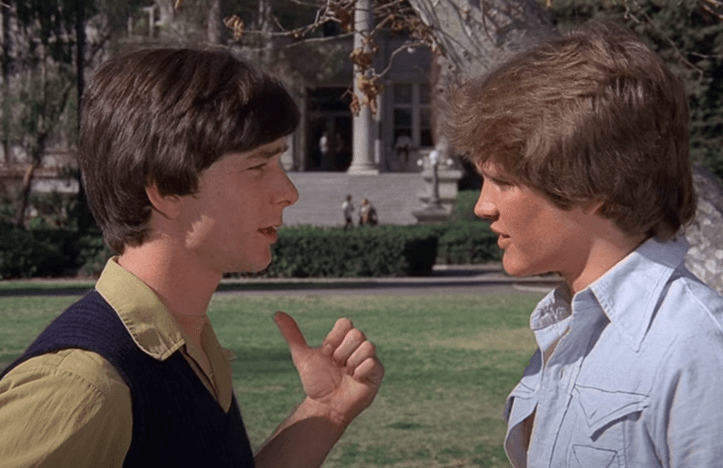
Things go too far when the prep goons (sans Mark) try to assault a pair of girls and David wades in, fists flying. Embarrassed by their one-on-three beatdown, the preppies go whining to Mark, but he still refuses to turn on his friend. When they confront David later his knee is crushed, bringing an end to his high school sprinting career. And that’s when the revenge begins.
But David is no modern-day Prometheus. He offers destruction of the powers that be, but that’s the extent of his effort. The second (and oft-ignored) part of Lord Acton’s quote, “Great men are almost always bad men,” applies to Massacre at Central High just as much as the first part does. David rejects the preppies and fights them because it’s in his nature. He’s not looking to be a hero; he simply struggles against inequity. But as the bodies of the bullies begin to pile up, and the downtrodden turn the tables on their former tormentors, he rejects taking any sort of leadership role. Instead, he watches as the void that he created is filled with another set of power-hungry adolescents, and then he decides to deal with them as well. He’s destroyed one social order only to see the inevitable power vacuum filled by another, and then comes to the conclusion, without ever offering an alternative idea, that society itself is at fault and must be destroyed.
No one is pure in Massacre at Central High, and no one comes out unscathed. This is a revengesploitation flick that takes a very dim view of humanity in general, playing out the social dictum and frictions of society against the backdrop of its high school setting over a decade before Heathers trod very similar ground. But while Heathers was a dark comedy, Massacre at Central High takes its subject matter seriously.
And, OK, it’s maybe a bit too serious at times, but the actors involved are a solid lot and keep the material from descending into melodrama or camp. Look for a young Robert Carradine in an early role, as well as Kimberly Beck, best known to horror fans for her role as Trish in Friday the 13th: The Final Chapter. Massacre at Central High is a well-made teen flick from an era that turned out fairly pedestrian fare like clockwork, and features some pretty nifty pyrotechnics and stunt work as well.
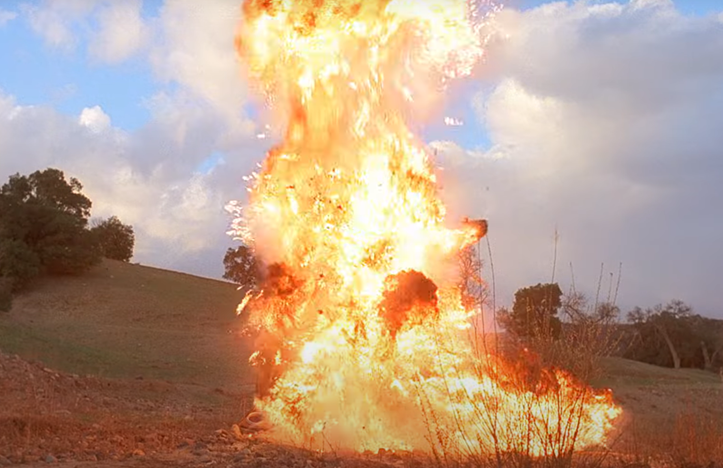
And it’s OK if you shed a tear when the ‘66 Shelby Mustang goes boom. I know I did.
Intermission!
- Why do ‘70s preppies always drive MG’s? Those things are far too labor-intensive for the sweater set.
- The theme song “Crossroads” belongs in a CBS TV movie of the week. A bad CBS TV movie of the week.
- Reminder: always check the pool for water. If none is present, avoid the diving board and go grab your skateboard instead.
- That was a really awkward skinny dipping scene.
- A van tumbles down a hill. Wait for it… Yes! Thar she blows! The ‘70s loved them some exploding cars.
- I’ve seen a lot of cinematic butts in my time, and now I’ve seen Robert Carradine’s. Yay…?
- Sure, kids have been dying at the school in strange ways, but let’s have a dance anyway.
 Mutant Reviewers
Saw this about 10-11 years ago, still remember it, proper messed up film but in the best way possible