
“The greatest danger of all is that danger never ends.”

Chad’s rating: It’s time for the apes to go into hibernation.
Chad’s review: When the original Planet of the Apes debuted in 1968, I don’t think 20th Century Fox expected the Charlton Heston-starring film to spawn such a durable franchise. In an age when sequels were a rarity, the studio released Beneath the Planet of the Apes (1970), Escape from the Planet of the Apes (1971), and Conquest of the Planet of the Apes (1972) to successful, if diminishing, returns. The fifth and final entry, Battle for the Planet of the Apes (1973), was meant to wrap up the aging series but also set the stage for the franchise’s future.
The executives at Fox were also delighted that the Planet of the Apes films became a licensing bonanza. Many children who grew up in the 1970s remember the plethora of Apes merchandise, like action figures, playsets, trading cards, and comic books. One wonders if George Lucas was inspired when he signed his Star Wars deal to write the clause that he retained the movie’s merchandising rights. In any case, Fox was eager to keep their cash cow going by greenlighting a weekly TV series alongside Battle for the Planet of the Apes, closing out the film franchise.
This places Battle of the Planet of the Apes in creatively murky waters, as it’s essentially the final chapter of the five-film saga but a soft prequel to the 1974 TV series. The film suffers the same flaws from earlier entries with its cheap-looking budget, clunky plotting, and scientifically dubious storylines. There’s still a socially thematic undercurrent, with this chapter exploring a clash of civilizations and how it takes hard work to keep the peace versus the easy violence of war. These compelling ideas are never fully explored, as the franchise was running on fumes at this point.
Battle picks up 20 years after the 1991-set Conquest, where the ape civilization led by chimpanzee Caesar now enjoys a fragile peace with the humans. In the intervening years, there were dozens of ape-led revolutions alongside a brutal nuclear war among humans, heavily reducing their populations. Humanity now lives as indentured servants for the evolved chimpanzees, gorillas, and orangutans under the rule of Caesar.
While Caesar is content with his wife, Lisa, and their young son Cornelius (named after his grandfather), he still wonders about his time-traveling parents and what they know of the future. His human assistant Macdonald informs him that they may have recorded that information on video archives left behind in the ruins of Los Angeles, now known as The Forbidden City. Intrigued, Caesar, Macdonald, and orangutan Virgil, secretly travel to the radioactive ruins in hopes of finding answers about the future years ahead.
Once inside The Forbidden City, the trio finds the archived tapes at the headquarters of the old fascist regime (featured in the previous film). Caesar sees the footage of his long last parents, Cornelius and Zira, who give a vague timeline of the coming ape-led future. But the trio is soon attacked by a secret group of radiation-infected humans still living in the city under the command of the villainous Governor Kolp. After a daring escape, they return to Ape City with news of their findings.
But while Caesar, Virgil, and Macdonald were away, General Aldo and his faction of gorillas led a military coup, placing himself as the city’s leader. Aldo is angry that Caeser wants to live in peace with humans, whom he sees as inferior slaves who should be caged and beaten. Caeser returns to a society on the brink of civil war as Aldo claims martial law, rounding up the humans like animals. Soon, Caesar is pushed to the brink when Aldo kills his young son, Cornelius, breaking the sacred law of “ape shall not kill ape.”
As the Ape society tears itself apart, they are unprepared for the threat of Governor Kolp and his nuclear-mutated humans in the Forbidden City. Kolp and his mutated army stage a devastating assault on the Ape City, with Caeser and Aldo briefly joining forces to defeat the human attackers. After the battle, Caesar regains control and frees the humans from servitude, appointing Macdonald to the ape-led governing council. Caesar intends to chart his own path forward, leading to a peaceful coexistence with the planet’s species.
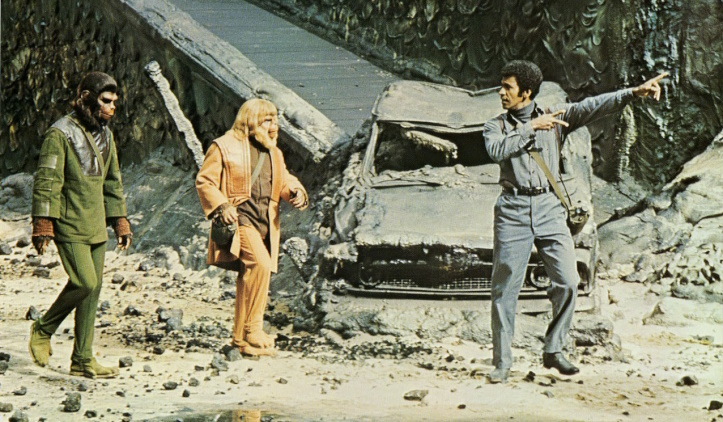
Battle of the Planet of the Apes brings the franchise full circle as this film resembles the 1968 original in tone and style. This was a deliberate course correction, as critics felt the previous entry of Conquest was too dark and violent for children, earning the series’ only PG rating. That film was a bold break from the franchise formula with its concrete skyscrapers and edgy, fascist imagery. Yet Battle softens those edges by returning to the more primitive, dune-swept production design of the earlier movies and a decidedly high adventure tone. It’s a backward step for a franchise that took big swings and tried to make each picture unique and fresh.
The story is full of questionable plot elements that don’t make any sense. Like how did Lisa and the other apes, who were previously shown to be mute and largely subservient, suddenly gain intelligence and speaking ability in just under 20 years? It’s also strange that Ape culture has adopted the same clothing and outfits featured in the first movie, which is supposed to be set hundreds of years in the future. Many of these elements were most likely introduced for the TV series, which would repurpose the sets and costumes for its upcoming production.
Roddy McDowall is still a pleasure to watch as Caesar, taking his second stab at the role after playing his father, Cornelius. Once Heston exited the series, McDowall became the face of the franchise, and his enthusiasm came through in his performance. I also enjoyed Austin Stoker as Caesar’s right-hand man Macdonald, whose low-key energy is a nice contrast to the high melodrama of the film.
One major headscratcher is the cameo of the legendary filmmaker/actor John Huston, playing the ape character knowns as the “Lawgiver.” Huston is best known for directing such classics as The Maltese Falcon, The Asphalt Jungle, and The African Queen, along with a villainous acting turn in the film noir masterpiece Chinatown. Apparently, he was a big fan of the Ape pictures and donned the simian prosthetics appearing in a short prologue and epilogue to the film. Both sequences are wildly out of place and shoehorned into the storyline. But hey, having the iconic director appear in your movie was a publicist’s dream come true.
And that’s the picture’s major problem, as it’s serving many masters but can’t function as its own entity. There are some genuinely compelling ideas here, but the wild swings in tone and clunky plotting damage any narrative coherence. Where the other Ape films were quirky and creative, the studio mandated this entry to resemble the 1968 original. It’s a credit to McDowall, who was a major cheerleader of the franchise, to bring an emotional consistency to the clashing styles. There’s some real dramatic weight when Caesar confronts Aldo over the death of his son, and it is made more notable when the acting is done through heavy prosthetics.
Ultimately, the original Planet of the Ape series can be seen as a proto version of the many high-concept and interconnected franchises headed our way. Sadly, the TV show featuring Roddy McDowall was dead on arrival and only lasted one season. There was even a short-lived cartoon series titled Return to the Planet of the Apes that aired in 1975, which is, to put it mildly, a product of its era.
And interestingly, many of the story elements of the Battle for the Planet of the Apes were used in the excellent reboot sequel Dawn of the Planet of the Apes starring Gary Oldman, Keri Russell, and Andy Serkis. That film was a showcase for stylish director Matt Reeves, whose gritty and moody aesthetic would bring a fresh spin to the updated Ape trilogy. And the long-winded titled franchise shows no signs of stopping, with another film already in production called (long breath) Kingdom of the Planet of the Apes.

