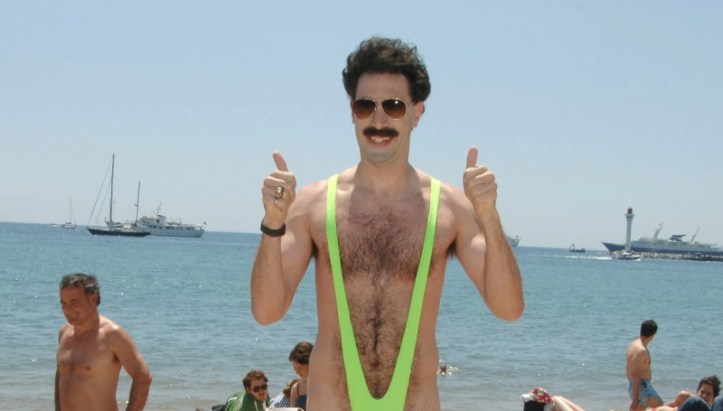
“High-five!”

Justin’s Rating: Kazakhstan number one exporter of potassium. Other countries have inferior potassium. Darn tootin’!
Justin’s Review: Humor can be, and often is, a weapon. If you ever take the time to really sit down and dissect different types of humor — Mutant Reviewers suggests traffic light stops and frequent, unannounced bathroom breaks during a keynote speech for this purpose — then you might have to work hard to think of humor that in no way offends, attacks or demeans someone else (fictional or real). Humor can be a cruel weapon used to rip into another person’s self-esteem; in fact, that skill is what we often laud most movie comedy stars of demonstrating. If there’s a group of people or an organization that we don’t like, yet it’d be “racist” or “offensive” for us to outright bash, then humor becomes the refuge for our darker natures. However, humor can also be used to reverse prejudices by creating a more extreme version of a common problem, which makes the audience laugh at the wrongness of the humor being executed, instead of the humor’s target itself.
Gah. I have no idea what I’m writing anyway. It’s 9:36 in the morning and my hand’s been thrashing about looking for a nonexistent cup of coffee for a good half-hour now.
In any case, the biggest question I had to ask myself was, “Is it okay to be laughing while watching Borat?”
Sacha Baron Cohen’s breakout movie hit was steeped in controversy, alleged racism, outright bannings, and potential fraud or libel. It also made me laugh so hard that, at times, my body forgot to breathe and the paramedics had to intervene. It’s a movie where humor is an incredibly deadly weapon, one which might be pointed at ourselves if we’re not careful.
Borat (Cohen) is a fictional TV reporter from a fictionalized version of Kazakhstan. His charming broken English and happily ignorant demeanor are countered by terrible flaws of character: He’s anti-women, anti-Semitic, anti-Gypsy, and impossibly clueless about social niceties. With only a couple of other actual actors, Cohen “travels” to America to expose Borat to our country… and see what the country exposes to him.
In progressively outrageous scenes, Borat meets with feminists, takes driving lessons, rents a bear for “defense against the Jews,” and goes on a country-wide quest to make Pamela Anderson his wife. With very few exceptions, everyone else in the film actually is under the impression that Borat is a real journalist from a foreign country, and there’s a safe sort of humor in watching Cohen come up with completely ridiculous things to say and do, while watching these clueless folk trying to respond.
Allegedly, the police were called about 91 times in the making of this movie, if that gives you any idea of what mischief Borat gets into.
Apart from being a goofy, bizarre foreigner who thinks nothing of letting a chicken run loose in a NYC subway car, Borat springs cheerful tirades of racist or offensive remarks when you’re least expecting them. The shocking part of the film is when other people, like a nasty rodeo owner or a trio of drunken frat boys, respond in kind — but only completely serious. Skillfully twisting the knife, Cohen gives us a bit of a lesson, as we find ourselves laughing at silly ol’ Borat… but then sit there in mild revulsion as the real people say pretty much the same thing. Our humanity is tested: either you laugh at Borat because his bigotry is pathetic, or you laugh with Borat because you agree with him and feel like someone’s at least saying it like it is.
To be fair, like any documentary — real or fake — we know that the filmmakers manipulate the audience to see and feel what they want them to. Borat’s been accused of being anti-American in spirit, electing to only show the worst reactions of the worst people they encounter. I don’t agree with that. Borat also tests some of the nicest people and finds them worthy; a Jewish bed and breakfast couple, a Southern dinner party and a Pentecostal revival are all mocked by Borat’s visit, yet they aquit themselves through their acceptance and patience with someone sent to test them of just that. I’m also sure that a few of the more negative reactions were tricked out of the participants or manipulated for the camera lens.
While threads of Borat’s racism and misogyny run through the film, such people happily don’t account for the whole movie. I’m glad, because there is a real danger of the producers being too eager to expose the nastier side of people that they forget that the audience just wants to have a good time, too. While it begins to drag toward the last third of the film, Borat is an absolute scream on several occasions. Cohen does a terrific job making Borat into a lovable goof who can get us giggling with his mere body stances and eye bulges.
Many people accuse Americans as being as racist or anti-foreigners as any other country, and those people might take Borat to use as proof. But I know that while mean people exist both here and abroad who have no problems with agreeing with Borat’s corrupted nature, I know that it’s just as much of a stereotype to label an entire country as anti-anything. Movies like Borat use humor as a not-so-gentle prod into reexamining our internal beliefs and prejudices, and to ask ourselves what we’re really laughing at here.

