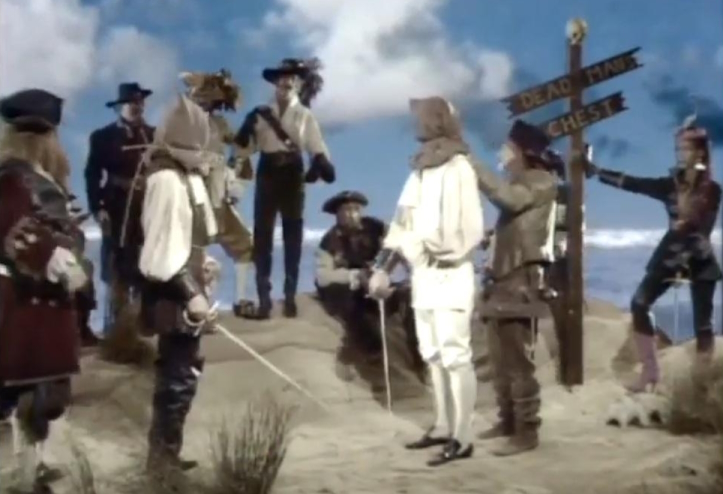
“Pirates! That’s all I need on a Monday!”

Sitting Duck’s rating: Two out of 10 planks that won’t be walked because that’s a Victorian fiction and we won’t be having that nonsense
Sitting Duck’s review: As a teen Back in the Day, one of the best genre parody books (and certainly the best standalone genre parody book) I encountered was The Pyrates by George MacDonald Fraser. It was like a wide selection of the pirate movies from Hollywood’s Golden Age taken and reimagined by Monty Python. Or Mel Brooks. Or Jim Abrams and the Zucker Brothers. Possibly all three. Though I lean more towards Brooks, as it features this pawnbroker character who I always imagine as being his personal cameo.
And of those parodies from my misspent youth, The Pyrates cried out the most for a big screen adaptation. The inherent grandiosity of the pirate movies of old means viewing such a film in a theatrical venue would have more impact than squinting at it on your phone’s Tubi app. But alas, pirates movies had a reputation as box office poison in the 1980s and 1990s.
Then one day while doing research on IMDB, through pure happenstance I came across the entry for an adaptation of The Pyrates. But my expectations were reigned in upon seeing that it wasn’t a theatrical release or even one of those Late Nineties/Early Aughts miniseries, but instead an eighty-four minute TV movie broadcast on the BBC in 1986. The best that could be hoped for was a diorama adaptation with sea battles staged in the executive washroom sink at Broadcasting House. And that’s assuming the production staff were able to obtain the key. So having discovered a copy on YouTube, I went in with low expectations. The only question was would it be Good Bad, Bad Bad, or Oh Dear Gawd Why Bad.
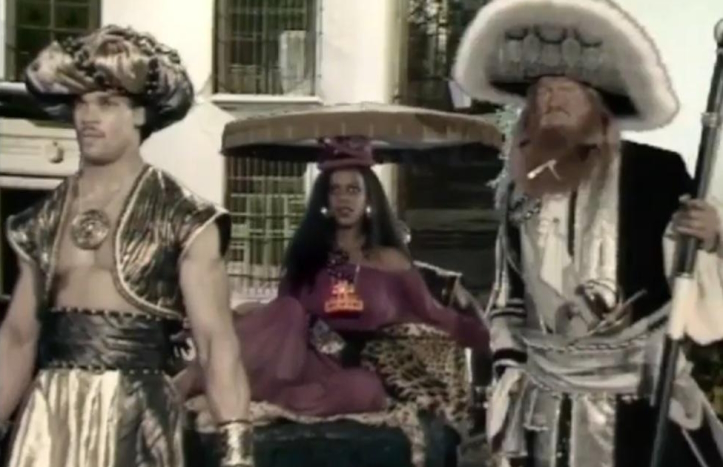
Dashing young naval officer Ben Avery (Marcus Gilbert, Army of Darkness) has been tasked by the Admiralty with an important assignment. The King of Madagascar had commissioned the craftsmen of London to construct for him a crown of unparalleled magnificence featuring five crosses, each with a unique gemstone mounted on it. Now that this gewgaw is finished, Avery is to travel to Madagascar and present it to the king as a gesture of goodwill between their nations. To avoid attracting unwanted attention, he’ll be transporting it on a civilian vessel.
However, Avery finds a couple of dubious passengers along for the ride. The first is notorious scalawag Colonel Tom Blood (Malcolm Stoddard), who is just a step or two ahead of a mob of angry men he had swindled and/or cuckolded and figures that some travel abroad will do him good. The other is the pirate queen Sheba (Josette Simon, Blake’s 7), who is being shipped off to an East Indies plantation where she has been sentenced to a life of hard labor.
But unknown to Avery is that the ship’s crew has been infiltrated by pirates led by Calico Jack Rackham (Tom Adams) and Firebeard (Nosher Powell), who intend to free Sheba. With the former having gained the captain’s confidence, he has been assigned to handle steering during Night Watch, making it a simple matter to guide the vessel off-course into an ambush by fellow buccaneers Happy Dan Pew (Nicholas Gecks) and Akbar the Damned (Forbes Collins).
Getting captured by pirates is bad enough. But matters becomes worse when a slip of the tongue by Captain Yardley (Howard Lang) reveals the existence of the Madagascar Crown to the pirates. While Avery refuses to divulge where it has been hidden, Blood (who discovered it on his own and had been thinking of swiping it just before the next landfall) is more pragmatic and squeals. The Crown is then chopped into five segments, with each pirate captain receiving one of the crosses to do with as they see fit.
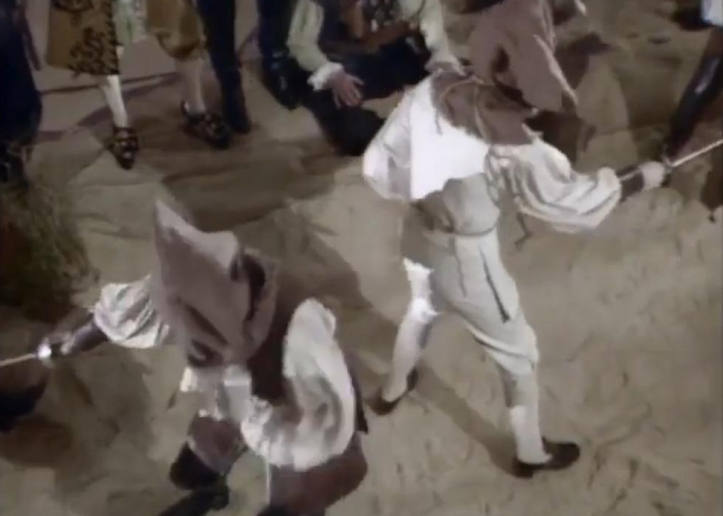
Avery and Blood are then taken to a nearby island, where the pirates have them fight each other to the death while wearing sacks tied to their heads for maximum comedic blundering. As part of the Pirate Code, the winner will be guaranteed a provisioned longboat to make his way back to civilization. However, the pirates skip out early due to an approaching storm, leaving Avery and Blood to continue flailing about. While Avery comes out on top, Blood’s appeal to the former’s goody two shoes instincts stays him from landing a killing blow. Avery is honour-bound to retrieve all the bits of the Madagascar Crown, while Blood offers to tag along to help Avery navigate the sketchy underbelly of seafaring society he’s bound to encounter along the way.
With their alliance of inconvenience established, Avery and Blood set off on the fetch quest for the Madagascar Crown, which hopefully can be patched up with a few dabs of Airfix. Along the way, there will also be damsels to be rescued, villains to be thwarted, and surely someone will get knocked over a ledge and plummet while Wilhelm screaming into a pool inhabited by man-eating, um… Octopi? Octopods? Octopodes? Octopuses? Octopoodles? Eh, it’s one of those.
One of the more troublesome issues that crops up in any film adaptation of a book is what to excise. Unless the source material is of novella length, some of it has to go. Ideally it’ll be scenes that have minimal impact on the overall storyline, with Narrative Spackle applied along the rough edges to smooth things out. Of course even the most incidental scenes will have their fans, and their removal will incite much sound and fury. But hard choices must be made.
There are a few good calls made in this regard. Sheba’s trial and sentencing is simple enough to handwave, as there’s no real need to expound on details the audience can fill in themselves. Cutting the scenes at the Lost City of Cohaclgzln is also defensible. It doesn’t have much direct relevance to the main plot other than it’s where Solomon Shafto is introduced (and that can in theory be moved elsewhere readily enough, more on that in a bit). And while having Groonbaun accompany Avery the whole way rather than catching up later does lead to a couple of awkward moments, the decision was ultimately a net positive.
The real tricky part in adapting these sort of novels is that a considerable portion of the humor comes from the glib narration. There are a variety of ways to handle this. Both the television and movie version of The Hitchhiker’s Guide to the Galaxy simply brute forced it in (possibly due to how its original medium was radio). In the case of the Discworld novels (at least the ones adapted by Cosgrove Hall), it gets exposited through visual means. Unfortunately, The Pyrates decides to jettison the whole lot.
As well as disposing of some really excellent comedic bits, it greatly hampers the character development of Happy Dan Pew. To a viewer unfamiliar with the source material, he’s just some guy who randomly spouts bits of French for no apparent reason. The original narration revealed that he had been a grammar school boy who took a blow to the head from a blackboard while reading a pirate story during French class. He then became convinced that he was a great French buccaneer, and he wasn’t going to let the fact that his command of the language was restricted to Volume One of Collin’s Primer stop him.
Throughout the story, he struggles with nasal vowels and irregular verbs and at one point has a mental breakdown where he’s reduced to conjugating être. It’s wonderfully hilarious (if perhaps a touch sad), and the movie is worse off without it. Maybe they could have occasionally shown him consulting a copy of Collin’s Primer whenever he got stuck on a tricky bit of French. Too late now.
Of the many characters who were excised, the absence of Captain Bilbo is most keenly felt. Among the original six pirate captains, it could be argued that narrative-wise he was the least essential. That may be true (though I would argue that it’s a dead heat between him and Happy Dan Pew), but it’s on a relative scale. There were just so many points in the narrative where his presence was key and weren’t so easily brushed over. There’s also the matter of how the character is in effect a pastiche of all the swashbuckler villains who have been portrayed by Basil Rathbone. This is not something to be lightly tossed aside.
But just as confounding as what they remove is what they retain. Or rather how they retain it. Specifically with Solomon Shafto. In the book, he was a significant supporting character who in the movie ends up in just one scene. His appearance there is so random and superficial that he probably would have been better off being cut entirely.
The acting is shockingly lifeless across the board. So much so that it almost has to be the fault of the director, with whoever handled casting as a possible accessory. The only performer who puts any real effort in the role is Malcolm Stoddard as Colonel Blood. Even he falls a bit short, as he plays the character a bit too much as a buffoon rather than the cunning and self-serving knave from the book.
By far the biggest miscast is Tom Adams as Calico Jack Rackham, who in the book is presented as a Genius Bruiser. Here he’s just another Robert Newton wannabee, something more appropriate for Firebeard. Ideally, this role should have gone to Bernard Bresslaw (of Moon Zero Two and Krull), who would have had the right sort of physicality for the role. He probably would have also liked getting a chance to break out of his usual typecasting in big dumb guy roles.
Let’s talk about the location shooting. Specifically how there is none. It all occurs on a sound stage, and that’s probably for the best. A BBC TV movie isn’t going to have the funds to jaunt off to the necessary exotic locales. And there’s no way to convincingly mock up Rhyl as Libertalia, or Bournemouth as the coast of the Spanish Main. You just kind of accept the limitations. Or you go insane.
Finally there are the fight scenes, something which any pirate movie is going to live or die by. Now I went into this without any illusions that this aspect would even approach being good. This is 1980s BBC we’re talking about. I have seen their miniseries adaptation of The Lion, the Witch, and the Wardrobe, as well as the Doctor Who serial “Battlefield.” I know how bad it can get. Yet even with all this in mind, the fights were so embarrassing to watch. The only one that worked was the duel between Avery and Blood on Dead Man’s Chest, and that’s because it was suppose to be a clumsy and awkward affair.
Attempting to cram a 400-plus page book into a TV movie of less than 90 minutes was always a fool’s errand. So it’s no surprise that this production came up short. But at least it appears they were attempting an honest go at adapting the source material but simply lacked the resources to do it properly. Which is more than you can say for the Wheel of Time streaming series.
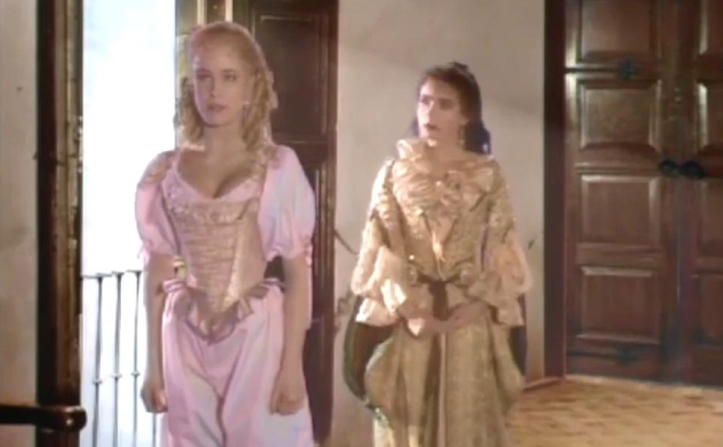
Intermission!
- “I trust you are also a man of honour.” “Sir, I am a gentleman!” “So is the king, and look at his doings.”
- Really laying on the sappy music
- “Captain Yardley, don’t let them flog her in public. Surely they could lambast her behind some building.”
- “Two points to starboard, mister.” “Eh?” “Go right a bit.”
- Right in the souk
- Those cheap imitations will do that
- Just randomly open this chest a crack for the audience
- That was tactless
- “Mr. Groonbaun, I told you to sign only good British seamen.” “Sorry, sorry. I thought you said British sea scum.”
- “I’ve told you it’s merely girlish infatuation. Just keep taking the cold baths.”
- At least it’s more lively than the one in Bride of the Monster
- “I think it’s time you and me got down to business, Mr. Pepys.” “Business? Surely you mean blackmail.” “Certainly not! It’s a simple matter of extortion.”
- “Tell whoever wins I was on their side!”
- Obligatory MST3K Connection: Howard Lang (Captain Yardley) portrayed a colonel in Gorgo.
 Mutant Reviewers