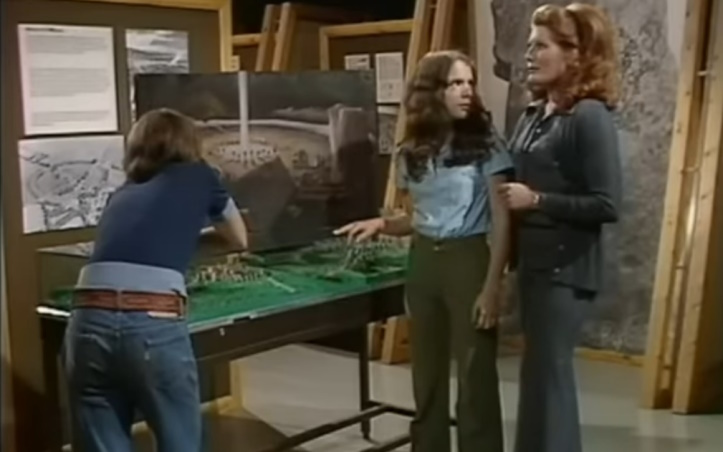
“Suppose they all turn out to be nutters. Do we have to stay the whole three months?”

Sitting Duck’s rating: Forty-four out of fifty-three villagers turned into menhirs
Sitting Duck’s review: As the resident Lovecraft fanboy here at Mutant Reviewers, it’s a tricky proposition digging up adaptations that can be regarded as suitable for all ages. Whatever the reason, Lovecraft films are rarely family friendly, especially if Stuart Gordon is involved. These problematic elements can sometimes be relatively mild, like Virginia Wetherell answering a door while fully nude. Other times we get… whatever it is David Gale’s head is doing to Barbara Crampton.
Seriously, Stuart Gordon, what is your problem?
But if you look hard enough, you might eventually find what you need. And so it is with this seven-episode ITV miniseries from the 1970s, which would later be introduced to American audiences on the Nickelodeon anthology The Third Eye.
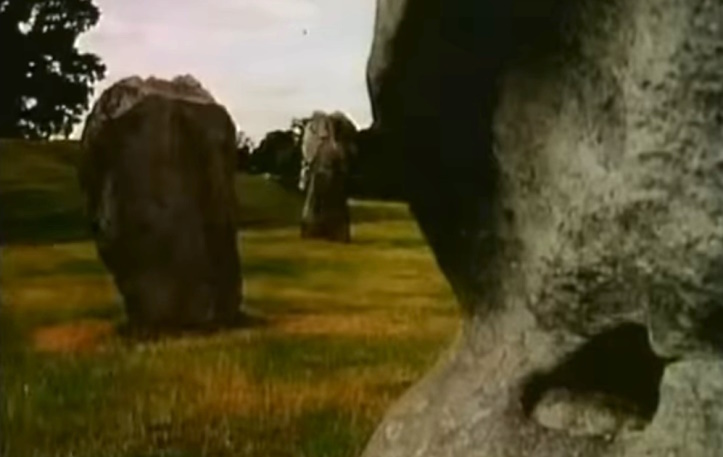
Widower astrophysicist Adam Brake (a pre-Blake’s 7 Gareth Thomas) and his teen son Matthew (Peter Demin) have just arrived at the village of Midbury. The purpose of this visit is strictly work-related for Adam, who is studying the local stone circle. And it certainly has its share of oddities. The most notable is how, unlike other stone circles, it does not track the movement of any visible celestial bodies but rather a seemingly empty space in the middle of Ursa Major. The use of ground penetrating radar reveals that there’s a rock dish under the surface, with the stones being placed along the perimeter.
Measuring the stones with a theodolite shows that, despite the stones having the appearance of leaning, they are in reality pointing straight up. But what is most unsettling is how a painting Matthew purchased several months back at a junk shop on a whim has uncanny resemblance to the Midbury stone circle down to the placement of the stones and the topography of the landscape.
Adam gets introduced to more outré theories by local museum curator Margaret Smythe (Veronica Strong), a widow who had moved to Midbury a few months earlier with her teenage daughter Sandra (Katharine Levy). While he may scoff at talk of ley lines, psychic phenomenon, and other such occult mumbo jumbo, it does offer some insight into the people who originally erected the menhirs and why they did it.
But just as strange as the stone circle are the people who live in Midbury. Aside from a few recent arrivals, the villagers display an almost unnatural placidity. They’re also keen about preforming pre-Christian style festivities that border on being Wicker Man (no nudity, though) on a regular basis. Then there’s the way they greet each other by stating “Happy Day”, which comes across as less of a salutation and more of a verbal secret handshake. The only locals who don’t seem to be affected are the twitchy vagrant Dai (Freddie Jones, Dune) and the local squire Raphael Hendrick (Iain Cuthbertson, The Stone Tape). Both clearly know more about what’s going on but aren’t entirely forthcoming.
Works in the fantasy, horror, and science fiction genres often include a huge amount of exposition in comparison to other types of fiction, as they feature much more background information that won’t be immediately apparent to the average reader/viewer. Conveying this information can be awkward at best and often results in inelegant infodumps, with the worst of them being preceded by the phrase, “As you know.”
Children of the Stones primarily uses the teacher/student technique of presenting its exposition. This involves a “teacher” detailing the information to a “student” for whom it would be reasonable to be unfamiliar with the subject, with the latter occasionally offering up prompting statements and questions. It’s far more organic than a character stopping to monologue for no particular reason (or Gawd help us, a voiceover guy metaphorically slapping on worldbuilding spackle). The fact that Adam and Margaret are both academics makes this choice especially fitting.
Something which might appear to be sloppy writing but isn’t involves Matthew’s psychometric abilities. To the inattentive eye, it can appear to have been abruptly shoehorned in for the sake of plot convenience. However, it did get a proper setup back in the first episode. This occurs when Adam is talking about his wife’s death to Hendrick and how he remarks that Matthew has adjusted as well as can be expected but had a tendency to get morbid whenever he handled any of his mother’s old things.
The acting is competent enough, a little above average for a television production. The standout performance comes from Iain Cuthbertson as Hendrick, whose Affably Evil persona nearly stands at the same level as Vincent Price. Gareth Thomas as Adam presents an engaging forcefulness that would later serve him well as Roj Blake. Freddie Jones as Dai can be uneven. His jittery eccentricity can be intriguing, but there are times when it’s just annoying. As for the child actors… weeeeell, I didn’t hate them. Most of the time. And when it comes to child actors, for me that is a major accomplishment.
An aspect which I’m not sold on that gets a lot of praise is the music. Now I’m on board with the basic concept, wherein it’s meant to be reflective of the primitive work songs that the original builders of the stone circle would have sung. But execution is everything, and the end result sounds like it’s being performed by a Swingle Singers knockoff group. As I’ve mentioned previously, I’m not that fond of the Swingle Singers, so it all ends up being distracting.
Set design is about what you can expect for a 1970s British television production, for better and for worse. This particularly stands out with the scenes at Hendrick’s manor. The majority are done on location (you can tell by how they’re shot on film instead of videotape, as was common practice in British television at the time). However, the dining room set is… Oh dear Gawd! Well, at least it probably helped acclimate Gareth Thomas to what he would experience working on Blake’s 7.
One aspect that can be divisive occurs during the climax. Specifically the manner in which Adam and Matthew thwart Hendrick’s scheme. A lot of it will come down to whether you think the solutions Angus MacGyver regularly comes up with on his self-titled show are brilliant or stupid.
What really makes this folk horror Lovecraftian in tone is the way that it employs science fiction elements. I can’t go into detail without revealing spoilers. Just know that they’re there. And overall, this makes for a fine package for introducing those snotnosed punks to the joys of folk horror. Sure, there are a couple of hiccups, but these are mostly personal issues. Who knows, maybe you’ll like the singing.
Intermission!
- Creepy girl staring through the window
- The local pedo perhaps?
- All that’s missing is the Seventies cop show music
- I’m not a stalker!
- Livestock mathematics
- Maybe she’s just trying to come on to you, being a lonely widow and all
- Go ahead and stick your tongue on it. I double dog dare you
- Too bad Seventies TV production values couldn’t actually show us that
- Hope he doesn’t backwash
- The traditional cry of whiny teenagers everywhere
- Why not make it the friends we made along the way?
- At least it’s not the Stick and Bucket Dance
- That thing is getting pretty ragged
- That combover is just sad
- So it was the butler all along?
- Shot in Avebury, Wiltshire. The local stone circle was regarded as too sparse by the production crew, so fake menhirs made of plasticine were placed to fill it out. There’s an apocryphal tale in which a tourist who wandered in between takes touched one of the plasticine menhirs (unaware of its lack of authenticity), causing it to tip over which resulted in the tourist panicking.
 Mutant Reviewers