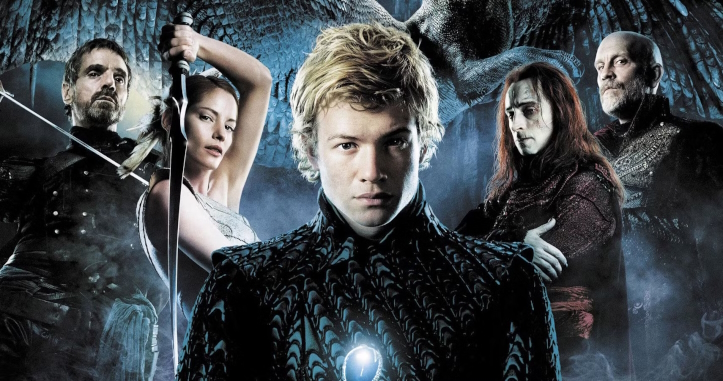
“Your day will come too, Eragon, and you will decide for yourself the kind of life you wish to lead.”

Thomas’ rating: Zero shiny dragon eggs
Thomas review: Ah, the hero’s journey! A tried-and-true template for satisfying adventure stories. The basis of so many modern fantasy classics. But sometimes, it’s a vessel for the most empty and lifeless storytelling imaginable.
Eragon comes on the heels of a golden age of successful fantasy films such as Harry Potter, The Chronicles of Narnia, and Lord of the Rings. In contrast, Eragon exists to show us how miraculous the others are. This right here is what it looks like when your 2000s cinematic fantasy franchise doesn’t work.
I haven’t rewatched (and have hardly thought of) this film since its release almost two decades ago. In 2006, I was a fresh and avid fan of the source material. Christopher Paolini’s fantasy novels followed the exciting adventures of a simple farm boy, Eragon, who happens upon a dragon’s egg and is plunged into an epic world of destiny and magic.
When Eragon’s uncle is killed, he leaves home with Brom, a wise mentor who teaches Eragon the history of the world and shows him how to use magic. After they rescue Arya, a rather princess-like elf, Brom dies and Eragon, alongside roguish scoundrel Murtagh, is left with no option but to join the unified rebellion, known as the Varden.
Sound a bit familiar?
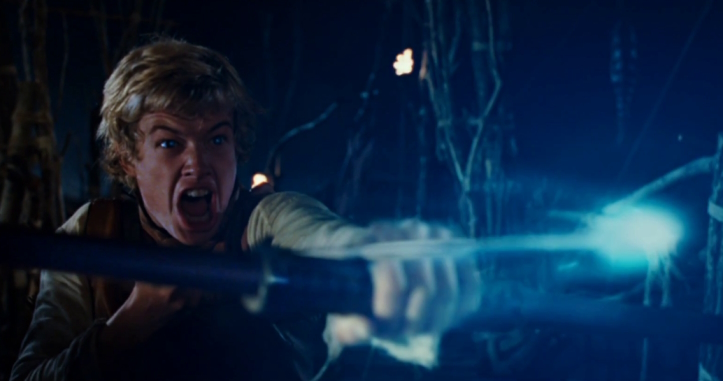
Yes, this is A New Hope transplanted almost one-to-one onto a fantasy world. But whereas Christopher Paolini’s Eragon novel fleshes out the land of Alagaësia, adds some interesting fantasy concepts, and concocts a cast of endearing characters, the film adaptation strips back all of this colour, leaving one of the blandest, hollowest hero’s journeys I’ve ever seen.
The first two minutes of the film establish the setting in a hurry, with a dizzying montage accompanied by a generic voiceover by Jeremy Irons that lacks the respect or patience to successfully emulate the thing it clearly seeks to copy: the prologue from The Fellowship of the Ring. Perhaps the filmmakers are worried the younger audience they’re appealing to would lack the patience for a seven-minute backstory by Cate Blanchet?
Eragon is immediately inconsistent. At one moment, it’ll emulate an epic Lord of the Rings travel montage, with huge mountainous vistas and music soaring as our heroes ride horseback toward the promise of adventure. Then a scene later, when the characters are making camp, they’ll exchange meaningless shallow nonsense, all in bland cliches. As they blunder through swathes of empty exposition, it feels as though the film’s crew are tired and the director has decided not to provide any direction to the actors.
Most of the film progresses in this manner. It’s a series of scenes which look and sound like a fantasy adventure film — but where nothing has any particular consequence or relationship to anything else. At one point, Eragon visits a fortune teller, so she can say something vague about his destiny, which ultimately relates to nothing. Later, Eragon uses his magic to bless a baby — a significant and morally challenging plot point from the book, which is meaningless in the movie. Why did they even leave it in?
I feel sorry for the editor, who I can only imagine was losing their mind trying to stitch this incoherent tapestry of scenes into a motivated story. Particularly after the first act, the trajectory of the plot feels mucky and messy, and the editing becomes impatient and chaotic.
Many lines throughout the film are clumsily added in post-production; monotonous ADR was clearly required to fill gaps in logic or desperately used to inject a little humour into wooden exchanges. This is how Eragon communicates with his freshly hatched dragon, Saphira: through awkward voiceover layered over shots of Eragon and Saphira just staring blanky at each other.
Saphira is actually quite a beautiful dragon, though. I’m reminded how good CGI became very quickly in the 2000s. This film has one or two fairly thrilling dragon-riding sequences, some pretty grizzly monster effects, and several surprisingly dazzling displays of magical abilities.
So it’s bad… but it’s not all bad. There are moments of passable fantasy wonder here, and there are times when I’m reminded just enough of the epic source material to make this movie’s ultimate failure profoundly disappointing.
I don’t think any of these actors should be blamed for the dreadful production they’re trapped in, though some fare better than others. Ed Speleers makes sense on paper as Eragon; he’s a bright-eyed strong-jawed youth with glowing hair who doesn’t look out of place atop a dragon. But outside a few fleeting moments of genuine pathos, it feels like he was never given the time or direction to actually produce a believable performance. In many sequences you can feel him thinking, “Is this the right thing to do here? I’ve no idea.”
Worst of all though, Eragon is a nobody. An empty vessel. He hardly speaks, and we have very little access to his thoughts. When he performs an exact imitation of Luke Skywalker’s binary sunset scene, we have no idea what he’s thinking. When Luke gazes at the twin suns, we understand his longing for adventure amongst the stars. Eragon, on the other hand, just looks at a pretty ordinary sunset and thinks… well, who knows! It could be “what’s for dinner” for all we know.
Eragon’s relationship to every other character is complete nonsense. I never believed that he was truly sad when his uncle was murdered, or that he came to see Brom as a father figure, or that he had a crush on the beautiful young elf Arya.
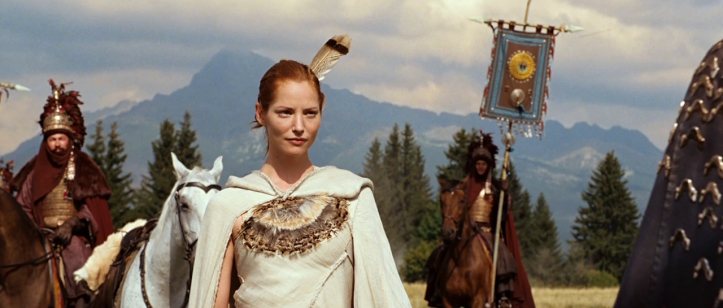
Speaking of Arya, Sienna Guillory looks the part, but she is no Princess Leia. As with every element of this adaption, all complexity is removed, all her strong characteristics are muted, and she is rendered little more than a pretty elf and a damsel in distress. Garrett Hedlund also brings a great aesthetic as Murtagh, with his emo hair and deep voice, but he’s given nothing much to do.

The more experienced members of the cast fare better, just by the weight of their gravitas. Steve Speirs is iconic in his brief appearance as the slimy village butcher, Sloan. And Jeremy Irons, in full Ben Kenobi mode as grizzled reluctant mentor Brom, is the highlight of the film. He manages to turn every cheesy line into something iconic.
“The thing is the word. Know the word, and you control the thing.” -Brom
I also love John Malkovich in this film. He’s in it for about 60 seconds (he was probably only on set for a single day), but he plays one of the most memorable parts of the whole production as the evil king, Galbatorix. The Emperor, essentially. Voldemort. Sauron. The White Witch. The Dark One. You get the idea.
Admittedly, Galbatorix does nothing in this movie but stand in front of a map, sit on a throne, and give a couple of commands to his monstrous vassal Durza (who’s quite a cool vampirical antagonist, styled with big contact lenses, red hair and increasingly disturbing makeup). But even in such a short amount of time, Malkovich’s offbeat drawl is delectable as ever. It’s easy to imagine this portrayal of an all-powerful mad king being an exciting and dastardly villain… in a better movie.
“I suffer without my stone. Do not prolong my suffering.” -Galbatorix
The final thirty minutes is just a rush to the finish line. The crew are tired, the director has given up, Jeremy Irons has been killed off, and the final act of the story is told with a series of very short scenes, where characters stand in one spot and speak the themes outright. The filmmakers have become so efficient that they can even shoot the final battle setpiece in this manner. Aside from a few wide shots of a horde of extras streaming into a set, roaring and pretending to wreak havoc, the battle is largely stitched together with shots of our main characters standing in one spot, pulling serious faces and shooting some arrows into the distance. At least Eragon and Saphira get an aerial dragon fight with Durza, which is actually quite visceral, if short-lived.
At the very end, a Saphira death fakeout feels like a desperate attempt to inject a little bit of drama into the final moments of the film, where everything is otherwise just fine. The good guys have won, Eragon is an uncomplicated hero who has vanquished evil, and there’s no sense of the losses suffered or threats that are still out there. The ending is profoundly empty, and its no wonder that despite making decent box office returns, no one wanted to continue into a sequel.
Again, it’s not all bad though. That’s the painful part. I haven’t mentioned the music much, but it’s consistently incredible. Patrick Doyle is at the top of his game and makes his orchestra sing like one of the great fantasy epics. His score is richly thematic and boldly sentimental. The ten minute climactic action cue, “Battle for Varden,” rivals Hans Zimmer’s Gladiator for propulsive sprawling action and is one of my favourite pieces of music of all time. This is musical material that was worthy of sequels, even if the film wasn’t.
The final shot of the movie sees John Malkovich, having learned of his defeat at the hand of Eragon and the rebels, cry out angrily, brandish his sword, and cut down his hanging map to reveal a menacing dragon. It’s essentially a precursor to Thanos’ “Fine, I’ll do it myself” except without the iconic line or the feeling that anything will actually proceed from this cliffhanger. It’s just confusing.
All in all, Eragon is a pastiche of much better stories. Admittedly, so is the source material, but much more successfully. The film, by throwing away any complexity or drama in the story, reduces the plot to its most basic and cliché hero’s journey beats. Every scene is a cheap riff on better films from the early 2000s, and I have a strong sense that the cast and crew knew it.
It’s a profound experience to have a long fantasy novel you can spend many hours immersed in transformed into a nothingburger of an empty shell of a movie.
“Time moves quickly. Just think; yesterday you were a farm boy. Today you are a hero. Tomorrow may see us together again.” -Arya

