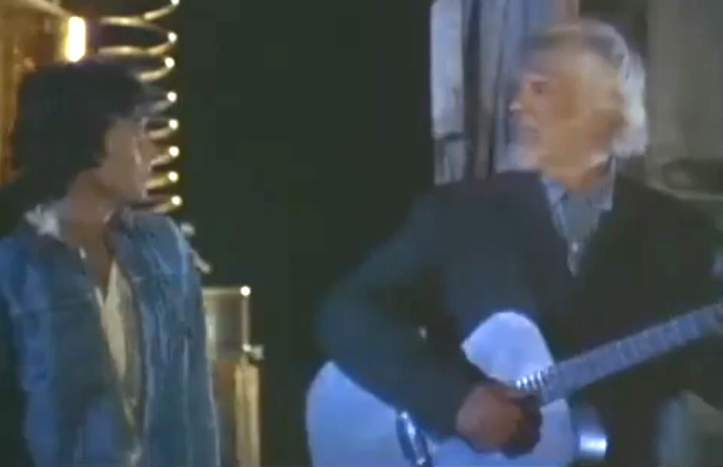
“Here in the hills of Appalachia, the Devil, or the Stranger, Old Nick, or the Corps of Army Engineers, or Satan, or Beelzebub, or His Majesty, or what you will, is as familiar and more fearsome than old age.”

Sitting Duck’s rating: 2 out of six silver guitar strings
Sitting Duck’s review: Some authors get all the Tinseltown glory. Film and television producers can’t help but adapt Sherlock Holmes or Tarzan or Dracula or Frankenstein over and over and over again. And the latest bestseller novelists can always count on receiving multi-million-dollar options for the chance to see their writings make it to the silver screen.
Then there are guys like pulp writer Manly Wade Wellman, who get little exposure in other media. Only a handful of his stories have been adapted, mostly on TV anthologies. Probably the best known of these is the Twilight Zone episode “Still Valley.”
But it turns out there was a feature film based on his writings. What’s more, it involved his most famous creation: John the Balladeer AKA Silver John (though the character is only ever addressed in-story as John).
For those unfamiliar, the character John is a Korean War veteran who wanders through Appalachia with his silver string guitar, encountering all manner of supernatural tomfoolery and dealing with it. In one particularly memorable story, he takes down a warlock by tossing a silver quarter (silver being a counteragent to black magic) at him. This not only disrupts the hex being cast, but it also summons the spirit of George Washington, who proceeds to rip the warlock a new one.
However, after discovering a laserdisc transfer of The Legend of Hillbilly John on YouTube, I went into it with more than a bit of trepidation. Not only was I concerned with the possibility of some clueless hack with delusions of “improving” on the source material mucking things up, but there was a matter of the title. Often, “hillbilly” is used as a pejorative term. That sort of mentality goes against the spirit of the John the Balladeer stories. Because, even though Wellman may not have been a native of Appalachia, he respected the people and their traditions. So this bad first impression is worrying to say the least.
Our story begins with John (Hedges Capers) heading back home after deflowering his gal Lily (Sharon Henesy). While he presumes that all the disapproving remarks from the people he meets on his way back are due to his little indiscretion, it’s actually for something far darker. For his Grandpappy, who is also named John (a pre-Dukes of Hazzard Denver Pyle), has declared that he will challenge the Devil by singing the Defy at midnight.
However, Grandpappy isn’t going into this half-cocked. For he knows that the Forces of Darkness fear the power of true silver. To that end, he has melted down five Kennedy half-dollars, which he has formed into strings for the guitar on which he’ll perform the Defy. This ends in his death, since Kennedy half-dollars are made from a nickel-copper alloy that doesn’t do jack diddly against Old Scratch.
Following this tragedy, John commits to continuing in his Grandpappy’s footsteps. With the help of the diviner Mr. Marduke (Severn Darden), he digs up a collection of silver pieces of eight to use in making proper true silver guitar strings. He then sets off to wander the hills and defy the Devil and those who serve him wherever they may be.
The first thing to note is how this is essentially an anthology film. This is not an unexpected approach, as Wellman predominantly featured John in short stories. The ones that get featured are “The Desrick on Yandro” and “O Ugly Bird,” with a third story of uncertain origin (more on that in a bit).
Let’s start off by addressing the obvious. While there have been quite a few singers who managed to eke out successful film careers, Hedges Capers is not among them. In fact, this was his only movie credit, and it’s not hard to see why. Capers plays the character like a cross between a stereotypical hillbilly and a hippie that awkwardly straddles the line between simple and stupid. A far cry from the sharp-witted autodidact of Wellman’s stories.
Many of the supporting characters aren’t much better. Sticking out the most in this respect is Sharon Henesy as the rather needy Lily. This was the last of four credits listed in her IMDB profile. It’s rather amazing that she managed to stay in the industry that long, as her acting is just sooooo wooden. Nearly as bad is the portrayal of the hill folk. For the most part, they get characterized as a bunch of stupid, cowardly, and ungracious bumpkins. This goes against the tone established by Wellman. But seeing as how the film’s title uses the word hillbilly, it’s hardly unexpected.
Another issue concerns how the setting was presented. Aside from occasional mentions of John having fought in the Korean War, the original stories have a strong neverwhen vibe to them, like you get from the Earl Hamner Jr. penned episodes of The Twilight Zone. Unfortunately, the horrors of the Seventies have a tendency to butt in at unwelcome moments. Sometimes it gets to haranguing, to the point where you expect to see Tom Laughlin’s name in the end credits.
As you might imagine with a feature where the lead character is a balladeer, there are quite a few songs. By far the best is “The Song of the Defy,” which is performed over the opening credits and by Grandpappy in the first act. Even though it was written specifically for the movie, it still sounds like a genuine Appalachian folk song. Unfortunately, the other songs consist of insipid hippie folk songs that are about as authentic as those Kennedy half-dollars Grandpappy melted down. These provoke reactions ranging from “Blarg” to “Oh dear Gawd, please make it stop!”
Speaking of auditory agony, let’s talk about the sound design. It’s a sad truth that the best movie sound design is the kind that audiences don’t consciously discern. This phenomenon is illustrated through a very noticeable sound effect that crops up throughout the film. It occurs whenever the silver strings on John’s guitar are working their protective hoodoo and involves a very annoying whining sound that can’t end soon enough.
As for the segments themselves, the first one is the strongest. Part of this is due to how it doesn’t deviate much from the source story. The only significant change occurs to preserve the budget, as the encounters with traditional Appalachia folk monsters like the Behinder during the walk up the mountain are excised (FTW a Behinder is a horrific monster that no one has ever seen because it’s always behind ya, and should not be confused with the Beholder). But there’s also how Harris Yulan as Yandro has good screen presence, and almost offsets Capers’ limp performance. If you were of a mind to bamboozle some Night Gallery fans into believing that there was an unaired segment of that show written by Earl Hamner Jr. that had recently been unearthed, this particular segment might do the trick.
Alas, this is the final high point of the movie, with nowhere else to go but down. A major issue for the second segment is how Onselm as portrayed by Alfred Ryder doesn’t have the same intensity as Yandro from the previous segment. Another problem comes from the writer deciding to Seventiesfy his motive. In the original story, Onselm was a warlock running what’s amounts to a protection racket, with those who refuse to pay up either getting hexed or having the Ugly Bird sicced on them. Here he’s using his mystical intimidation to get the locals to cede over their land so that he can strip mine the whole place.
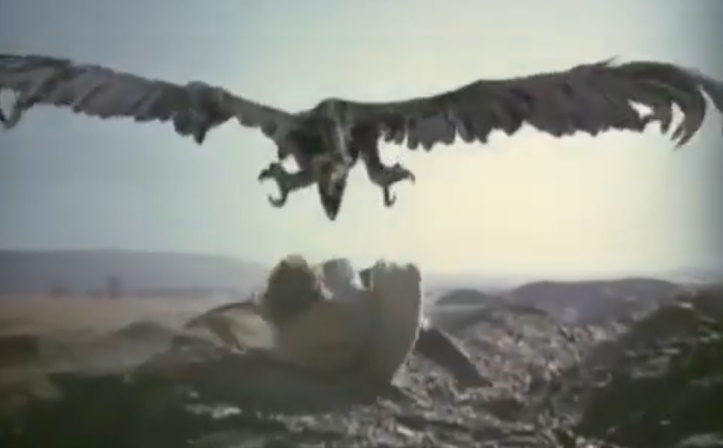
Speaking of the Ugly Bird, it was clearly regarded as the key special effect in the movie. I suspect the producers believed it would draw in the viewers, judging from how prominent it is in the poster art. And um…

Well, it is ugly. I’ll give them that.
In a cruel twist of irony, another weakness in this segment comes from it being too faithful to the source material. This occurs when John defeats the Ugly Bird by giving it the El Kabong treatment. There really wasn’t any way to not make it look silly.
Another silly-looking aspect that crops up here and throughout the rest of the movie is how magic gets handled. Now Appalachian folk magic doesn’t involve the flashy smashy whizbang pyrotechnics common to post-D&D fantasy. So props to the production crew for getting that right, even if it was more due to it being less expensive to film. But it comes at the price of not being that impressive visually. From Marduke’s divining to Onselm’s spazzy hexing, it all too often ends up looking like they’re doing a series of awkward Kamen Rider poses. And Kamen Rider’s moves were pretty goofy looking to begin with.
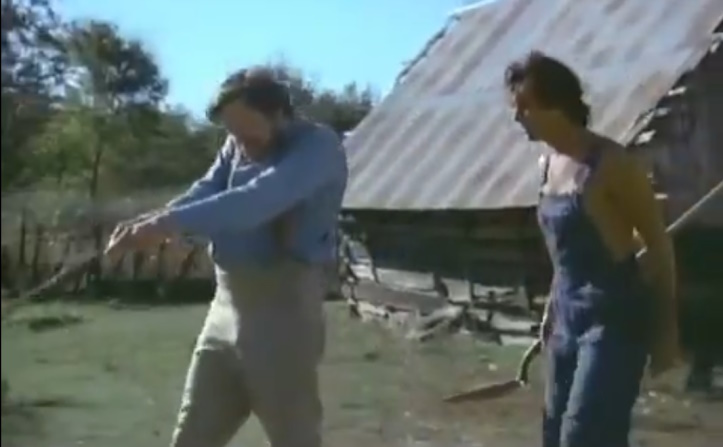
The final segment occurs when John arrives at a cotton plantation, where the boss is brazenly shortchanging the black sharecroppers for the harvest they bring in. One fellow by the name of Anansi declares that he’s not putting up with this anymore. The boss responds by summoning a voodoo houngan whom he’s clearly afraid of to put Anansi in his place.
I’m not entirely sure what to make of this one. There’s some implication that time travel may be involved. But if that’s the case, it’s needlessly confusing. And that’s a shame, because there are some intriguing aspects to it.
The key problem with this segment is that John doesn’t really do much of anything. For the most part, he just stands there gawping like the rube he is. My suspicion is that this may be adapted from a Wellman story outside the John the Balladeer series, though for the life me I can’t determine which one (plot summaries of his writings are scarce online, and the Manly Wade Wellman wiki is remarkably useless). The allusion to the West African trickster deity Anansi is more likely to have come from Wellman (who grew up in what is now Angola, where he absorbed much of the local folklore) than some random script drudge. Whatever the case, it’s Anansi who does most of the heavy lifting narrative-wise, with John largely being there for the ride. So really, what is the point of his presence?
While hard data on its box office performance is not easy to come by, it’s a safe bet that The Legend of Hillbilly John flopped hard. This is just as well, as the implied sequel of Hillbilly John Goes to Washington is something too horrible to contemplate. As for the prospect of future adaptations of John the Balladeer, I’ve come across a suggestion that perhaps the Coen Brothers could do a proper job. Eh, maybe. Even so, this is a property that is better off being left in its original state.
Intermission!
- The dreaded “And Introducing” credit
- Careful that you don’t backwash
- I’m pretty sure the name John appears with some frequency in the Bible
- “Your Majesty, are you listening? I’m giving you the heart and liver of a new caught fish, a fine three-pound speckled trout, not to harm that expensive, innocent still of mine.”
- Where’s that drum accompaniment coming from?
- The projectionist must have snuck out for a smoke
- “You know what a Behinder is, kid?” “Ain’t nobody ever looked on one and lived to tell.” “Well, that’s ’cause nobody ever seen one.”
- Not the witchy lovin’ you were expecting
- The Pete Townshend Appalachia Tour
- What a world! What a world!
- Please tell me they’re not skinny dipping
- Yeah, I’m sure the realtor won’t mind you squatting there while potential buyers are being given the tour
- That song has no place nowhere no how
- MST3K Connections: Sidney Clute (Charles) also portrayed Rudy Moran in Mitchell. Susan Straberg (Polly Wiltse) also portrayed Nancy Kingman in SST: Death Flight. Chester Jones (Uncle Anansi) also portrayed Ladu in The Leech Woman and the newspaper vendor in The Bubble. Special effects technician Gene Warren was also visual effects technician for Avalanche. Key animator Harry Walton was also animator for Laserblast. “Song of the Defy” writer and performer Hoyt Axton also performed the title song from Mitchell.
 Mutant Reviewers
I don’t think I’ve read any of his stories, but it sounds like they’d be preferable to this movie I haven’t seen. Off to the library site I go.