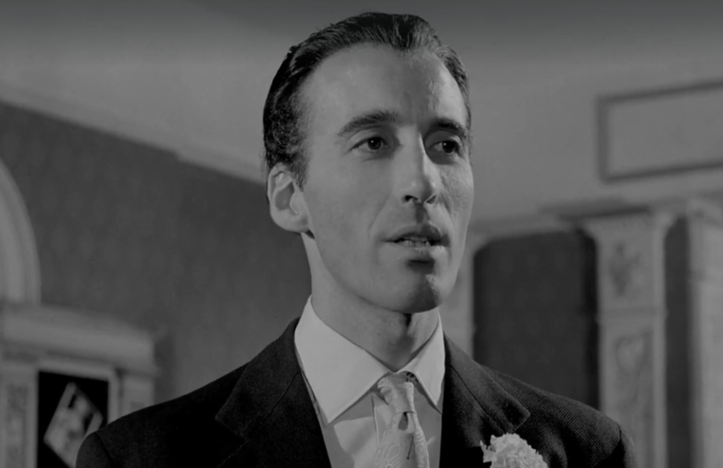
“A swinging cat like you is always welcome.”

Drake’s rating: Exploitation, British Style
Drake’s review: So we’ve all seen at least one or two (or maybe 30 or 40) teen exploitation movies. The 1950s were rife with them,* with the ignored children of negligent parents turning to drugs or crime or, even worse, communism!
Lessons were learned — but almost always too late as a stern judge admonished the parents or the teens, or sometimes both, about their failures and the disgrace they had brought not only upon themselves, but also upon their communities and, by extension, the entire U.S. of A. Heads were hung in shame, actions were lamented, regretful speeches were given and jail cells were filled with teens who had crossed the line and become that dreaded thing known as the juvenile delinquent. Titles like Dragstrip Riot, The Violent Years, and Teenage Devil Dolls lit up the marquees and the kids were there to watch their cinematic peers struggle against, and lose to, a system they were ultimately powerless to oppose.**
But what if we took all that teen angst and faulty parental oversight and flew it across the Atlantic Ocean to a post-war London? Why, then we’d get Beat Girl, a film which doesn’t really want to make a splash in the juvenile delinquent movie pond so much as give it a minor makeover and a British accent.
Jennifer (Gillian Hills, Blowup), is the daughter of a fairly well-to-do architect. She’s a tinderbox of pout and angst, ready to rebel against whatever she can find. Lucky for her that Daddy brings home a young French wife, giving Jennifer a foil she can focus her ire on for the next 90 minutes.
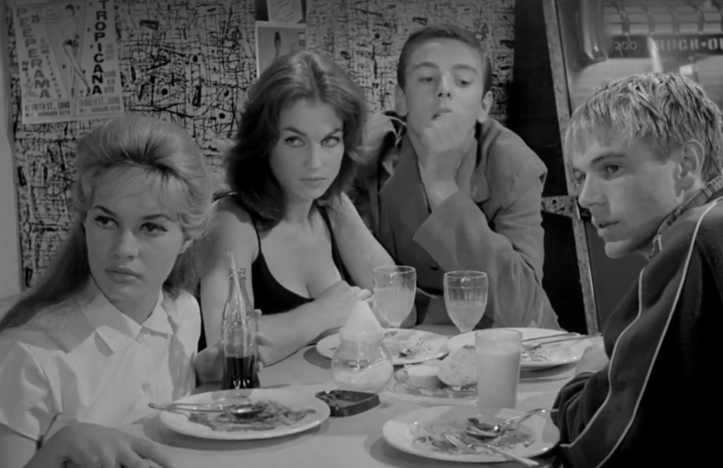
Nichole, the new wife, makes friendly overtures but Jennifer’s in no mood for a stepmother, and sneaks out every night to party with her beatnik friends. They in turn complain about “squares” and occasionally break into song, since the lead beatnik is played by British teen idol Adam Faith.
Hey, at least they didn’t start with the impromptu beat poetry, but there was enough mournful jazz clarinet that I found myself eyeing the mute button on my remote.
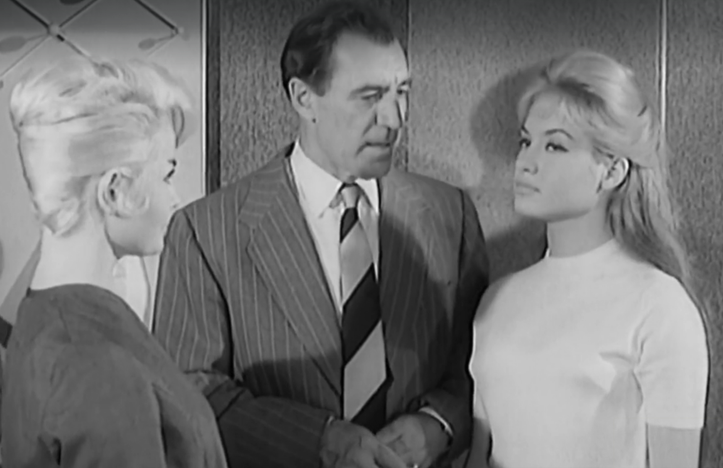
The premise of Beat Girl does vary enough from the standard JD flick to warrant some mention, however. The thing is, Jennifer’s not wrong to be upset. Daddy dearest is a bit of a lout, and arrives home with his young (and I mean young, as Nichole is only six or seven years older than Jennifer) wife with absolutely no clue that his daughter might just be a wee bit miffed over the whole affair. It’s hard not to take the teenage girl’s side here as she’s thrust into the position of having a radically altered family dynamic thrust upon her with absolutely no say in the matter.
Unfortunately, Beat Girl doesn’t really want to embrace that idea as anything further than an impetus for Jennifer’s wild behavior, so we’re left with a teenager acting out due to definite, if unintentional, provocation. Which is fine, but sympathy for such a character is a natural reaction and at the same time the movie wants Nichole to have such a role as well, leaving the audience’s sentiments in conflict. And none of this is helped by a misplaced subplot involving strippers and a seedy nightclub owner who’s probably a vampire*** because he’s played by Christopher Lee.
Beat Girl does have a few moments, including one where the beatniks talk about the war and the London bombings, and how it affected them as children. It’s a grim reminder that the early experiences of these kids was vastly different than their opposite numbers across the Atlantic. But again, this is something never expounded upon and we instead get antisocial behavior, wild parties and the requisite drag race, just to satisfy the exploitation movie checklist.
Beat Girl isn’t a bad movie, but it does lack focus and a strong narrative. It feels like what it was: An attempt to cash in on the teen exploitation movie craze filling up drive-ins across the U.S. That’s all well and good, but in concentrating on melodrama over camp, an exploitation flick featuring beatniks, strippers and tawdry secrets is somehow less fun than it really ought to be.
*There were teen movies in the 1920s, but the “tough kid” genre established by the Dead End Kids movies in the late ‘30s were a direct predecessor to the later “juvenile delinquent” movies.
**A generation later, teens would be lining up to see their counterparts in film be dispatched in gruesome ways by dozens of deadly slasher villains. The outcome was never in doubt in those movies, either.
***He’s not. Bummer.
Intermission!
- We get a very young Oliver Reed here, rocking a plaid shirt three decades before Kurt Cobain made it a fashion statement.
- And a score by future Academy award winner John Barry.
- Let’s play chicken with the train! The train always wins, guys.
- The blue screening in this movie is so apparent as to be distracting. And there’s far too much of it. We’re approaching George Lucas levels here.
- Nichole’s eyebrows are also distracting. I think she’s a Vulcan.
- It all ends in histrionics and learned lessons, of course. But disappointingly there’s no stern judge in a wig to frown and pontificate on the failures of all involved.
 Mutant Reviewers