
“Everybody always asks me the same question. I always tell them the same thing.”

Anthony’s review: Whenever a contemporary movie tries to reproduce the 1970s, it never feels quite right to me having lived during that time myself. They focus on the bell bottoms and the hair and the drugs, but they never nail the true desolation of it. That decade was the exact antithesis of the ’50s: grime everywhere, poverty, pollution, hopelessness… and silence. All the great evils of the era were silent ones, from Bruce the shark to Michael Myers. When you think of it, few things bring more dread, discomfort, ill ease and anxiety than facing a wordless threat.
And before John Carpenter brought proof of that through the Shatner-Masked one, he perfected that darkness on the price tag of a modern-day mobile phone. A cheap one too.
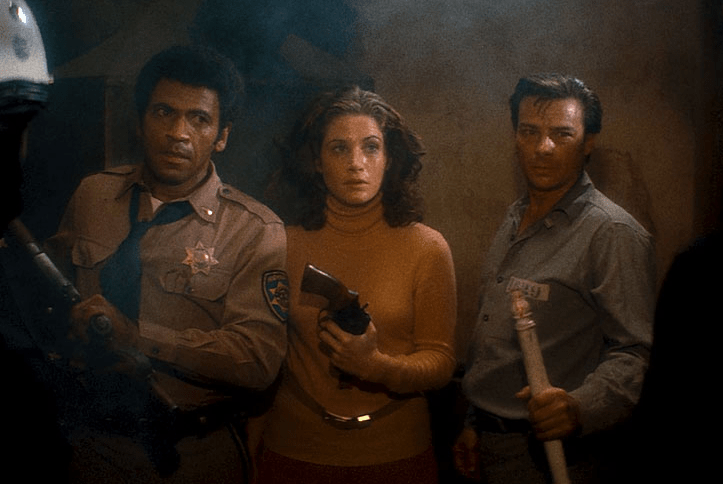
For the uninitiated, Assault on Precinct 13 concerns a prison transport forced to stop for the night at a municipal police precinct that is in the final stages of moving to a new location. The quasi-deserted precinct is occupied mostly by a substitute chief brought in to babysit and a grizzled secretary who’s seen it all. The ragtag group will need to quickly make some trust exercise when they provide refuge to a man chased by a vicious street gang bent on destroying anything and anyone they see as an enemy, their own lives be damned. Of course the wild bunch start dropping like flies, until all that’s left of them is the chief, the secretary, and the most notorious of convicts in that transport, multiple murderer Napoleon Wilson.
First off, if the title Assault on Precinct 13 primarily brings to mind the Ethan Hawke atrocity where Morbius and an all-star cast do a reverse Die Hard, my sympathy to you and yours and I hope you can recover. I’m not saying ALL remakes are mistakes, but that one truly elevates the art of failure to 2016-American-Presidentials level of putrid blunder. It’s like “re-imagining” a cheeseburger by adding every single thing from the produce section of a supermarket and a sprinkle of pet food as well for good measure. The lead character is so blandly played by a paycheck actor that the movie needs to give him a complex backstory, and SHOW it to us right from the offset. Then bring in a shrink to take us by the hand and EXPLAIN to us the complexity of that character and his backstory. The villains monologue and plot and anguish and vocalize every way they can think to threaten, John Leguizamo goes full John Leguizamo, and the highlight of it all is when Lady Frasier predictably gets her own brain spoon-fed to the her car windshield. Oh, spoiler alert, beeteedub.
If George Lucas, another master of the ’70s, taught us anything without learning it properly for himself, is that going to the very basics always makes for a much better story. Star Wars was about a White Knight who is sent on a quest by an old mage to rescue a princess from the fortress of the Black Knight, and along the way he meets an anti-hero who may or may not assist his quest. That’s Propp’s structure of the magic tale word-for-word, and Lucas used it to make one of the most influential and successful movies of all time.
Then he fudged it up over and over, but the point is Carpenter did the same the year before: Cut the fat, go for the story. Simple, but gritty and nerve-racking.
Bare in mind this was Carpenter’s second film, which might explain some of the grittier choices he makes, starting with the gruesome crime that sets the titular assault in motion. Years ago I made list of my Top 10 most WTF moments, and this one was easily in the Top 3, yet you don’t even need to see it. You see the lead-up and the aftermath then the director allows your imagination to fill you with an absolute sense of horror that never leaves you until the credit start rolling.
That feeling is maintained, keeping us mouth agape and brows furrowed in abject dread, through his villains who might as well be rabid zombies since they never talk, never relent, and never show any sign of humanity. Yet worse than any of Romero’s flesh eaters because those are living, thinking killer s who chose to be this way but never explain to us why, never monologue and plot and plan. They came to kill you, because they decided to. NO other explanation, and that, THAT, is a scary villain.
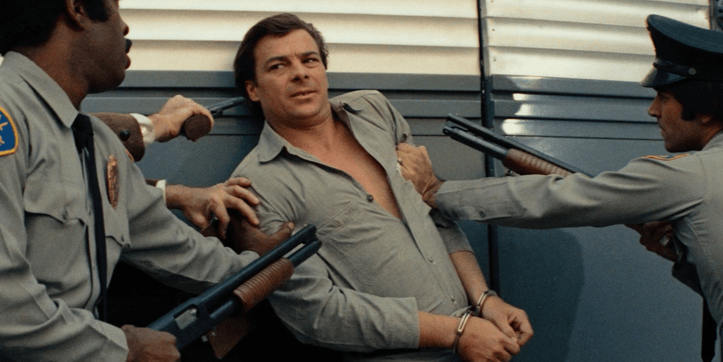
A great villain means nothing if you don’t have a powerful hero to root for, and in Napoleon we get the ultimate anti-hero — a street-level everyday Rambo, the great-grandfather of Bob Odenkirk’s Nobody character. He was played by a dude whose biggest credit at the time was being the director’s next door neighbor. You don’t truly know what Napoleon did exactly, but you know it’s bad, really bad, and yet you still absolutely root for him to blast that shotgun in the gang members’ faces then make it out alive at the end of the night.
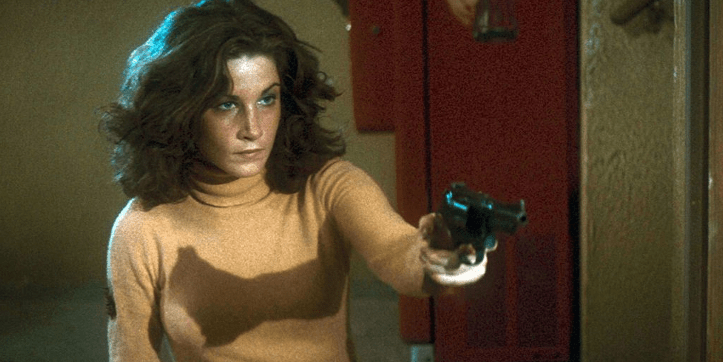
By his side, badass beauty Laurie Zimmer, playing bad-timing staffer Leigh, holds much more then her own in a role that made her a cult figure and re-ups the question why her career lasted only three years. And rounding up the main cast is a perfectly solid turn by ’70s fixture Austin Stoker who brings racial issues into the mix by playing the temporary sent on a dead-end assignment in more ways then one.
I honestly love a LOT of Carpenter’s body of work, but none of it happens without Assault on Precinct 13. You can fully appreciate in it the genesis of his many staples, from the silent relentless Killer of Halloween to the ultimate rebel brawlers of Escape from New York and They Live. Add to that yet another iconic soundtrack mastered by the man himself, and you get THE ONE inescapable entry in his library that any of the man’s fans must watch if they are to call themselves movie buffs at all.

Drake’s rating: A single scoop of vanilla
Drake’s review: After the members of a dangerous gang steal a cache of firearms, six of them are gunned down in an ambush by the police. In response, the gang leaders vow vengeance. Arming up, they go looking for trouble.
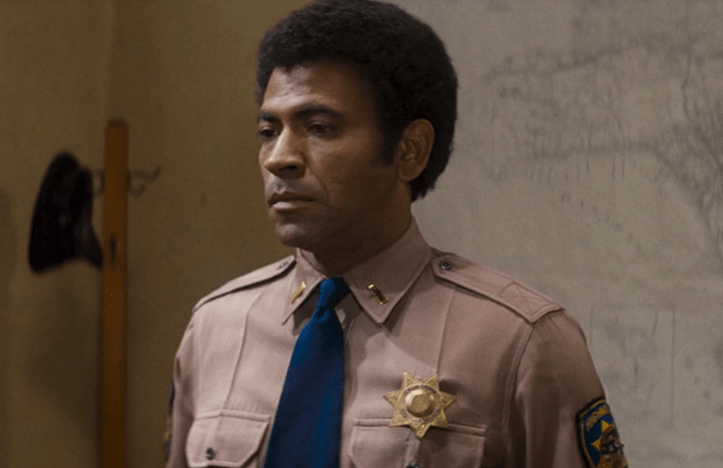
Meanwhile, Lt. Ethan Bishop (Austin Stoker, Battle for the Planet of the Apes) is put in charge of the final days of closing down a local police station in Anderson, the crime-riddled neighborhood where the gang makes its home. Only a few people are left, and Bishop has orders to merely answer the phones and forward the callers to the new precinct.
At the same time, three prisoners are being transferred to another prison, including Wells (Tony Burton, Rocky) and accomplished killer Napoleon Wilson (Darwin Joston, The Fog). The third prisoner is sick, and the officer in charge of the transfer makes the decision to stop at the Anderson precinct so that a doctor can be called in.
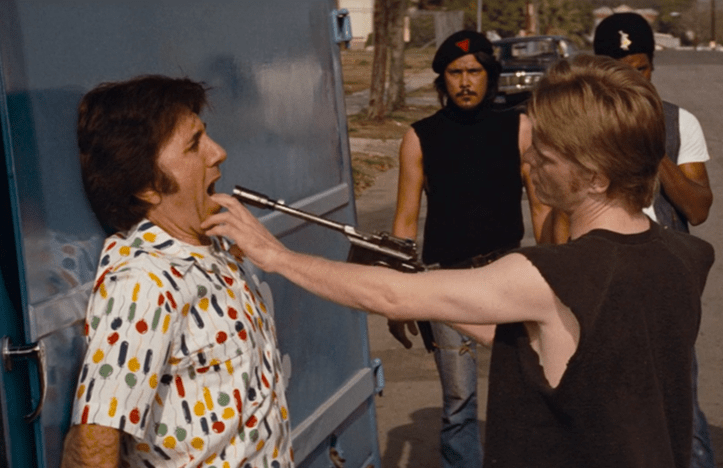
But then the BAD THING happens, and trust me, it is BAD. The BAD THING serves as the impetus for all of the plot lines to converge, and the gang descends upon the nearly-abandoned precinct looking to kill anyone and everyone inside.
That’s the basic outline of John Carpenter’s Assault on Precinct 13, the director’s taut sophomore effort. A tense action thriller, Carpenter instills a feeling of isolation in the police station setting, even though the precinct is in the middle of a busy city. The gang cuts the phone lines, leaving Bishop unable to call for help, and then the lights go out and the protagonists are literally left in the dark. Attempts at escape are violently curtailed, and those inside the police station find their numbers quickly reduced.
Bishop never says die, though, and Wilson isn’t the type to run from a fight. Working together, cop and criminal have to find a way to keep everyone else alive.
As he does five years later in Escape from New York, Carpenter expertly blurs the line between the good guys and the bad guys. The gang is an obvious menace, but the opening scene showcases how brutal the cops are as well as they shotgun the half-dozen gang members in a closed-off alley. And of course Napoleon Wilson, an obvious forebear to Snake Plisskin, has his own sense of honor and grows into a trusted ally for Bishop.
Assault on Precinct 13 is an undeniably low-budget film, but every penny of it can be seen on the screen. John Carpenter wisely chose to invest much of his scant funding into post-production processing, and it shows. The film has always looked and sounded great, especially in comparison to many of its exploitation peers. Even at this early stage of his career, Carpenter was well aware of the technical aspects necessary to make an effective film, and he utilized his experience with the end-product here to great effect over the next few years.
The film is not without its flaws, however. Some scenes drag on a bit as Carpenter was fond of filming them long, and a few of the line deliveries land with a resounding thud. Stoker was likely the most experienced actor on the set, and it shows in his performance. He keeps things animated, realizing that in a tense situation people are filled with adrenaline, making them fidgety. Stoker leans into that just enough to give his performance a restless edge, highlighting the anxiety that any given person would feel when they’re trapped and their life is on the line, without ever going overboard and making Bishop into a nervous wreck.
Assault on Precinct 13 showcases just where John Carpenter was going in the late ‘70s and early ‘80s. Although it resembles Escape from New York more than, say Halloween or The Fog, the movie nevertheless features his oft-used theme of desperate people in a seemingly hopeless situation. I’ve seen it highly praised as a lost cult classic, and some consider it among Carpenter’s best films. I would argue with both of those points. Assault on Precinct 13 was never really a “lost” film as much as it was an unfairly ignored one, and in the Carpenter filmography I would personally rank it as one of his mid-tier films, sitting alongside The Fog and In the Mouth of Madness, but well below such films as The Thing and Prince of Darkness.
It’s way above the likes of Escape from L.A., however. Way, way above.
Intermission!
- Believe it or not, the British theatrical rights for the film were bought by a man named Michael Myers. That may well be where Carpenter got the name for his most famous cinematic villain.
- To get an R rating instead of the dreaded X, Carpenter cut the scene with the BAD THING from the copy he sent to the censors, and inserted it again for the film’s release.
- In more recent years, Carpenter has stated that he regretted shooting the BAD THING scene the way he did. Which, honestly, says a lot about his later films, and why they didn’t work. That scene is the shocker, and it kicks the film into gear. Changing it to be less intense would have lessened the overall impact of the movie.
- Inspired by the zombies in George Romero’s Night of the Living Dead, Carpenter makes the gang macabrely quiet. They barely have any lines, and attack the precinct in near-silence.
 Mutant Reviewers