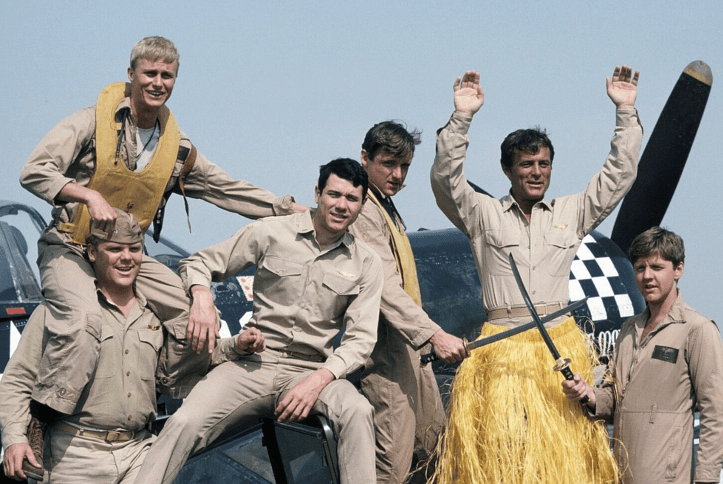

It’s easy to say “it didn’t age well” about something you enjoyed decades ago when in truth it is you who were a completely different person, let alone lived in a world that no one from that long ago would recognize. The difference with Baa Baa Black Sheep is that it was anachronistic from the very inception, which is most likely the reason it didn’t last very long,
I just didn’t care back when I watched its reruns — in FRENCH — every day one summer of the mid-80s when I was a school boy. Therefore when I saw both seasons had been released a few years ago on physical media, I had to see if I could jump back to that feeling. Short answer, yes. And f**k no.
Greg “Pappy” Boyington is a flying ace who joined a group of volunteer American pilots serving in the Chinese Air Force during their conflict with Japan in 1941. He’s also very cavalier in his attitude toward rank and decorum. After the Pearl Harbor attack, Pappy goes back to the U.S. Air Force and scams his way into taking over a Marine fighter squadron that he populates with hot-headed troublemakers who were all otherwise destined for court martial or dishonourable discharge.
After a shaky start, the boys known as the Black Sheep Squadron becomes the terror of the South Pacific air, all the while Pappy is being hounded by a tight-arsed superior bent on taking him down.
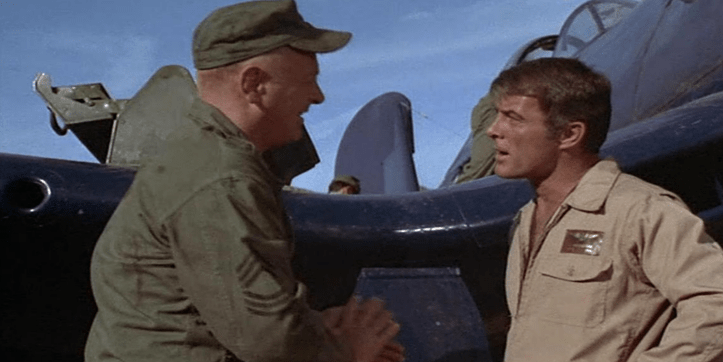
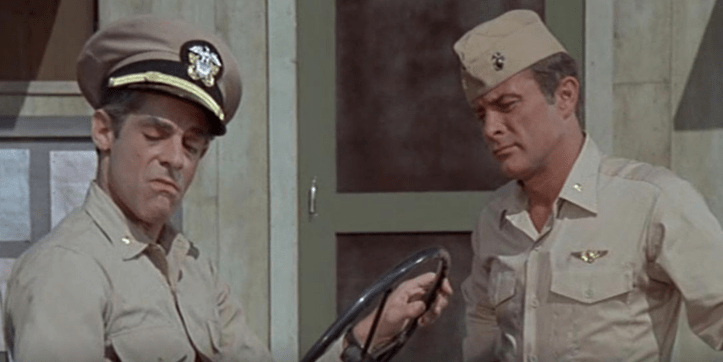
Of course the series was very very very loosely based on the actual real-life squadron, with Boyington being pretty much the only actual person depicted (and even that with some liberties by TV fixture Robert Conrad). He’s surrounded by actors who were equally ubiquitous to that era of television, like Dana Elcar who later bossed around the original MacGyver, Simon Oakland whose tough guy routine plagued many a ’70s TV hero from Kolchack to Quincy to Poncherello, and a very boyish looking young newcomer named John Laroquette.
Now, back to that childhood feeling of mine. I guess what connected with me so much as a kid was that Conrad played a macho rebel, a rule breaker with no F’s left to give. What hormonal tween boy doesn’t respond to that, I ask you? Problem with the show was that it treated war — specifically World War II — as a frat party where being a soldier was “swell.” This was being put on the air exactly one year after the end of the Vietnam War, which to this day remains polarizing for its very existence.
To drive the nail further home, the series was late to the war-comedy game as Hogan’s Heroes had already made complete clowns of the Nazis years before and M*A*S*H* used its own comedy to tackle serious societal issues head-on. Sure, Hawkeye and Trapper John liked a good prank with a drink, but at the end of the day their antics mirrored their belief in the futility of armed conflicts. Pappy and his posse reveled in it, however. They LIKED going on the prowl and shooting at the other guys seemingly for the sake of it. When Pappy threw a beach party, it wasn’t to fight the power, it was to party, period. Kid me didn’t see the nuance, adult me living in a shooter-drills-in-schools world sees things differently.
But Anthony, I hear you all say to your screens, does that mean John Wick should be banned? Dudes. come on, they killed his dog…. HIS DAWG!!! But more to the point, John Wick is a ballet of well designed action set-pieces. Violent, yes very very much so, but so beautifully choreographed and filmed that you can only sit and watch in awe. Watching John Wick 4 and Oppenheimer in theatres both brought about the same experience: people watched in complete silence, mesmerized by the screen. When’s the last time YOU saw that in a multiplex?
Of course, Baa Baa Black Sheep could not have benefited from anywhere near the budget, but still TV shows of the era were often much better looking. When the boys throw punches at each other you could park a car between the fist and the face and yet you hear the blow sound like you just walked on celery. That kind of thing sometimes makes you smile with a certain nostalgia, but in this case it just took me out of it entirely. I tried as much as could to to at least watch all of season one but I gave up soon enough so I could enjoy Keanu-fu a few more times instead.
During a Q&A in 2013, before his timely passing, Conrad was asked why the show didn’t last more than two seasons. “Women against violence in television,” he bluntly answered, the same movement he blamed for the cancellation of his one-hit show The Wild Wild West. Like pappy and his his boys, Conrad remained until the end a dude whose values were left behind by his own time. I will always remember with fondness that one summer I spent watching the show eons ago, but this old dog just don’t bark to such a moon no more.
 Mutant Reviewers