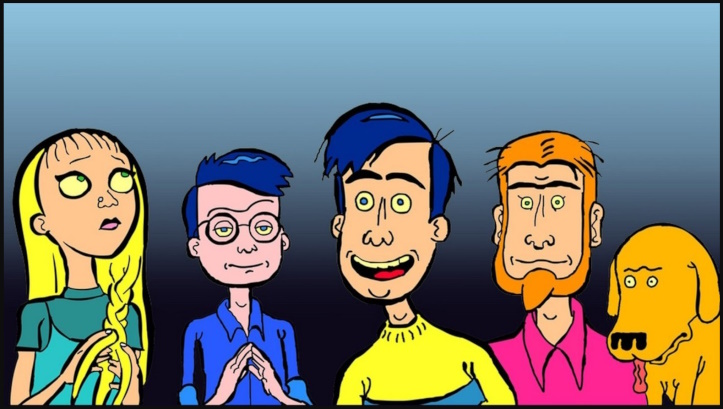
It’s the late ’90s and Simpsons showrunners and writing partners Bill Oakley and Josh Weinstein decide to get out of the Homer business while the getting was good (not-so-coincidentally marking the end of the “Golden Era” of the show). For their next project, the duo draft up a different kind of animated sitcom — one that revolved around Gen X slackers in the early years of their adult life.
This became Mission Hill, an extremely short-lived 13-episode series that broadcast on The WB. While ratings weren’t great and the show was quickly axed, subsequent showings on different networks started to generate a bit of a following for Oakley and Weinstein’s baby.
I actually remember watching and liking this back during its original airing, perhaps because I was addicted to cable back then. Mission Hill didn’t exactly rock my world, but it was amusing enough I was bummed when it got cancelled. I hadn’t seen — or thought about — it until this year, when I stumbled over all 13 episodes on YouTube.
Binge time!
Mission Hill centers around four people sharing a flat in the titular district of a San Francisco-like city. Andy French is a 24-year-old aspiring cartoonist who’s the very definition of “minimum effort.” He lives with space cadet Posey and his long-time friend Jim, and is neighbors with a bunch of colorful characters including an artist, a nameless baby, an elderly gay couple, and a revolutionary.
Andy’s aimless life is given a little bit of direction in the pilot episode when his parents send his nerdy 17-year-old brother Kevin to live with him and finish out high school in the city. Kevin and Andy generally don’t get along very well, but gradually Andy starts helping his little brother make the transition into adulthood.
While the stories are fine and the humor amiable if not laugh-out-loud funny, Mission Hill’s most notable feature is its visual style. Everything looks a lot like older comic strips or print ads where the colors don’t exactly fit in the inked outlines. Also, there’s a lot more dependency on neon shades and old timey comic conventions (such as dots to signify sight lines). It makes the show stand out in the looks department, although whether you like it or not is up to you. I’m middling on it, myself.
The 13 episodes that exist definitely showed promise. Even though Andy (and Jim and their dog) is a slob and there’s a predictable bent of liberal politics (of the 2000-era variety), these folks are pretty likable. I think that back then we had so many movies and TV shows where the lead character was an Andy, giving us a carefree, partying lead who said “whatEVER” a lot. I guess we were supposed to look up to them — or maybe we did? — but from today’s lens, I just wanted Andy to grow up.
And the thing is, he did. Mission Hill did offer some continuity in character development, and it would’ve been interesting to see where they went with it. Andy does get a better job and becomes a better surrogate parent for Kevin by the end of this run.
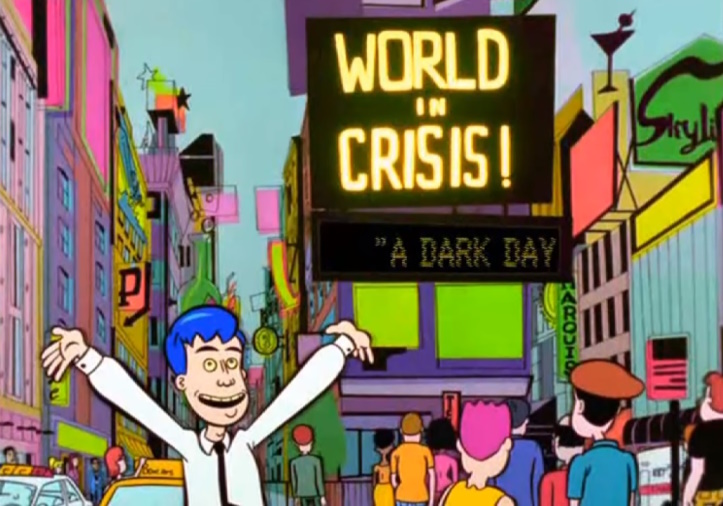
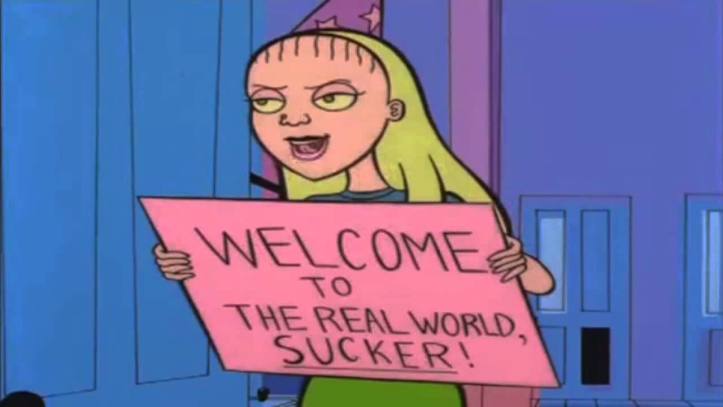
Out of all of the episodes, there are two that were the most memorable to me. The first is a flashback episode where we see the earlier days of the loft when Andy decided to join MTV’s The Real World (again, this was far more relevant at the time). And the second has Andy desperately trying to get to a date with an actress while the world is falling apart due to a global crisis. The thing is, all of the crisis takes place solely in the background and is never fully explained except that it’s increasingly ridiculous and is solved by celebrities.
It’s a good, solid show and one of the better animated efforts from the late ’90s/early 2000s. I’d recommend it with the caveat that you shouldn’t expect TOO much or get TOO attached. But Mission Hill was a fun revisit — and that theme song by Cake is living rent-free in my head now.
 Mutant Reviewers
Never even heard of this but I wanna check it out.
[…] the runaway success of The Simpsons. It seemed that many attempts emerged around 2000-01, including Mission Hill, Undergrads, Clerks, and the focus of this article, The […]