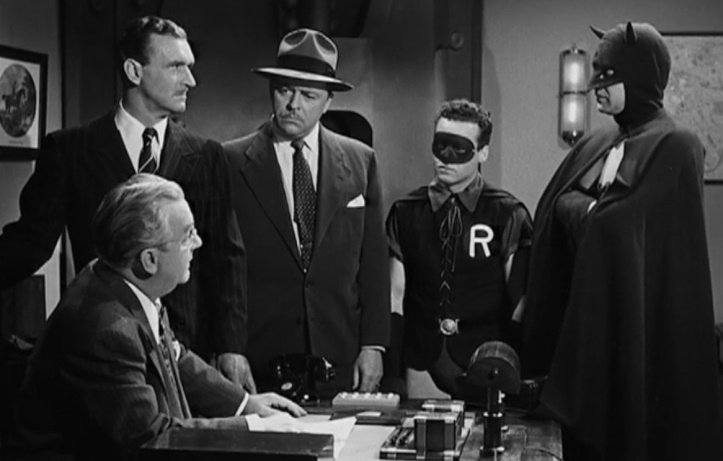
“I always have a plan.”

Sitting Duck’s rating: Gotham City has never been so lacking in urban infrastructure
Sitting Duck’s review: So back in 1943, Columbia released a 15-chapter serial featuring Batman and Robin simply called Batman. And apparently it was enough of a success that a second series was greenlit. However, this didn’t come about for another six years, resulting in a mostly different cast and crew.
Of these new participants, the most critical proved to be producer Sam Katzman. A veteran of notorious poverty row studio Monogram (where Bela Lugosi spent a significant portion of his declining years) along with a couple of other fly-by-night production companies, Katzman was one of the earlier examples of the cheapskate producer. It could be said that he was Sam Arkoff before Sam Arkoff was Sam Arkoff. And while the first Batman serial wasn’t exactly awash with cash (none of the serials of old really were), Katzman took cost-cutting to greater lengths. This could be seen here in aspects ranging from the ill-fitting costumes to Batman’s ride being downgraded from that sweet black Caddy convertible from the first serial to a stock Mercury sedan.
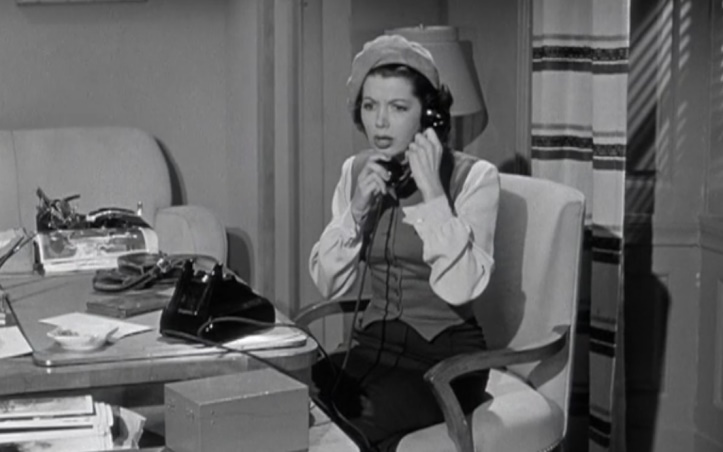
In the oddly rural metropolis of Gotham City, the crime rates are held in check thanks to the endeavors of Batman (Robert Lowery) and Robin (Johnny Duncan). Though they have to put just as much effort in distracting the persistent spunky girl reporter Vicki Vale (Jane Adams) from uncovering their secret identities as anemic millionaire Bruce Wayne and his middle-aged ward Dick Grayson.
However there’s a new threat in town in the person of The Wizard. Recently, a gang of thugs in his employ enacted a heist at the Generic Research Corporation, getting away with a cutting edge remote control device. With it, The Wizard can take full control of any vehicle within a fifty mile radius. Thus he can accomplish truly fiendish acts like changing your radio presets or moving the driver’s seat up all the way so that the steering wheel is jammed into your area.
So who could The Wizard possibly be? Maybe it’s Professor Hammil (William Fawcett), crotchety inventor of the remote control device who may have decided to repossess his creation so that he can Show Them All. Or perhaps it’s ethically impaired radio newsman Barry Brown (Rick Vallin), who could be using his radio broadcasts to send out orders to his goons.
Who are we kidding? They’re both obvious red herrings. And the true answer is going to hurt. Badly.
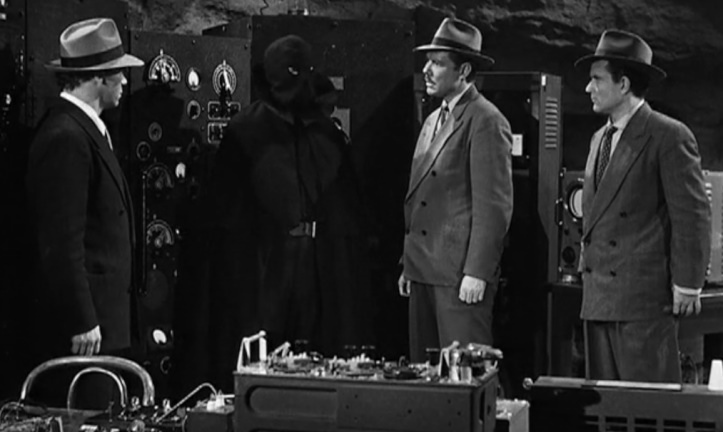
Let’s talk about the most derided aspect (with plenty of justification) of serials, the cliffhangers and how they get resolved. To encourage audiences to come back for the next installment, each chapter in a serial concludes with one or more of the protagonists stuck in some seemingly inescapable peril or appearing to have been killed. The problem is that these would invariably be dealt with using one of a handful of stock resolutions. Vehicle went over a cliff? Hero bailed out just in time and does it without breaking anything. Death ray fired at the hero and blasted him to smithereens? Turns out he managed to step out of the line of fire. And so on. Sometimes I wonder how long it took theater audiences of the day to catch on to this nonsense.
Batman and Robin is just as guilty of this sort of tomfoolery as any other serial. But I will give credit where credit is due. There are a couple of instances where the resolution is, um… unique. For instance, the resolution of the Chapter Six cliffhanger is so stupid that it wraps around to a sort of demented genius. As for the resolution of the Chapter Ten cliffhanger, it should not be pondered on too long or hard, for that way lies madness. The complete absence of logic as it unfolds is astounding. But at least it’s not the same old same old.
Another issue common to serials are the way car chases are handled. These get staged on country roads where production crews don’t have to worry much about traffic getting in the way. The problem here is that the superhero genre is one that is commonly attached to urban environments. Watching the Caped Crusader and the Boy Wonder chasing down thugs as grain silos and green bean fields zip by in the background just feels out of place.
Which brings us to the Batmobile, or rather the lack thereof. Now to be fair, Batman in the comics didn’t have a themed set of wheels from the get-go. But by 1942, the Batmobile was a standard part of his arsenal. However, the fact that Batman traverses the tumbleweed-littered streets of Gotham City in an unmodified Mercury sedan isn’t in itself a problem. No, the problem is that the sedan in question is Bruce Wayne’s car, registered at the DMV in Bruce Wayne’s name. Further failing to separate the Bruce Wayne and Batman identities, they don’t drive out of a cave in Bronson Canyon or something like that. No, they scamper up the driveway in front of Bruce Wayne’s modest suburban home (apparently Stately Wayne Manor got repossessed) fully costumed and hop in. It’s a wonder the neighbors haven’t noticed.
Another strike against this serial is the shoddy design of the Batman and Robin costumes (which incidentally are shown as being stored in a filing cabinet). Especially in how they bunch up in some unfortunate places. Now I suppose it could be argued that, being one of the earlier attempts to adapt a comic book superhero, Tinseltown costume designers simply hadn’t figured out how to go about the task. And it’s likely that it was the case for this particular crew. However, the 1941 serial Adventures of Captain Marvel (featuring the superhero more commonly known nowadays as Shazam) disproves that. The costume in that one looks great. And it was produced by Republic, who generally had less cash to play around with than Columbia.
Something that can be regarded as troubling is the dysfunctional relationship that is presented between Batman and Vicki Vale. Now, I understand why Batman would regard Vicki’s constant snooping as annoying. Still, his behavior is often outright callous. When he catches her tailing him during a mission, Batman takes away Vicki’s car key, effectively stranding her in the middle of the desert. Had she not had the foresight to bring along a spare, she could have easily ended up as vulture chow. Later on, some of The Wizard’s goons tie up Vicki and stuff her in a car that gets pushed to go over a cliff. While Batman stops it in time, he then just leaves her there. With luck Vicki might also be an escape artist, though we never see.
Then there’s the way they handle the reveal of The Wizard’s true identity. The narrative leans into implying that it’s Professor Hammil. This is accomplished by showing Hammil doing something that appears nefarious and then fade to The Wizard entering his workspace to twist a few knobs on his machines. The fact that there is no trail of hints laid out about his identity (aside from matching the character with the same voice and build as The Wizard) prior to the reveal makes it feel lazy. But that’s not the worst part. The worst part is that the nature of The Wizard’s true identity involves not one but two clichés. Granted, said clichés may not have yet worn out their welcomes back in the 1940s. Even so, it does result in a poorly aged product.
Something that gets downplayed or outright ignored in more current iterations of Batman is his aspect as a detective. The serial leans more into this facet of the character. Sure it may be because it’s cheaper to film than tense car chases or brutal fight sequences. Still, it does help broaden the character as we see him perform (albeit often half-baked) deductions, analyze evidence in his Batcave lab, and perform undercover infiltrations. It may not always be competently presented, but it’s the thought that counts.
Yet even with all this substandard ballast, there is one undeniably good thing to come out of this and the prior serial, and that is how Alfred is handled. Something which more casual fans of the franchise may be unaware of is how Alfred in the early comic books was kind of a buffoon whose main purpose was to be a laughingstock. The character’s more dignified portrayal in the serials helped set his trajectory in a more positive direction. Can you imagine what it would be like in the more modern iterations had that not happened? He’d be less a father figure to Bruce Wayne and more of a drunk uncle.
So while Batman and Robin isn’t a total disaster (unlike its 1990s namesake), it’s definitely on the lower end of the quality spectrum among Batman adaptations. A lot of this can be pinned on the budgetary constraints imposed by Sam Katzman. Unlike fellow penny-pincher Roger Corman, Katzman didn’t really have much of a knack for getting the maximum bang out of each stretched buck. If you decide you want to watch it anyway, I recommend doing it with the RiffTrax commentary. It’ll be twenty-eight dollars well spent.
Intermission!
- So police just shot at random suspicious characters at their discretion Back in the Day?
- Burt Ward would have totally quipped that
- The chief henchman being named Nolan is retroactively hilarious
- Just because there’s hot pursuit doesn’t mean you can’t have a smoke break
- Move his spine around a lot
- The classic Double Head Bonk
- So now they use their guns
- Must have a Utility Belt of Holding
- That’s an unconventional way to pronounce Batman
- Back then, radiation was good for everything
- Go ahead and leave him stranded in the middle of the desert
- These goons need a refresher course on securing prisoners
- Batman should get the shocks on his car replaced
- Sure, why not?
- Obligatory MST3K Connections: Quite a few, actually. But I’ll try to keep this relatively short. Jane Adams (Vicki Vale) was Helen Paige in The Brute Man. Don C. Harvey (Nolan) was a lab guard in Beginning of the End, a policeman in Teenage Crime Wave, and Mac in Revenge of the Creature. Jack Chefe (plant guard) was the headwaiter in I Accuse My Parents. Frank Hagney (plant guard) was the juvenile court bailiff in Teenage Crime Wave. Myron Healey (Walker) was Mark Houston in The Unearthly and General Michael Perry in The Incredible Melting Man. Knox Manning (narrator) was the Newscaster in Invasion USA. George Offerman (Vicki’s noncanonical brother Jimmy Vale) was Freddie in Gunslinger. Eddie Parker (Holt and a stunt double) was a Khan’s guardsman and a stunt double in Undersea Kingdom, Bela Lugosi’s stunt double in Bride of the Monster, and a mole person in The Mole People. Allan Ray (Mac Lacey) was a man at the loudspeaker in The Space Children. George Robotham (the Car 4 driver and a stuntman) was a stuntman for Master Ninja I and The Mole People. Batman co-creator Bill Finger was a writer for The Green Slime and Track of the Moon Beast. Writer George H. Plympton was a writer for The Phantom Creeps. Producer Sam Katzman was producer for The Corpse Vanishes and Teenage Crime Wave. The property was also cheaply ripped off by The Wild Wild World of Batwoman and brazenly ripped off by The Batwoman.
 Mutant Reviewers