
“I’ll show you what the Robot Ninja is all about.”

Drake’s rating: When trash cinema and forgotten comics collide
Drake’s review: So waaaaaay back in the mid-1980s, the comic book industry saw an explosion of black-and-white titles hit the racks. Publishers started popping up out of the woodwork and churning out B&W comics as fast as they could, and there was a market for them for one very simple reason: Teenage Mutant Ninja Turtles.
In 1984, a pair of creators named Peter Laird and Kevin Eastman put out the first issue of the TMNT comic, and sales took off. Within a few years, there were toy deals and cartoons and movie rights. It became evident even around 1985 or so was that it was possible to have a hit comic and not have to print it in color, which was a ridiculously expensive proposition for a fledgling publisher. But a B&W book? That was considerably easier, faster and, most important of all, cheaper to produce than your average Marvel or DC comic.
The B&W explosion died out fairly quickly, however, since it was built on a collector’s market that soon found out that none of the comics that were filling the stands had the collectability of TMNT. And honestly, most of these comics weren’t exactly classics, and most would be hitting the discount bins by the decade’s end.
Still, that short-lived B&W comic book craze was somehow the inspiration for Robot Ninja, a superhero movie that shows what happens when the hero isn’t bulletproof, lacks mutant powers, and hasn’t been bitten by a radioactive spider.
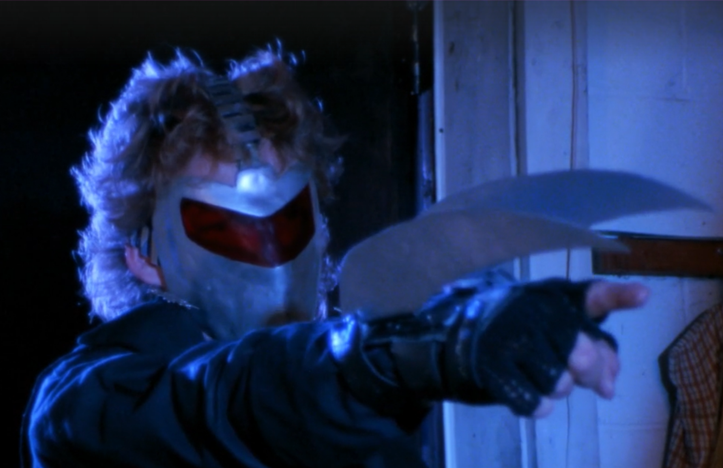
Leonard Miller is the disgruntled creator of the comic book character Robot Ninja, a black-and-white comic book that seems to have decent sales. Trust me, the phrase “only in the movies” applies here. Unhappy with his sleazeball publisher* Stanley Kane (Burt Ward, Batman The Movie), the direction of the comic book, and seemingly life itself, Leonard asks his friend Dr. Goodknight to put together a costume that will hide his identity so that he can fight crime.
Instead of getting Leonard an appointment with a clinical psychiatrist to work out his issues and maybe a prescription for medical marijuana to ease some of that hypertension, Goodknight goes along with the plan. He outfits the young artist with a black costume and a metal mask as well as a pair of blades strapped to his arm because it was the late ‘80s and Wolverine was just the coolest kid on the block.
Leonard then has a short training montage, does a few sit-ups, and gets ready to fight crime as the living embodiment of his fictional superhero, Robot Ninja.
Now in the comics that Leonard creates, I’m assuming that the character is both a robot and a ninja, which would kind of make him a cross between Bruce Lee and the Terminator. Not the worst idea for an ‘80s comic. Unfortunately, Leonard is neither robot nor ninja, and so his success rate as a superhero is considerably worse than his fictional counterpart’s. In fact, Leonard is a downright pathetic crimefighter, which seems to be the entire point of the movie. He can’t really fight, gets pounded on, stomped and stabbed into a bloody mess, and has obvious head trauma that gives him delusions. It’s not a pretty sight.
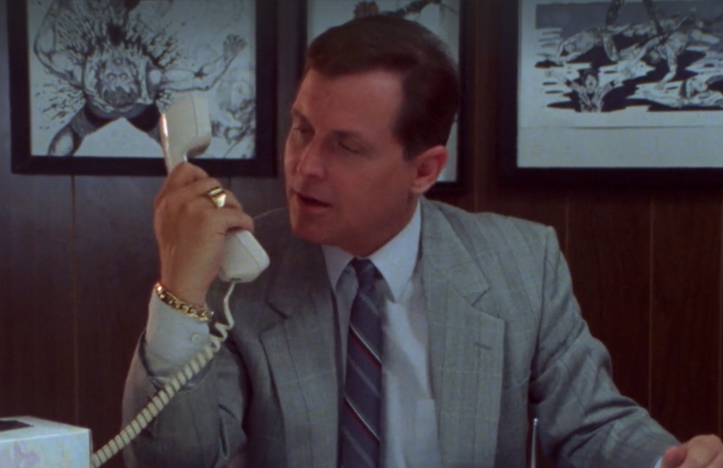
And indeed, Robot Ninja itself is a fairly ugly movie. Shot on a reported $15,000 budget, with most of that no doubt going to latex appliances and blood packets, this is one amateurish-looking flick. If it weren’t for the welcome appearance of Linnea Quigley, one would think that this was shot by a bunch of friends over a weekend on a lark. At least the bits with Quigley and Ward are a bit of fun, even though the notion of a B&W comic book publisher having an office, much less an assistant, are far-fetched at best.**
But to be fair, the comic books that inspired Robot Ninja were generally pretty ugly as well,*** and often violent to the extreme. It’s honestly kind of impressive that writer/director J.R. Bookwalter was able to unapologetically channel the source material so well. That doesn’t make Robot Ninja a good movie, but it is a uniquely honest one in adapting the look and tone of the B&W comics that it was unofficially adapting.
Grimy and gory, Robot Ninja is either bottom-tier exploitation, or a weirdly self-aware homage to a brief bit of comic book history. Or maybe it’s both. I have no idea.
Either way, I’m off to read a few issues of the Adolescent Radioactive Black Belt Hamsters. The real classics never get old.
*Which is to say, publisher.
**OK, full disclaimer here: I do know more than my fair share about this particular comic book phenomenon since I did a few comics back then. And when I say that most of them were bad, I include my own. Just dreadful stuff.
***An exception to these was a book called Grips that featured a hero of the same name, who was basically a Wolverine clone that used one extended claw instead of three. The writing was fairly abysmal, but the artwork, by a talented fellow named Tim Vigil, was very impressive. Considering the fact that Grips also had a secret identity as a comic book artist, one wonders if that book was a direct inspiration for Robot Ninja.
Intermission!
- Bad comic book art for the introductory sequence, but pretty accurate for the look of what they were going for.
- Burt Ward? Holy desperation, Batman!
- He has one of those chunky car phones. He’s a B&W comic artist. How can he even afford a car?
- Sit-ups will definitely help him fight crime.
- Robot Ninja sounds like he’s talking into a tin can.
- “You ain’t much of a man, man!” The dialogue channels those B&W comics as well.
- Leonard really has the featheriest of feathered hair.
- The thugs hit a video store and take a kid hostage. In my head canon, that’s a young Justin.
- Just the Robot Ninja, driving slowly away in his non-robotic Firebird.
- Inserting metal plates to fix horrific wounds. Kids, don’t try this at home!
- The thugs all have movie-related names.
- “We’ve already sold more copies than DC’s Dark Knight series.” HAHAHAHAHAHA. No.
 Mutant Reviewers
your mention of Adolescent Radioactive Black Belt Hamsters, reminded me of a more obscure TMNT knockoff – Pre-Teen Dirty-Gene Kung-Fu Kangaroos
https://ultimatepopculture.fandom.com/wiki/Pre-Teen_Dirty-Gene_Kung-Fu_Kangaroos
It’s honestly impressive how a parody book like TMNT was able to spawn a countless horde of imitators, but that’s the nature of the comics industry.