
“But, my dear Longstreet, the papers that explain this wonderful gun – have you brought them?”

Drake’s rating: I also created an x-ray gun, but Justin understandably took it away
Drake’s review: The name Julia Crawford Ivers is not a particularly well-known one, even among silent movie fans, and that’s a shame. A pioneer in the field of filmmaking, Ivers was primarily a writer and director, although like many of her peers she wore many hats while working in and around the early studios. She partnered with renowned director William Desmond Taylor for several years before his still-unsolved murder and ended her career in 1923 after a mere decade in the movie business.
She left behind some solid work, including The Intrigue, which mixes science-fiction and espionage in a way that presages Ian Fleming’s James Bond novels, along with a bit of Agatha Christie.
Guy Longstreet is, as the movie tells us, a “young American scientist” who has designed an x-ray gun capable of destroying a target up to 25 miles away. The x-ray gun is not an errant piece of artillery, however, and instead can lock on specific targets and fry them on the spot. Surprisingly, the United States is not interested in the device, so Longstreet takes it to Europe, where a war is raging. There, Longstreet stages a demonstration of a scaled-down version of the weapon that impresses one of the European powers, and they buy it on the spot. Still, Longstreet has to go back to the U.S. since only he can manufacture the specific parts for the gun, and so he sails off across the Atlantic once again.
Longstreet’s not alone, however. The European power buying the weapon sends along a dastardly fellow named Baron Rogniat to make sure the deal goes through. Or, failing that, to make sure Longstreet isn’t around to try to sell it to anyone else.
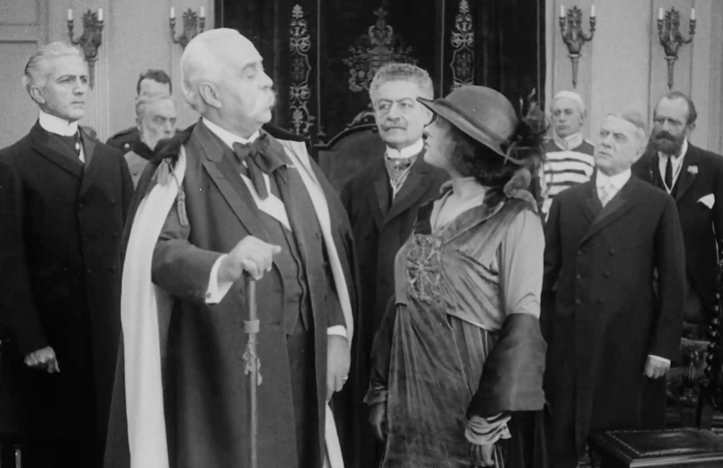
But there’s a third interested party on the ship as well. Countess Sonia has been sent along by the emperor of the opposing European nation as well, since they really don’t think that their enemies having a death ray is a good thing. A spy in the emperor’s court tips off Rogniat, but Sonia is one step ahead of the baron, and has her maid travel as the Countess Sonia while Sonia herself pretends to be an immigrant heading for America.
The real Sonia of course catches the eye of Longstreet and Rogniat both, and the latter man hires her as a maid for his stay in America. Which, of course, gives Sonia the opportunity she needs to snoop around the baron’s mansion and listen in on his plans. Plans which of course include doing away with Longstreet so that no one else ever gets their hands on the x-ray gun.
The Intrigue is a solid little silent film featuring a beautiful spy, a menacing villain, and a love interest who may be a brilliant mind in the laboratory but lacks common sense outside of it. It’s a formula that is certainly well known now, over a century later, but Ivers’ scenario certainly feels just a bit ahead of its time for 1916. It’s not a movie that will convince you to love silent films, especially if you’re already ambivalent about them, but it’s certainly a solid reminder of what the format was capable of even early on.
So if you have an hour or so free, and you’re just looking for a quiet little espionage movie that features mad science, death rays and nefarious villainy, you might want to give The Intrigue a try. It’s a fun peek at the spy-fi genre that was to come.
Eventually.
About 50 years later.
Intermission!
- Pallas Pictures, the production company behind The Intrigue, was a short-lived but fairly prolific studio that provided films for Paramount to distribute. It was merged into Famous Players-Lasky in 1916, and the Pallas brand name was discontinued two years later.
- Director Frank Lloyd had a prolific career behind the camera in Hollywood, directing dozens of films over a forty-year career. He was something of a journeyman, working for several studios over the years, and is another name that is lesser known due largely to the fact that he did not indulge in self-promotion. He was nominated for several Oscars, however, winning two and being nominated again for his biggest film, 1935’s Mutiny on the Bounty with Clark Gable and Charles Laughton.
- Julia Crawford Ivers left another lasting legacy in Hollywood, that of her son. James Van Trees was a very successful cameraman and cinematographer who had a lengthy career of his own. He shot several of his mother’s movies including The Intrigue.
- Hollywood notables in The Intrigue include Florence Vidor, who played the maid impersonating Sonia, and her husband King Vidor, who had a small part as a chauffeur. Florence was a very prolific actress in silent films, but couldn’t make the transition to the sound era and retired from movies in 1929. King Vidor, on the other hand, became a very successful director, with movies including Northwest Passage, Duel in the Sun, and 1956’s War and Peace. He also directed several sequences on The Wizard of Oz, including all of the black-and-white scenes.
- King Vidor may have also been the one to (unofficially) solve the murder of William Desmond Taylor, as he did extensive research on the case while compiling material for a potential screenplay. Years of notes, articles and interviews Vidor conducted himself were found in 1982 by his biographer, Sidney D. Kirkpatrick, who compiled the material into the novel “A Cast of Killers.” I won’t give any spoilers, but I have read it and do think Vidor was probably correct in his findings.
 Mutant Reviewers
Neat! I like seeing new reviews for old films I haven’t heard of. I’ll look for this.
I know it’s on YouTube, which isn’t a bad go-to for silent movies since they’re almost all in the public domain (finally!). I had a good time watching this one, so I hope you enjoy it!
Yeah……..but I’m a sucker for D.V.D. extras.
Totally understandable. Kino Lorber does have a nice BD of Julia Ivers’ work, which includes another movie she wrote & directed (and a partial third film, but only the surviving single reel of it). It’s happily sitting on my silent film shelf with a bunch of other movies that need to be reviewed whenever I can slip them past Justin…
O. 🙁 I don’t have a Blu-ray player.
BD?
Sorry! Blu-ray disc.