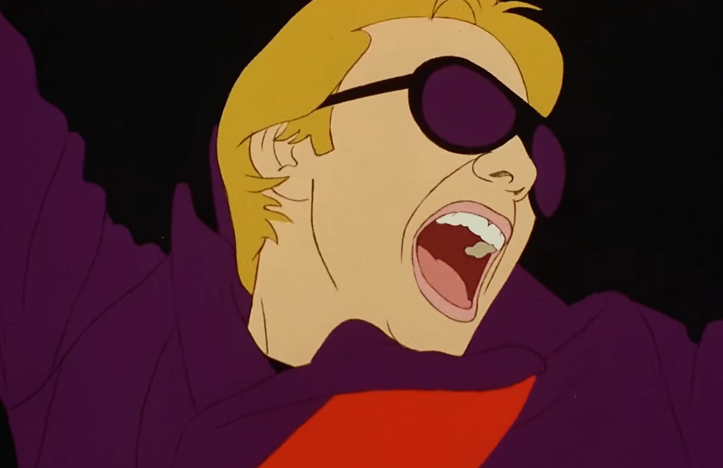
“Singers sit on pianos an’ things. Strippers is always on their feet.”

Drake’s rating: Warning: Spoilers for a four-decade old movie ahead
Drake’s reviews: The name “Ralph Bakshi” is a familiar one to anyone who knows the American animation industry. A success in both television and in theaters, Bakshi had only recently completed a troubled Lord of the Rings feature when he decided to concentrate on a more personal project. Blending his own history with that of other immigrants to America and a healthy dollop of 20th century music, Bakshi created American Pop, the sometimes heartbreaking story of one family as they traverse the decades, each generation heavily influenced by the sounds of the times.
It starts off dramatically enough, with a young Jewish boy named Zalmie escaping the Russian pogroms with his mother. Young and lacking much in the way of education, Zalmie ends up working for a burlesque club, a job that introduces him to the world of show business. And where he learns to spell from the dancing horse. Who says burlesque isn’t educational?
Zalmie’s fascination with that world, and his endless yearning to be a part of it, seems almost to be genetic as it’s passed down to his son, Benny, a talented pianist. But if Benny loves music, he’s less interested in success. He plays music simply because that’s what he’s always loved, but he ignores record contracts and big opportunities. And then comes World War II, and Benny ends up in the thick of it.
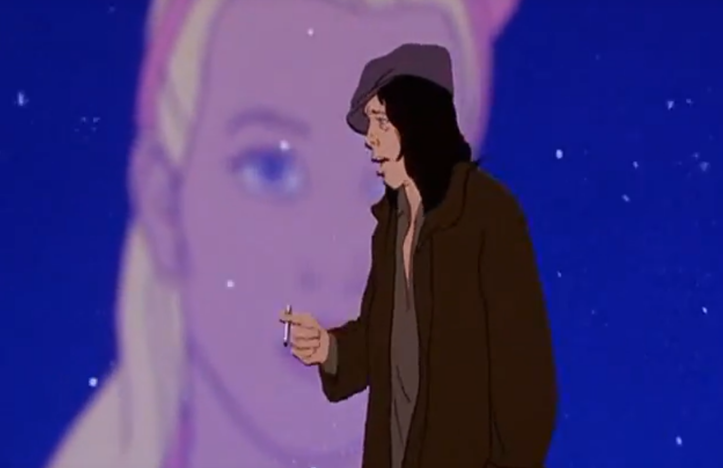
Benny has a son, though, a kid named Tony who listens to beat poets and leaves New York, trekking through the country until he ends up in Kansas. He falls for a young blonde waitress, but Benny’s restless nature sees him moving on and soon he’s fallen in with a band talented enough to make it big, thanks in part to Tony’s songwriting. But as the years pass their talent isn’t enough to overcome their addictions, and both lead singer Frankie and Tony himself fall prey to chasing the dragon. It all ends badly, of course, with Frankie overdosing before a show in Kansas City, where Tony meets a little blonde boy named Pete. And it’s then that Tony realizes that he’s wasted his life and his talent, breaking down in a gut punch of a scene as his world crashes down on him.
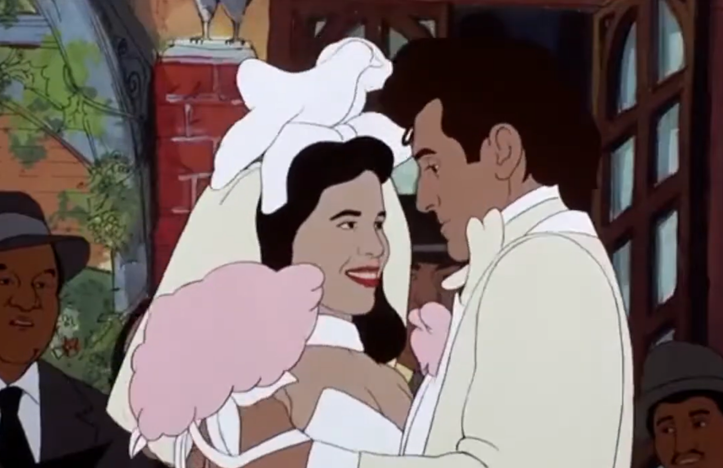
Tony’s not strong enough to change, though. Heading back to New York, with Pete trailing along, he continues dealing and using on the same streets that Zalmie had walked decades before, until he finally leaves Pete on his own, recognizing that the boy is better off without him. And surprisingly, Pete is. Pete’s a survivor, a street smart dealer who ends up supplying drugs to rock stars and record producers. Knowing he has them in his grasp, Pete demands they play one of the songs he’s written or they can just find a new pipeline. Desperate, they agree to play one song, and that song is where the movie stumbles. Because that song needs to be something special, reminiscent of what’s gone by and foretelling of the music to come. And it’s played off as such, but…
BUT.
But when Pete hits the piano and starts belting out a tune, it’s… Bob Seger’s “Night Moves.”
Sigh.
Look, it’s a fine song, but for one thing, it was written in 1976, and by 1981 it was a downright old-fashioned piece. And for another, the reaction that Pete gets from the band and the recording personnel makes it seem like he’s Guns n’ Roses belting out the first few bars of “Welcome to the Jungle.” They’re shocked! They’re amazed! They’re reacting like this five-year-old soft rock ballad is the greatest thing they’ve ever heard! Pete is just rocking out, putting it all on the line, and the song that makes the music industry stop and listen is “Night Moves.”
No. Just…no. And the other big problem is, you need that song to be definitive of the time period, just as the earlier music had been. You want it to sound like the dawn of the ‘80s, with a strong taste of what’s to come, and that’s not without difficulty. But it’s also not “Night Moves.”
Do I recommend this movie? Oh, definitely. I think it’s a great movie, and certainly one of Bakshi’s best. He delves deep into the American experience and ties it into the ever-changing musical landscape with a solid 90% success rate. It’s funny at times, and tragic at others, and the synopsis above is just the bare bones outline of the story. There’s so much more here, little bits of dialogue and surprisingly deep characters, and a fantastic soundtrack as well. It’s just that one song that rings false, like a broken piano key near the end of a Chopin nocturne. And to be fair, a medley of Pete’s songs follows that’s a much stronger listen.
So, yeah, watch this one if you get the chance. It’s an outstanding animated film by one of the legends in the field, and a fantastic showcase for the work of some very talented artists. “Night Moves” or not, American Pop is a good time.
Intermission!
- So you’re no doubt wondering, “Then what would you pick for Pete’s song, smart guy?” And, wow, that’s a tough one. For me, one of the biggest bands that really typified that late ‘70s/early ‘80s sound was Blondie, and they had the number one Billboard hit the previous year with “Call Me.” But I don’t think that Pete could convincingly pull off Debbie Harry’s vocals.
- The other band that was ahead of the curve was The Cars, who blended rock and synth-pop with just a smattering of punk. “Shake It Up” would work, except for the tiny fact that it debuted over eight months after American Pop hit the theaters. Candy-O came out in ‘79, though, so I’d probably go with either “Let’s Go” or “Dangerous Type” from that album. And Pete would be much more convincing singing with either Ric Ocasek’s or Benjamin Orr’s voices than he was with Bob Seger’s raspy pipes.
- A dark horse contender is something from The Babys, either “Rock n’ Roll is Alive and Well” or “Gonna Be Somebody” from their On the Edge album in 1980, either of which would have fit the theme of the film as well as the end journey for Zalmie’s family line.
- Although honestly, the punk rocker in me just really wants Pete to blow the record company’s doors off with something loud, proud and crass. Imagine capping this flick off with the Misfits’ “Bullet” or “Right Side of My Mind” by the Angry Samoans. The poor audience would never have known what hit them.
- Any fans of the early ‘80s Uncanny X-Men comic book out there? If so, you’ll want to know that artist Paul Smith, who penciled the book after Dave Cockrum left for the second time, worked on American Pop as an animator.
- And another comic book name in the credits is Russ Heath, an artist best known for his work on The Sea Devils for DC in the 1960’s. If there’s anyone from DC reading this, can we please get that series reprinted?
 Mutant Reviewers
Eh……..I like Night Moves. I don’t care when it’s from; I think it has the kind of melancholic, lonely nostalgia that works as a cap for this film (which I have seen). Bakshi’s works give me a feeling I’m not sure I can describe. It’s like……experiencing something overwhelmingly ominous +, for the first time, realizing that there is no guarantee that goodness will prevail. Not hopelessness, but…..perhaps awe combined with soulfulness?
Honestly, I think this is one of Bakshi’s best films. It seemed to have a centered narrative that really moved it forward and made it a strong, if melancholy, watch, and the work from the artists & animators involved is just top-notch. It felt like they were all really putting their absolute best into this one. Bakshi really is a unique watch.
Consistently gut-punching, too. In a quality way.
I like Night Moves, too! But why not use something from the band that played at the end of the movie: Fear! In my opinion, the song “I Don’t Care About You” may best fit the vibe here; Pete playing a song that would fit better into the scene. The band’s outfit there strikes me as more New Wave-ish, the rectangular glasses, skinny ties, not so long hair. Coming out of punk, but still with that edge. Pete seems to me to have that angst and that desire to succeed.