
“There is protection from nearly everything. But there is no protection from mankind.”

Justin’s rating: That’s it, I’m ordering room service and not feeling even a little bad about it
Justin’s review: Have you ever absolutely dreaded watching a movie that you were nevertheless compelled to see? That doesn’t happen to me too often, but when I do have that come up, I find it’s best to not draw out the tension and just get it over with.
So watch out, Aniara, here I come at a stubborn run, ready to knock down your nihilistic walls of scifi despair! For I have heard interesting things about this space flick, yet those were always coupled with the caveat that this haunted viewers for weeks after. And who WOULDN’T want to be haunted by a film? Honestly, anything to push the memory of Freddy Got Fingered out of my skull.
This ball of futuristic delight is from the Swedes and Danes, who were mad at not being able to see the sun for months on end and needed to vent or something.
Aniara sets up one of the most horribly thought-provoking situations that we’ve seen in a long time. The idea here is that a luxury transport spaceship bringing a group of settlers from Earth to Mars suffers an accident that knocks it off course and drains all of its fuel. At first, the passengers buy the crew’s assurance that help is on the way and that a slingshot back to their original course is possible.
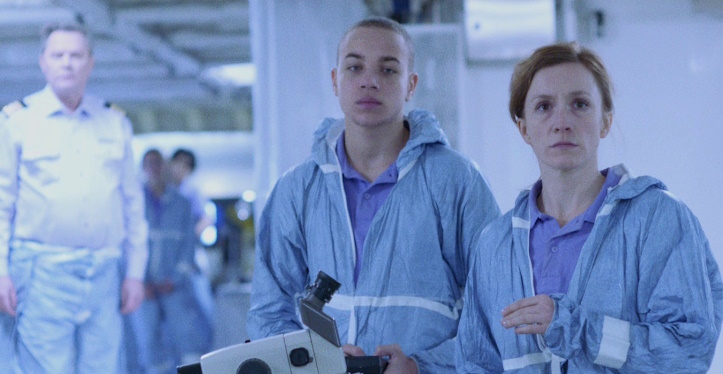
But eventually everyone comes to know the truth: There is no rescue, no course reversal. They’re all stuck on a ship that is driving into the deep black of space, never to escape or return. This is their life now, for what it is.
Instead of this being a Star Trek adventure where the crew figures out some technobabble way to fix the problem, Aniara presents a true no-win scenario and then documents what happens when a chunk of humanity is unexpectedly trapped forever.
Spoiler: It’s not good. Everyone tries to come up with a variety of ways to cope, including retreating into the Aniara’s version of the holodeck and eventually forming cults. But the despair is too overwhelming, and before long, suicides (and worse) begin to become commonplace.
This is not a happy movie. It’s not a happy scenario at all. These aren’t the most joyful people at the start of the journey, with many passengers and crew exhibiting body disfigurements (a weather ravaged Earth is suggested as the cause). The crew valiantly try their best to come up with temporary solutions and guidance, but no cruise ship is designed to be a generation ship.
As with, say, Passengers, the underlying question of this film is “How would I handle this impossible situation?” It’s not the worst place to be stuck for the rest of your life, what with food courts and swimming pools and arcades, but it’s still a prison that’s taken you away from family, friends, and the sensation of being on a planet. At least they had others to talk to and be a society, although they seem to be of the Mad Max Swedish variety.
What drags the viewer down here is that there’s virtually no attempt to look for any positive or pragmatic angle. Every character breaks down in a variety of awful ways, and nobody really comes up with a way for the community to bond together and, say, form a new “planet” that they now live on. Instead, the claustrophobia presses in, the future seems pointless, and by the end, it’s as bleak of a film as you might imagine.
While Aniara might be based on this famous book-long Swedish poem, it doesn’t seem to be that willing to invest much into its characters. I found everyone here flat and lifeless, with most everyone barely more than caricatures. Oh, the astronomer’s a drunk. The pilot’s a stoic. The captain is a tyrant. None of them seem particularly interested in trying to survive and thrive, so why should I, the viewer, care?
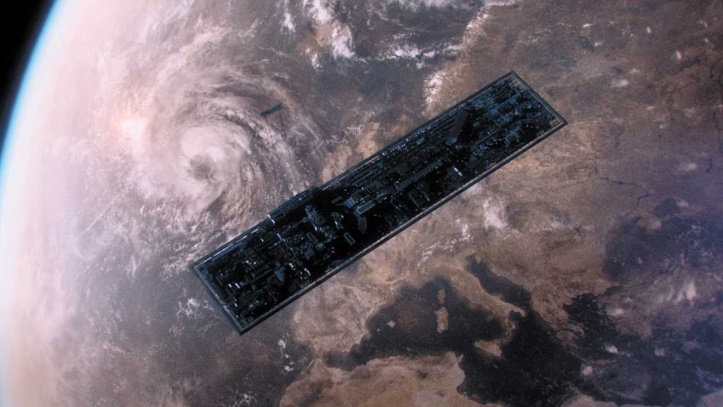
And while I’m expressing disapproval, I wasn’t that impressed with the spaceship itself. They obviously filmed in real-world concert halls, malls, and ocean liners with an extremely minimal scifi overlay. I think we saw the bridge like once, and the most interesting part was the space elevator ride up at the beginning.
Depressing as Aniara may be, this is fascinating science fiction that goes on a multi-year journey where you both want and don’t want to know what’s going to happen next. Honestly, it completely bummed me out for the rest of the day and into the night, so fair warning about the emotional impact of this. It’s a look at humanity without a grounding anchor, and while it’s not a movie experience I’d want to go through more than once, it was worth it. I think. Maybe.
 Mutant Reviewers