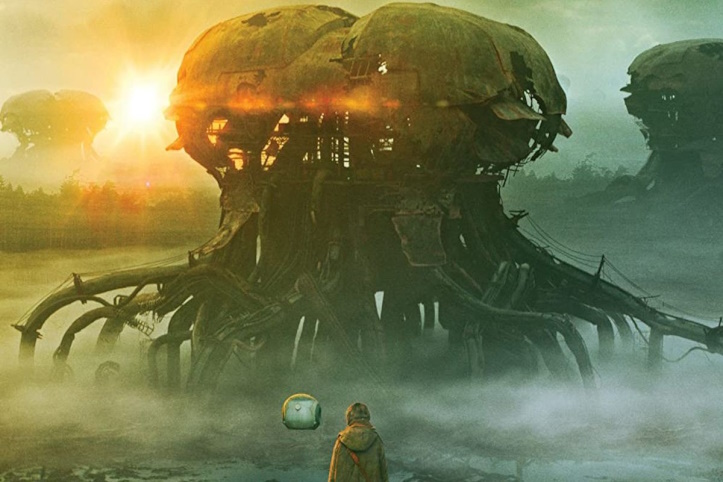
“Oh Vesper, you don’t know the cost of dreams.”

Justin’s rating: So nice to watch a foreign film in full English
Justin’s review: All right kids, it’s time for another underrated modern scifi outing from France! Welcome to earth in the “new dark ages,” with bio-engineering run amok and changing the very ecology of the world from the top-down. Only in the citadels is there any real civilization and food production, but the rest of the planet is a hopeless mess.
It’s out here in the decaying, altered mess that Vesper, a 13-year-old girl, ventures with her trusty floating robot sidekick to scavenge among countless genetic dangers. Her sidekick is actually her dad, controlling the drone from his paralyzed body.
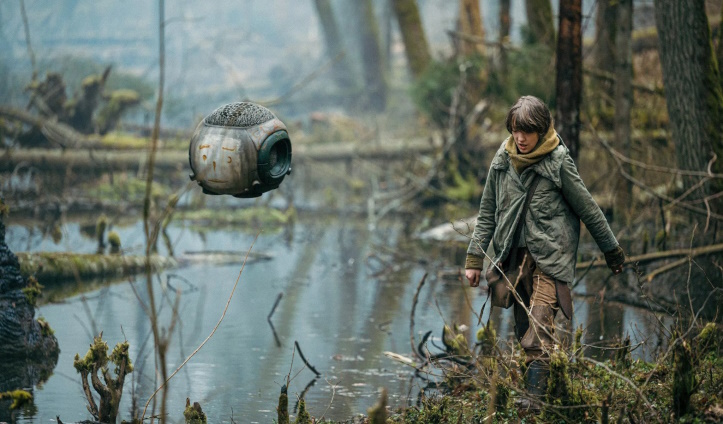
A great deal of Vesper’s world reminds me favorably of Annihilation — a transformed earth that’s rendered alien and unrecognizable with the radical shifts in flora and fauna. This is a much more far-ranging ecological disaster, however, and comes with changes in cultures and sects. This is a place where people trade in seeds and blood, not computers and high tech (even though there is that as well).
Mostly alone and still relatively young, Vesper is at a disadvantage in this post-apocalyptic setting. Yet her love for her father and her resourcefulness keep her moving forward and looking for solutions. It’s through her day-t0-day life that we learn more about this strange, wonderful, and terrible world — a world where her greatest talent is turning bacteria and genetics into helpful tools.
One day, Vesper comes upon a woman from the Citadel named Camellia, who is loaded with her own secrets. Camellia disturbs the balance of the area, especially as hunters from the Citadel arrive looking for her and the local slave master — a thug named Jonas — uses this as an opportunity to get revenge of a sort.
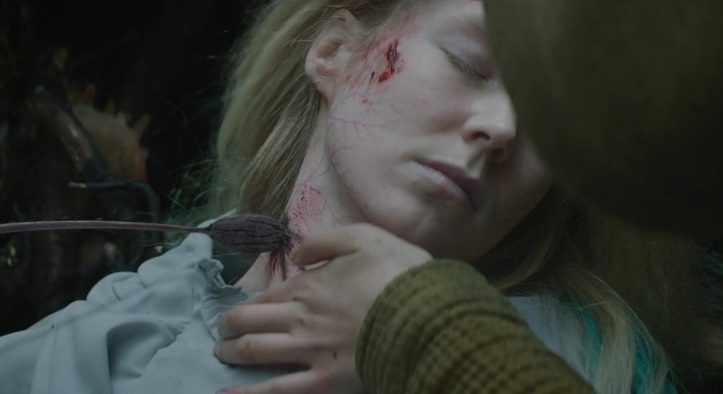
Vesper doesn’t do what most post-apocalyptic flicks do, which is to take characters on a journey to find a special thing or lead a revolt. It mostly stays in the area around Vesper’s home and focuses more on the juxtaposition between the ugliness and beauty of the world and people around her. It slows down to make you understand how these people live in such wilderness while sporadically giving us visual clues about the changes wrought upon this place.
That’s a great approach to take, especially considering how often post-apoc flicks unravel in the third act. It allows for more time to focus on deeper themes of sacrifice and tenacity, although it doesn’t necessarily fill that time with a sizable amount of story. This is a smaller flick in scope and tale, and much of the greater world — including a look into the Citadels — is denied to the viewer. Explanations are in short supply, so hopefully your imagination is up to the task.
In a lot of ways, Vesper feels like a brief prologue to a much greater movie that was never made. It’s quite good for what it is, but it did leave me feeling unsatisfied. Kind of like eating an appetizer when you really wanted to dine on a full entree.
 Mutant Reviewers