“When you grow up, your heart dies.”

Justin’s rating: If you think about it, a movie about detention should’ve been the dullest film ever made.
Justin’s review: I’ve been staring at a blank page for over 10 minutes trying to figure out how to start a review for The Breakfast Club. It’s easily one of the most famous ’80s movies, if not the top teen flicks of the era, and that fame brings with it lifelong devotion among some quarters and trendy backlash and patronizing criticism from others. It’s not now the edgy, semi-fringe film it used to be, and that makes it hard to approach it fresh.
It’s a rough movie in many spots and has been nitpicked to death for its perceived failings (Allison didn’t need a makeover rawrrr). But that roughness comes from a daring vulnerability — John Hughes tapping into universal teen themes and putting them on the screen, warts and all. It’s an authentic, not perfect, movie, and that’s why it’s special.
It’s 7:00 am, Saturday, March 24th, 1984. Five teens trickle into an otherwise empty Shermer High School to do eight hours in detention under the angry supervision of Vice Principal Vernon (Paul Gleason). What begins with small amusements and quiet boredom gradually opens up once the group figures out a way to get Vernon out of the room.
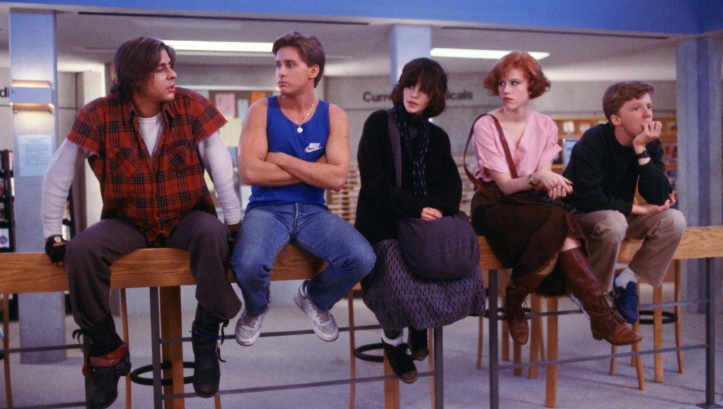
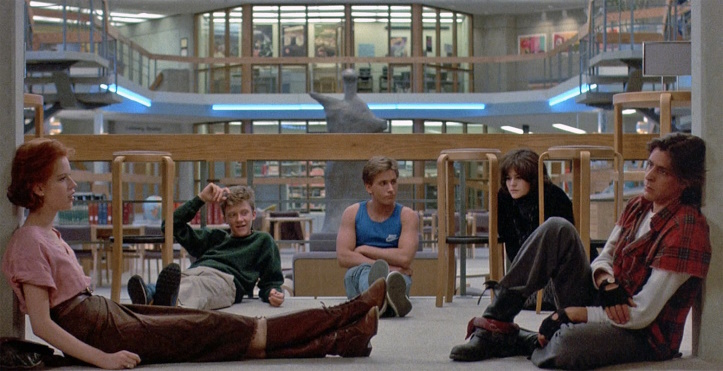
The titular “club” is made up of athlete Andrew (Emilio Estevez), human raccoon Allison (Ally Sheedy), nerdy nerd Brian (Anthony Michael Hall), prom queen Claire (Molly Ringwald), and angry bully Bender (Judd Nelson). With the exception of Claire and Andrew, none of them move in the same social circles and don’t have much in common — or so they think.
Early on, Andrew angrily tells Bender, “You don’t matter. If you disappeared right now, it wouldn’t make a difference.” In that retort, the central conflict of their lives are laid out. These teens feel like they don’t matter to each other, to their parents, or to the school leadership. In their own ways, they are hurting, lonely, and looking for connection with others who care.
And that becomes the mission of The Breakfast Club — a journey to connection. We go beyond the one-note stereotypes to nuanced depths of character. The group go on little escapades, entertain themselves, and most importantly, have some real heart-to-hearts. They open up about their home lives, why they got sent to detention, and what really makes them tick. Through these conversations, they see how societal conventions have kept them apart. They go from disconnected individuals to a club.
There’s so much to love about The Breakfast Club: The quotes, the silly little ways that they entertain themselves, the creative ways certain moments are framed, the joke that’s never finished, the iconic soundtrack, uncomfortable topics, the bonding moments, and the ability to turn from comedy to drama on a dime.
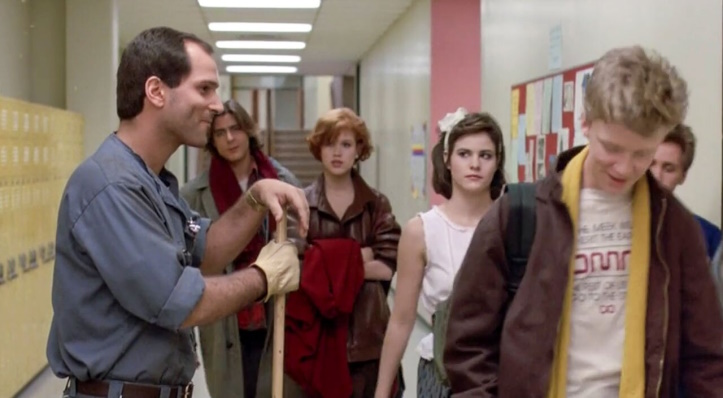
Oh, and there’s a really groovy janitor who might have it more together than anyone else here.
Think on this: This was only John Hughes’ second time ever as a director, and he pumped out a timeless classic for $1 million that took place mostly in a single room with five young actors. We’re told that it’s not cool to like this film any more in our enlightened, risk-adverse age. Well tough. I like this one a lot. It might not be my favorite Hughes film, but it’s one that I cherish.

Mike’s rating: Five out of five Neo-maxie zoom dweebies. (Extra points for the metal-head’s correct usage of the words “demented” and “condescend”).
Mike’s review: High school is, like it or not, the place where childhood ends. The realities of the inherent cruelty and brutality of life brought sharply into focus at a time when your perceptions are still rudimentary but your emotions are steadily becoming more complicated and confusing. Add to that the raging hormones and the near-addictive pull to social interaction with all the inherent stress that brings and it’s no wonder teenagers start to get moody and dramatic.
John Hughes’ films did something in the ’80s rather unheard-of for the era: he depicted these adolescents as complicated human beings with their own struggles, faults and inner narratives–as opposed to one-note stereotypes who main focus was “getting laid”. Nowhere was this on more prominent display than in this 1985 slice-of-life melodramedy, which in the space of 90 minutes deals with issues as complex and diverse as peer pressure, grade obsession, slut-shaming, parental abuse, bullying, mental illness, sexual assault and suicide — to admittedly varying degrees of success.
It’s hard to gauge the influence of Hughes’ magnum opus, but the fact that all of these issues remain achingly poignant speaks volumes about the universal appeal and timelessness of the film. For its enduring relevance alone, The Breakfast Club is rightly considered a classic.
The plot is deceptively barebones: We’re watching a group of teenagers over an afternoon spent in detention. At first everybody adheres steadfastly to the tropes of their clique; The troubled metalhead is a brash, vulgar instigator, the rich girl is vapid and image-obsessed, the jock is a meathead, the nerd is a goody-two shoes, and Ally Sheedy’s proto-goth Allison just hides in her over-sized hooded jacket and acts weird, not speaking until a half-hour into the movie.
The kids start talking, and things get interesting. The “criminal” is kind of disarmingly eloquent, the “princess” is kind of sweet, the “brain”, for all his book smarts, is kind of a bonehead, the “basket case” is an artistic soul whose chronic lies seem to be calculated to provoke introspection, the “athlete” is inwardly rebelling against the toxic masculinity expected of him and it’s eating him alive. As the day goes on, and the kids take full advantage of administrative neglect, presuppositions are questioned, prejudices are confronted, motives are examined and souls are bared (also weed is smoked). By the end of the day we’re watching five people who realize that they might actually like the people they’ve been stuck with better than the people occupying their respective social stations, and contemplating the frightening ramifications of that.
Paul Gleason is the sixth star of the film as Mr. Vernon; a typical pompous authority figure who long ago stopped thinking of these kids as human beings. You start out disliking him, but you can’t help but feel a little sorry for him as Bender mercilessly dresses him down, taking endless shots at Mr. Vernon’s clothes, his competency, his imagined coolness, in an ongoing attempt to undermine his authority. Vernon does an admirable job of keeping his cool and asserting authority in the face of the endless mocking. The day progresses and ever so slowly the facade of his professionalism cracks as Bender gets under his skin and he gets more condescending, petty, and mean. It’s a steady and gradual downward spiral, but when Vernon gets Bender alone in a supply closet and threatens to beat him up in a super-tense scene, the shock is still palpable.
In 2018, more than a few script choices by John Hughes in his ’80s teen phase have been rightly put under the microscope and found to be troubling (I’m looking at you, Long Duk Dong). The Breakfast Club is no exception. Allison’s out of nowhere makeover to become more classically pretty (what was wrong with her before?) suddenly drawing the attention of the cute jock boy is somewhat vomit-inducing. Brian’s contemplation of suicide is glossed over and rather quickly dismissed.
In a scene that’s played for laughs (and features a shot up Molly Ringwald’s skirt), Bender unapologetically commits sexual assault only for his victim to fall in love and kiss him at the end of the movie. While the first instinct might be to dismiss these choices as “it was a different time,” and just enjoy the film for what it was and is, I think it’s a better response to instead point out these cringe-worthy moments and talk about them and the kind of society that they were allowed to flourish in. Those conversations are worth having.
A few words about the movie’s framing device: The opening narration illustrates the movie’s emotional arc perfectly; establishing the stereotype of each of our detention-going miscreants in short order and then just as abruptly chastising the very idea that these labels define the kids they’ve been assigned to, right away differentiating TBC from a million other “high school” movies. As we’ll learn by the end of the film this narration is actually part of a longer essay—a pointed middle-finger to the abusive authority figure, punctuated with a delightful non-sequitur. This movie taught us that we are all more than just the simplest terms with the most convenient definitions, and the more we take the time to delve into the inner workings of the people we interact with, the more our similarities start to outweigh our differences.
That, and don’t mess with the bull. You’ll get the horns.
Intermission!
- Great choice on the credit font
- The burned out locker is nice foreshadowing
- “You see us as you want to see us. You see us as a brain, an athlete, a basket case, a princess, and a criminal.”
- I always love Bender walking right in front of the car without looking
- Bender quietly bullying Brian out of his seat
- Eight hours seems like an excessively long detention
- “Does Barry Manilow know you raid his wardrobe.”
- “If you gotta go, you gotta go.” *zip*
- Vernon’s got a swimsuit calendar on the wall in his office
- “If you disappeared forever right now, it wouldn’t make any difference.”
- Allison doing the finger guns
- “You wear tights?”
- “Screws fall out all the time, the world’s an imperfect place.”
- “If he gets up, we’ll all get up, it’ll be anarchy!”
- Bender mouthing “I’m cracking skulls”
- Dandruff makes good snow
- The soundtrack really likes Allison’s “HA!”
- “I can see you pushing maximum density.”
- Allison stealing the knife from off-camera
- “I’ve seen her dehydrate, it’s pretty gross.”
- Sushi for lunch, yum
- Locker guillotine
- “Slob!” “My maid’s on vacation.”
- Anyone else think Vernon should’ve just played basketball with Bender?
- “Impossible sir, it’s in Johnson’s underwear.”
- Andrew screams break the door? Somehow?
- Everyone going through each other’s stuff
- “They ignore me.” Such a heartbreaking confession.
 Mutant Reviewers