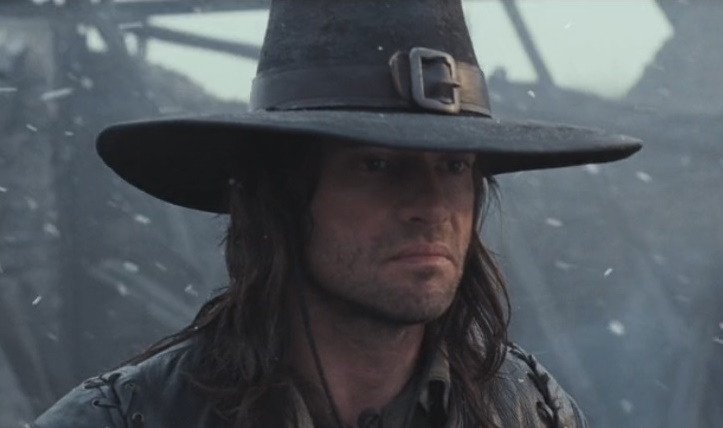
“There was a time when the world was plunging into darkness. A time of witchcraft and sorcery, when no one stood against evil. That time… is over.”

Sitting Duck’s rating: Six out of 10 flintlock pistols
Sitting Duck’s review: What immediately comes to mind when you hear the name Robert Howard? For the vast majority of you, it’s going to be Conan the Barbarian. But if you’re like me (and I know I am), it’s his other major creation, Solomon Kane, which introduced me to Howard’s writings.
For those of you unfamiliar with the man they call Kane, here’s an excerpt from “The Moon of Skulls” that should explain things: “He was a man born out of his time — a strange blending of Puritan and Cavalier, with a touch of the ancient philosopher, and more than a touch of the pagan, though the last assertion would have shocked him unspeakably. An atavist of the days of blind chivalry he was, a knight errant in the somber clothes of the fanatic. A hunger in his soul drove him on and on, an urge to right all wrongs, protect all weaker things, avenge all crimes against right and justice.”
Even though Kane is described as being a Puritan, nothing about the character has ever struck me as being intrinsically associated with that sect. My guess is that, since Howard was going with the character being a religious zealot, he thought making him a Puritan would fit the bill.
Though with all the supernatural hijinks going on, it could be argued that having him as a Catholic might have worked better (writer/director Michael Bassett seems to at least subconsciously agree, but more on that in a bit), especially considering his knight errant aspect. Also, Catholicism has something of a tradition of religious mysticism that the various Protestant sects which cropped up during the Reformation either lacked or actively rejected. But Howard says he a Puritan, so a Puritan he is. What with the legacy of Nathaniel Hawthorne and Arthur Miller, Puritans can use all the favorable publicity they can get.

Our story opens at an Ottoman stronghold in North Africa, which is under assault by privateer captain Solomon Kane (James Purefoy) and his crew. While initially they have an easy time of it, matters go sideways within the inner sanctum as Kane’s men are snatched away into mirrors by shadowy figures.
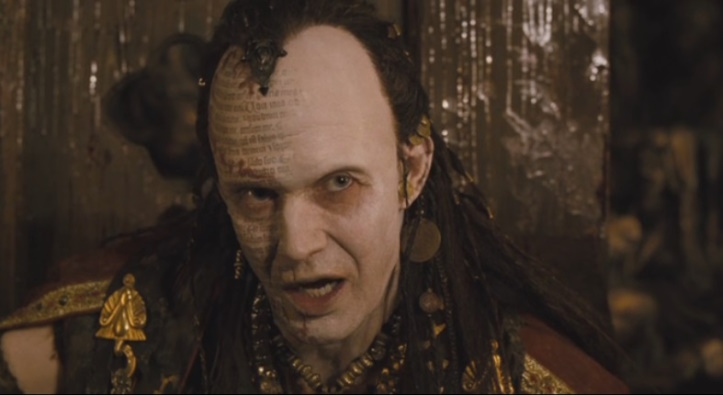
Upon reaching the throne room, Kane is greeted by a demonic being that tells him of how his wicked deeds have doomed his soul to damnation 00 and it has come to collect. However, Kane won’t go gently into that good night and makes his escape. Yet even with all Kane’s bravado, the demon’s pronouncement has left him troubled.
Cut to one year later, where Kane has sequestered himself at a monastery and given away his ill-gotten wealth to the Church. But at this point, the abbot tells Kane that he can no longer hide away from the world and must go forth. In his travels, Kane witness much in the way of cruelty and misery and often finds his vow to not resort to violence being sorely tested.
Kane acquires some solace upon meeting the Crowthorns, a family of Puritans who are setting out to the Americas to start a new life, with whom he travels. But their journey is not without incident. They come across the remains of a witch burning where the witch did some burning back. When the witch reveals herself, she places a mark on the Crowthorn daughter Meredith (Rachel Hurd Wood).
Later on, they run afoul of thugs in employ of the sorcerer Malachi (Jason Flemyng). Though Kane attempts to resolve the situation peacefully, the thugs aren’t having it. Noticing the witch’s mark on Meredith, they take her and assault the others. With talk having failed him, Kane vows to bring back Meredith and take down Malachi and his lackeys in the process, while facing the consequences of returning to his former use of bloodshed.
First things first. James Purefoy was perfect casting for Kane. Not only does he match the visual depictions on book covers and seen in the comic book adaptations, but his manner fits with the grim, dour personality of the character. Even though this is occasionally undermined by some hacky dialogue.
As with Conan the Barbarian, rather than adapt any of Howard’s material, this is an origin story intended to set up for a planned series that never came to be. Kane as written by Howard has even less background hinted at compared to Conan, often seeming to have always been a purveyor of righteous vengeance. While quite liberating proposition for a Tinseltown hack, it has the potential to go so horribly wrong.
With that said, presenting Kane as having once been a privateer is not that bad a starting point. It serves to both establish his wanderlust and his ease at dispensing violence. The manner in which his change of heart after encountering the demon is presented is perhaps a bit over the top, but not unacceptably so.
You know what was unacceptably over the top? The crucifixion scene, that’s what. The events that lead up to and during it are rife with heavy-handed symbolism and screenwriting cliches that occasionally veer into Narm territory. This gets outright silly when Kane yanks his wrists through the nails to free himself (did I mention this is rated R?).
Crucifixions are already pretty nasty, and that sort of damage is not easy to recover from with 17th century medical technology. While it’s strongly implied that magic was used to speed Kane’s recovery, it ends up feeling like a cheat. Overall, this is a pretty serious blemish on what is otherwise a competently executed damsel rescue scenario.
Like any work of fiction concocted by a modern mind employing a period setting, Solomon Kane has its share of anachronisms. While the average filmgoer won’t notice or even particularly care, there are a couple that happen to grate my cheese. The first is how a Catholic monastery would not have been able to operate so openly within England at that time in its history.
The other comes in the scene where Pa Crowthorn provides Kane with a crucifix, which he then uses to expose the witch’s true identity. One of the key traits of the Puritans (and where they got their name) is that they believed that the Church of England retained too many aspects of the Catholic Church, which they sought to purify from that establishment. This would include the wearing of religious bling like crucifixes hung around one’s neck.
While more overt than the Appalachian folk magic of John the Balladeer, magic in Solomon Kane is a force that is often sinister and certainly not to be engaged in lightly. This is an aspect the movie pulls off well, as displays of magic are creepy and unsettling. Other special effects work is competent enough, featuring a judicious mixture of practical effects and CG.
Meanwhile, the fight scenes avoid the use of shaky cam, which has been the bane of 21st century action cinema of all stripes. It also takes full advantage of the film’s R rating, with plenty of lopped-off limbs and gratuitous splatter to be had. So if you’re squeamish about that sort of thing, you might want to pass on this one.
Ultimately, I’m feeling conflicted over Solomon Kane. Had it managed to succeed at the box office, I might have been willing to give any sequel that came along a chance to see what direction it would have taken. But as a standalone, the not insignificant number of flaws make it so that I can’t really summon up much enthusiasm for it.
A final thought. Back in the 1970s, Hammer Films was seeking to reinvigorate their Gothic horror movies by creating franchises where the hero was the headliner instead of the monster. Their first effort was Captain Kronos: Vampire Hunter, which flopped like a freshly caught walleye on a lakeside dock and furthered Hammer’s tragic decline. That’s a shame, because Captain Kronos was an excellent movie with the brilliant concept wherein there are a wide variety of vampires with different strengths and weaknesses out there.
This is an approach that could have had some legs to if only audiences had been willing to give it a chance. Another notable aspect is how the action was more of the swashbuckling variety. In the parallel universe created in my demented imagination, this could have led to a series of Solomon Kane anthology films. Just think of it, Solomon Kane given the Hammer treatment! But whether it would have been brilliant or disastrous, it’ll have to remain as a Might-Have-Been.
 Mutant Reviewers
Okay, I’m a bit put off by how whatever program that gets used to decide which reviews to link to at the bottom decided that Howard the Duck would be a fitting choice.
Note to self: Never mention Robert E. Howard in a review again.
Ha ha! That took me a moment.
Dear gods, I love this movie.