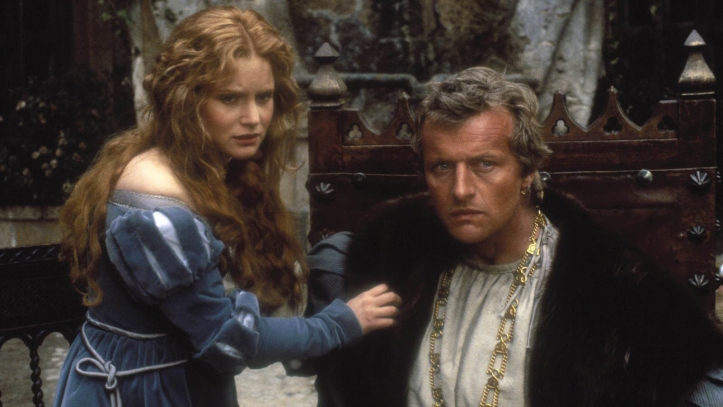
“My father’s half-dead. My bride has been captured. And you’re babbling on about seedlings?”

Flinthart’s rating: 7 out of 10 plague boils
Flinthart’s review: Having invoked Verhoeven recently in another review, it occurred to me I should maybe write up this cinematic oddity which I actually caught in its first big-screen run, back in the day. And when I say ‘oddity,’ I am not kidding.
For starters, Flesh and Blood is apparently Verhoeven’s first English-language film. He went on to produce utterly amazing films like RoboCop and Starship Troopers, edgy mainstream works like Basic Instinct, and trainwrecks like Showgirls (say what you will of Verhoeven’s work, but it is very rarely boring).
Then there’s the cast. Set in the warring city-states period of Renaissance Italy, this film involves a lot of sword-fighting and bloodshed, but the writing/plot is such that nailing a specific protagonist is difficult. We’ve got Tom Burlinson (yes, of The Man From Snowy River) playing Steven, the scholarly son of the nobleman Arnolfini, who is parted from his fiancé Agnes (Jennifer Jason Leigh) by the hard-bitten mercenary Martin (Rutger Hauer). And any of these three could genuinely serve in the role of protagonist. All three have distinct character arcs… but then again so does mercenary leader Hawkwood (Jack Thompson) although he doesn’t get quite as much screen time.
The story itself is simple enough. Arnolfini has lost his city to a coup. He hires condottiere Hawkwood and his crew of hardened mercenaries to retake the city, promising the rough-and-ready fighters that they can plunder the place. But once the city is taken, Arnolfini gets cold feet as the mercenaries extract their cash with considerable prejudice.
Meanwhile, Hawkwood has accidentally near-killed a beautiful young nun, and is desperate to save her — so when Arnolfini promises him fiscal support and a comfortable retirement Hawkwood is willing to betray his soldiers and see them driven out of the city.
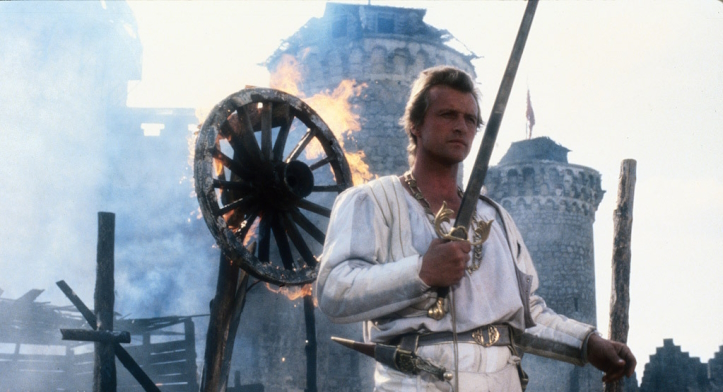
This sudden betrayal rather irritates the mercenaries, and a small band led by a ‘cardinal’ (well, he dresses in red, delivers Catholic rites, and follows ‘signs from God’) and by fighting machine Martin decides they’re going to get revenge. By chance, they plunder a caravan carrying Agnes to her betrothed Steven — and suddenly the movie is all about Agnes trying to find a way to survive as a prisoner to these rough, dangerous, amoral soldiers and their camp followers.
The very attractive and intelligent Agnes (and it’s a Verhoeven movie, right? Basic Instinct? Showgirls? If you think it’s going to lack for on-screen sex, violence, and nudity, you must be thinking of some other Verhoeven) manages to charm Martin, and then helps Martin and his band take the castle of some nearby random nobleman with her insider knowledge of such places. In order to avoid being turned into an all-purpose camp-follower like the other women attached to Martin’s little band, Agnes deliberately deepens her relationship with Martin, and introduces him to some of the benefits and practices of Renaissance-period High Society.
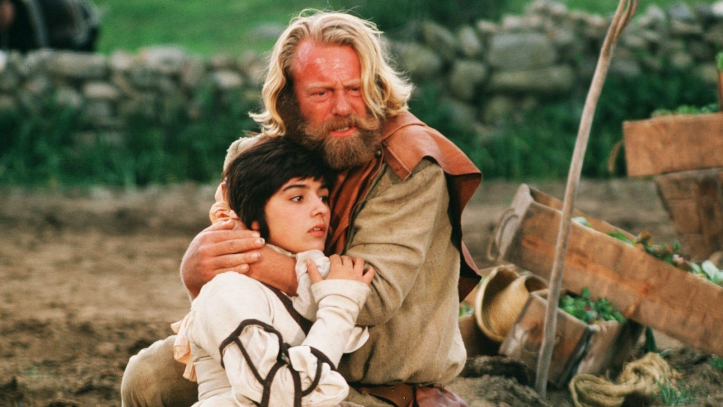
Naturally, Steven isn’t having any of this. Tracking Martin and Agnes to their hideout, he and his father force Hawkwood to come out of retirement and lead an attack on the castle. Steven brings his innovative scholarly knowledge into play, making him a tactical challenge for Martin. But Martin is up to it, borrowing an idea from Steven himself to thwart the attack, and capturing Steven in the process. But just when it looks like Steven’s time has come (and exactly who does Agnes really favour? Steven? Martin? It’s hard to tell.) Hawkwood throws a spanner into the works — or rather, throws pieces of a plague-infected dog over the castle walls, terrifying Martin’s band and setting the stage for a final struggle between Martin and Steven, with Agnes in the balance.
This is an interesting film in a lot of ways. As an early Verhoeven piece, it’s instructive to notice the elements that will go on to make his later films memorable (and not just sex, nudity, and violence). There are a number of intriguing themes at work as well: Agnes’ struggle, as a woman, to survive, outwit and manipulate Martin and his crew could be read as a (distinctly rough-edged!) piece of empowerment-feminist exploration.
Then there’s the clash between the old and the new: Steven’s Renaissance-science driven ideas on medicine and warfare become pivot-points to the narrative in several places, and Steven and Martin are explicitly held up by Agnes as being ‘the same man’ — one old, one young and new. Thus the struggle between these two becomes a clash of ideas and cultures.
Nevertheless, with so very much going on and so many central characters, the film suffers from a lack of focus. It’s clear Verhoeven didn’t want to present us with “good guys” and “bad guys,” which I personally appreciate. But in spreading the story across those three (four?) protagonist characters, we wind up with a tale that somehow doesn’t deliver the punch that perhaps it should.
Still, Flesh and Blood is very watchable. High production values, a startling cast (Bryon James is in there too, as one of Martin’s associates) and a vigorous, action-driven story mean that there’s almost always something going on to hold your attention. It’s far from a masterpiece, but it remains an interesting chunk of cinema which clearly hints at the greater works that were to come.
Intermission!
- Wow! Tom Burlinson with a Renaissance mullet. Okayyy…
- Jack Thompson is a mercenary captain in Renaissance Italy? Watch him channel his J F Thomas from Breaker Morant, but this time in full plate armour.
- Jennifer Jason Leigh is 23 in this? Wouldn’t have guessed!
 Mutant Reviewers