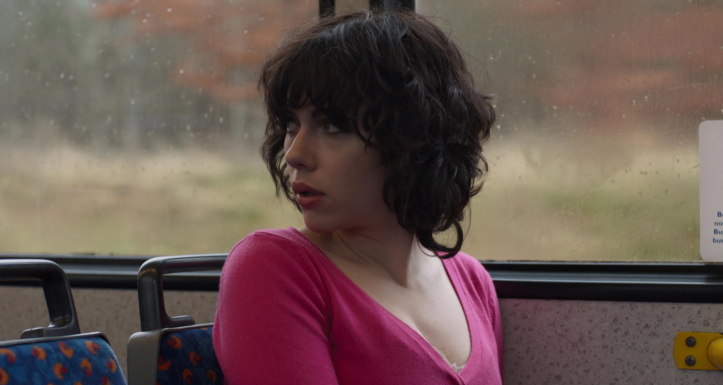
“Do you want to look at me?”

Flinthart’s review: Where to start? I mean, on the surface, Under the Skin is ideal Mutant fodder, right? It’s a strange, low-budget independent film about a young woman who is actually… no, spoilers, dammit. But she is traveling anonymously around Scotland, picking up men off the street and taking them to some kind of… some kind of featureless dark space where they sink into… uhh…
Wow, yeah. Can’t treat this one the usual way.
So let’s say this: not all weird independent science fiction movies are rubbish, dear readers. Some of them are thoughtful, disturbing, unsettling, engaging, ambiguous, threatening, and maybe even dangerous — and Under The Skin is all those things.
The first of Glazer’s films that I saw was the near-legendary Sexy Beast (2000) featuring an absolutely blood-curdling performance from Ben “Gandhi” Kingsley as a Brit gang enforcer so brutally hardcore that he comes across as a genuine force of nature. Sexy Beast was remarkably well-written, beautifully shot, tightly directed, and featured a completely unbeatable cast (Ray Winstone and Ian McShane as well as Kingsley!) and when I watched it, I had absolutely zero idea it was Glazer’s very first feature-film directorial outing. In fact, I still have trouble believing it — but if you need proof, go hit up IMDB. It’s right there, in print: before Sexy Beast, there’s nothing but TV commercials and rock videos. Under The Skin is only Glazer’s third feature, and the fact that it’s such an unnerving, powerful piece of work has to be an indication of just how good the man is.
How good? Well, after Sexy Beast, he did Birth in 2004, working with Nicole Kidman at the height of her career. And for Under The Skin, he somehow managed to engage none other than Scarlett Johansson, who had just done the first of the Avengers movies the previous year. Despite that Glazer’s film had a budget of only $13 million, despite that Glazer was nothing like a household name, despite that the film was to be shot on the streets of Scotland and the story itself was bizarre and ambiguous, and despite the fact that Johansson was required to appear fully nude as some kind of… alien sex predator thing, she dove right in and did it.
And holy spunt, didn’t she do it well?
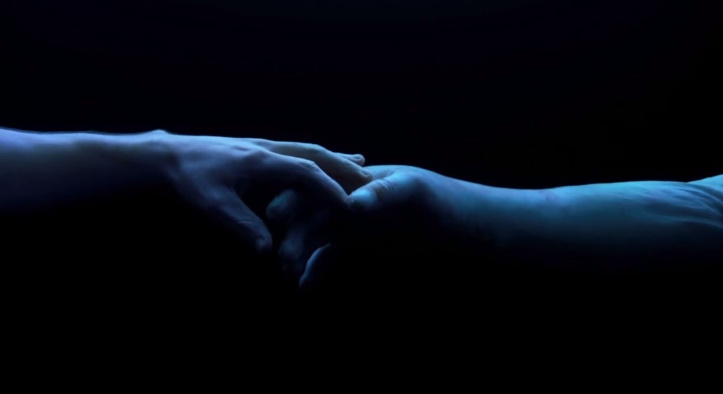
Look, there’s no way to review this film without giving away the central narrative. As the film opens, a mysterious motorcyclist collects a young woman (who is probably dead) and Scarlett Johannson dons the woman’s clothing. She then drives around Glasgow in an anonymous white van, picking up men at random, chatting them up — and those who take the bait are driven to a dilapidated building wherein they are… killed? Probably? By sinking into some kind of black fluid which the progressively more nude Johansson just walks over the top of?
Now that’s out of the way, we can dive in a little deeper. As the movie goes on, it becomes clear(ish) that Johansson is not actually human. It seems most likely that she’s some kind of alien construct, gathering information about humans and humanity by this process of collecting men and dropping them into the black fluid. In her efforts, she is aided and abetted by a small group of anonymous, human-appearing motorcyclists who follow her about, tidying up behind her.
Johansson continues to collect victims up until she engages with a young man suffering from neurofibromatosis (the Elephant Man disease), but rather than letting the Black Fluid claim him, she releases him and takes off for the countryside. She engages in more human behaviours as she goes, but soon discovers that she can’t actually eat: taking in food makes her retch. When a sympathetic male stranger takes her in, and they eventually get around to trying to have sex, Johansson (look, her screen credit for this film is ‘The Female,’ I’m gonna keep calling her Johansson, all right?) cries, freaks out, grabs a lamp and turns away for a good long examination of her genitals.
Presumably what she finds does not reassure her. She runs off into the forests, where she encounters a creepy forestry worker who chases her, attempts to assault her — and tears off chunks of her skin, revealing some kind of black, latex-like, featurelessly humanoid construct underneath. Horrified (and guilty) he sets her alight and flees — and eventually, the enigmatic motorcyclists come along to clean up the remnants.
So what makes this movie worth seeing? Well, honestly: it’s so very unsettling that it’s absolutely brilliant. Under The Skin, despite being a box office failure (and we Mutants don’t mind that, do we?) has received a tremendous amount of critical acclaim. The very fact that it gives us so little to work with is the core of its brilliance. It is a film about isolation and alienation, about being an outsider, and Glazer’s direction places the viewer squarely into that space. Like The Female herself, we have no context. We know by the accents that the location is Scotland, but we know nothing more. Who is The Female? What is she doing? Why is she deliberately engaging with random men on the streets? Who are The Motorcyclists? We get no hard and fast answers, which forces us to engage with the film, to watch and rewatch, to pay attention to the clues and the cues and come up with our own theories as critics around the world have been forced to do. And this, readers, THIS how cinematic immersion is achieved.
If “Art” is about producing an emotional response, Under The Skin is a resounding success. I just rewatched it with some friends and my university-age daughter, and I asked her how the film made her feel. She said: ‘I felt anxious the whole time. I felt like something terrible was going to happen at any moment,’ and quite honestly, that’s an excellent summary of the emotional context of the movie. Yet it’s not a horror movie, or at least the horror fans wouldn’t recognise it as such. And it’s not “scifi,” even though it clearly invokes fantastic tropes and ideas. It is a film about the nature of human identity, in which a near-perfect mimic of a human being gradually becomes aware of her own inhuman identity against the backdrop of the human creatures upon which she apparently preys. It is a journey from slickly performative human-like behaviour to raw, bleeding confusion in an altogether alien entity which paradoxically becomes all the more human as it loses its capacity to pretend and to emulate.
I could make a big deal out of directorial choices and scriptwriting, and I probably should because Glazer is not only the director but a co-writer, and this sparse, stripped-back gem of anxiety and trauma owes its very existence to him. But at the same time, I simply cannot say enough about Johansson’s work on this film. Without exaggeration: it’s breathtaking.
Consider: an A-list actress and a ‘sex symbol’ at the peak of her career, Johansson chose this disturbing, dark role in a minor independent film which demanded not only the physical nudity, but the kind of vulnerability, approachability, and genuine humanity that made it possible for her to engage with random Scottish men from the driver’s seat of her van, or in a nightclub in a wholly believable fashion despite her admitted ‘star power.’ And how very believable she is! For though it’s hard to believe, Glazer wanted those interactions to be as real and as raw as possible, and so many of those scenes are completely unscripted, simply ad-libbed by Johansson in response to men who are literally just random by-passers. (After such scenes were shot, Glazer and the production company then contacted these non-actors, explaining the situation, getting permission to use the footage, and covering the details.)
I won’t lie. When I first saw this at the cinema, the idea that Scarlett Johansson could drive up to a man on the streets of Glasgow wholly unrecognised, ask him for directions, banter with him, and try to lure him into the van with her — well, you have to see it to believe it. I mean, here’s Marvel’s Black Widow doing what to my ear sounds like a pitch-perfect upper-class British accent, riffing off the trivial bits of personal material offered by complete strangers who are totally ignorant of who she is or what’s going on. It’s just my personal opinion, but I think someone who can pull off that kind of thing while simultaneously playing one of the most instantly recognizable characters in one of the biggest box-office hits of this century so far must have a once-in-a-generation kind of talent, and I salute Ms Johansson for her artistic courage and her undeniable ability. Even if this film had nothing else to recommend it, watching those improvised scenes alone would be revelatory.
But of course, there’s so much more. Still, I’ve said enough. It’s up to you, now. If you’re a fan of daring, thoughtful, provocative, risky cinema, you owe it to yourself to see Under The Skin. The work of a genuinely remarkable director, highlighted by an incredible performance from an A-list actor who is clearly far, far more than just a box-office draw, Under The Skin is a challenging, unnerving, disturbing piece of cinema which will leave you thinking about it for a long time afterwards.
No snarky comments at all about this one. It’s brilliant.

Justin’s rating: Avengers, disassemble
Justin’s review: Most movies that most people watch are safe. When I say “safe,” I mean that they make sense, explain themselves, and are relatable. You understand the plot, you get the characters, you identify the tropes, and your life more or less goes on as it always has.
People like safe movies. Yet there are unsafe ones out there — ones that are weird, abnormal, abstract, surreal, unconventional, and mind-bending. You wander into an unsafe movie, and you best be prepared with an exit strategy to regain sanity afterward.
Under the Skin may sound a bit like a knock-off Species — a gorgeous woman who’s actually a lethal alien looking to mate — but it’s as uncommercial as they come. Honestly, it’s more like an art piece that wants to play with your emotions more than give you a narrative to understand.
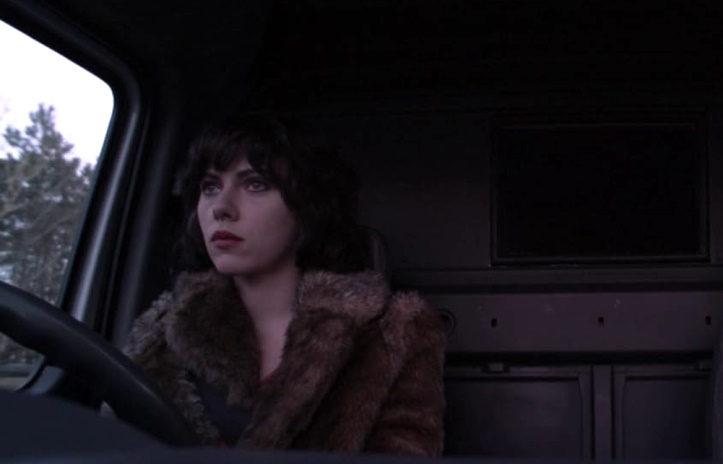
Filmed before The Avengers truly made her famous, Scarlett Johansson plays the unnamed Female, an extraterrestrial who’s assumed a human form and is on the prowl in her cargo van for isolated Scottish men. She brings them back to her apartment where they disrobe and then slowly fall into an inky black void that the Female walks on top of. Later, we see the void preserving the men for a while before sucking their innards out and leaving their skin behind.
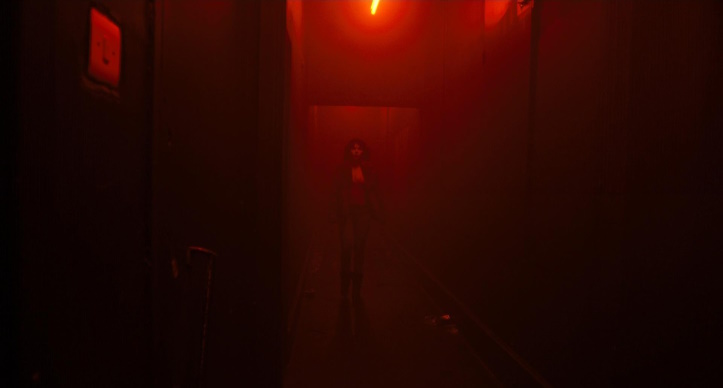
Gradually, the Female starts to empathize with her prey. It’s undeniable that the Female is attracted to elements of our society, which makes it even more heartbreaking for her when her alienness makes it impossible to fully partake. And this growing conflict of interest serves to ignite some friction with her handler, a mysterious man on a motorcycle who cleans up after her abductions and participates in a few himself.
But this is me trying to coherently make sense of what is nearly two hours of an unsettling soundtrack, unexplained symbolism, and unclear meaning. Under the Skin could be commenting on a whole lot of things, or it could be simply portraying a truly alien visitor first absorbing and then identifying with the culture its visiting. I have no idea, to be honest. I’m not that smart.
If you were to press me, though, I might stammer out something regarding the title. There’s what we see with our eyes — the “skin” — and what’s actually true underneath. Sometimes there’s integrity between the two, often times not. In this film, nice-seeming guys can end up being hooligans. A severely disfigured person turns out to be a person worth getting to know. And, y’know, aliens who can look like Johansson but care not one whit for you.
I can’t even decide if this is truly daring and provocative scifi or a total snooze fest. Artsy movies can be both. All I can tell you is that it’s not like the others on your Blu-Ray shelf.
 Mutant Reviewers