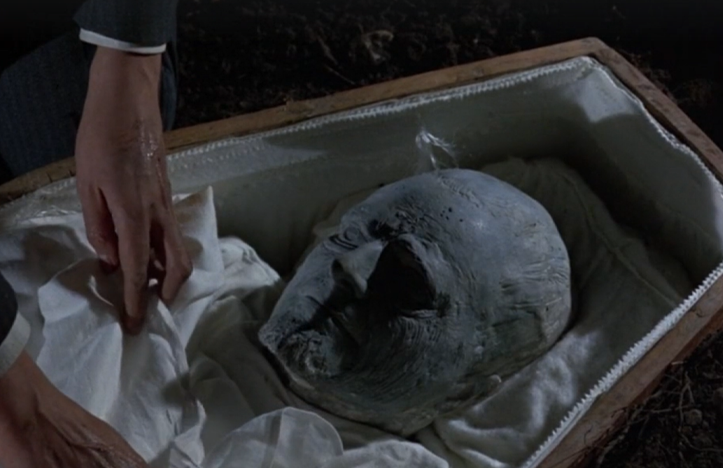
“The proper word is Gorgonized, which literally means ‘turned to stone.’”

Drake’s rating: This is part of the movie swap. Sitting Duck sent me this one and I sent him a Burt Reynolds flick from the ‘70s. He doesn’t speak to me anymore.
Drake’s review: So when you think of a Hammer film, what do you think of? Dracula, right? No doubt as played by Christopher Lee, with his deadly fangs bared near the neck of a young actress whose period costuming involves the requisite plunging neckline. Or maybe you came to Hammer through the side door, where Lee lurches along as the Mummy, carrying a young Yvonne Furneaux (whose neckline is slightly more modest, this being 1959). Maybe you even think of Lee as Frankenstein’s monster, menacing his creator in lieu of a nubile young maiden (with Peter Cushing keeping his neckline high and buttoned, thank you very much).
The Gorgon gives us none of that. Instead of one of the classic movie monsters we have instead a creature from Greek mythology, transplanted to a pre-World War I Germany, where it menaces the populace of a local village until Christopher Lee comes to the rescue.
Madness, I tell you!
We see the results of the Gorgon’s work early on, as a young woman is killed by the creature while she searches for her boyfriend one night. Apparently, he had run off to ask her father for permission to marry the girl. Her body is brought to Dr. Namaroff (Peter Cushing, At the Earth’s Core) for an autopsy, which is more than a bit unlikely since the poor girl has been turned to stone.
The local polizei place the blame on her boyfriend, who is found dead himself, his non-stone body hanging in the woods. The girl’s granite-related demise is conveniently glossed over at the inquest and the deceased boyfriend is found responsible for a murder/suicide, a verdict unacceptable to the boy’s father, Professor Jules Heitz (Michael Goodliffe, Von Ryan’s Express). Taking it upon himself to solve the mystery and clear his son’s name, Heitz delves into the secrets of the village himself, certain that a Gorgon named Megaera is behind the stoning.

And I’m going to have to interject here, because we’re only a few minutes into the movie and it’s already taking all sorts of liberties with Greek mythology. So, yes, there were three Gorgons, the most famous of which was Medusa, who was killed by Perseus. The other two were Stheno and Euryale, whose mythological fates are unknown, but one could make a case for one of them fleeing the Mediterranean to avoid the multitude of monster-hunting Greek heroes that proliferated throughout the region in days of yore. The name Megaera, however, belonged to an Erinyes, also known as a Fury. Granted, Stheno or Euryale might have decided that a fresh start in Germany required a new identity, but randomly grabbing one already in use by a goddess of vengeance seems like a bad idea.
In any event, Heitz investigates the deserted Castle Borski in search of answers, but only finds his doom as he comes across the Gorgon as well. He’s fortunate in that his stoning isn’t instantaneous, however, and as he slowly turns from literature professor into garden statue (which is accompanied by some very nice makeup effects) he jots off a note to his other son, informing him of the goings-on in the little village of Vandorf.
So at thirty minutes in, The Gorgon is channeling some real Game of Thrones energy. It’s hard to get too invested in any possible protagonists when they die like flies just minutes after their introduction. And that’s not helped by the fact that son number two, Paul Heitz (Richard Pasco) is a rather placid lead, a fact brought to stark attention when Christopher Lee finally shows up in the third act and effectively steals the movie as Paul’s mentor, the much more dynamic Professor Karl Meister.
The Gorgon isn’t a bad movie. In fact, it has very good production values, nice costuming, veteran direction by Hammer regular Terence Fisher, and of course both Lee and Cushing giving it their all. None of that can overcome a weak plot, however, which takes great leaps of logic to explain away or ignore the fact that people are, y’know, turning into stone! It wants to turn the Gorgon creature into something of a Dracula figure, lurking in a crumbling castle and taking advantage of the nearby villagers, but that trope works much better with a vampire who needs to feed on the local populace to survive, than a creature who turns her victims into statues just for the kicks.
The Gorgon does have all the hallmarks of a Hammer film — an intense (perhaps mad) doctor in his laboratory, dark castles, digging up graves in the moonlight — but it all feels misplaced, like tropes taken from other movies both because they’re expected, and to fill out the runtime. This one is in no way a waste of time, and I’m glad to have seen it, but it’s certainly a far more mundane affair than one would expect from a Hammer film of the time, with nary a plunging neckline in sight.
Intermission!
- First the girl is turned to stone, then a careless attendant wheels her in on a gurney and knocks one of her fingers off. How undignified!
- Christopher Lee was only in his early 40s here, just a few years older than the actor portraying his student, so they have him sporting a distractingly bad mustache/wig combo to make him look like an aged professor. And then Lee goes on to have a more energetic performance than the rest of the cast combined.
- We’re well into the last fifteen minutes of the movie and Lee and Cushing finally have a scene together.
- Now they’re making a big deal of the full moon. Is the Gorgon a lycanthrope? Like I said, the misplaced tropes run thick here.
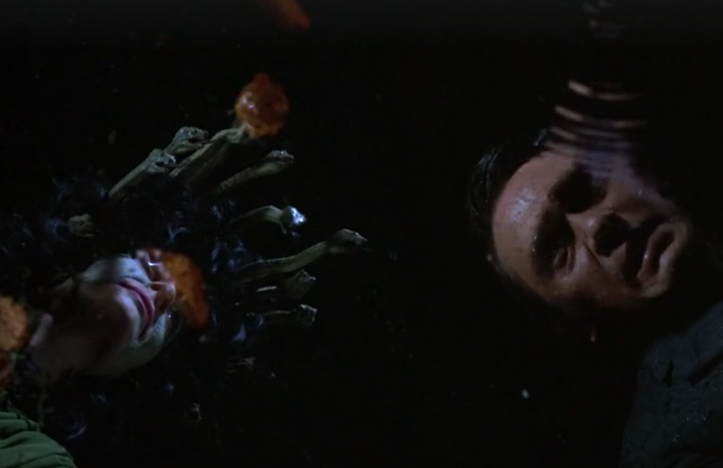
- OK, so maybe you shouldn’t look directly at the lady with the snake-filled hair. You know what happens when you do. Or, hey, bring along a mirror! I’m just saying, Perseus figured this out over two thousand years ago.
- So just seeing a Gorgon’s reflection turns your hair grey. Nice! I’m going to tell everyone that’s what happened to me from now on.
- On the Justinian Scale of Movie Swaps, I’m going to guess Sitting Duck was throwing me a curve ball here. Mainly due to the lack of plunging necklines.
 Mutant Reviewers
Another point of interest. Inspector Kanof is portrayed by Patrick Troughton, AKA the Second Doctor Who.