
Flinthart’s review: I’m always suspicious in regard to the film versions of novels in general — and of well-loved novels in particular. A good novel is a complex affair. Even a dedicated reader will usually take a few days (putting all the hours of reading together) to complete an encounter with a novel. How, then, are we to expect miracles from two or three hours of cinema?
Some of the better directors have figured that out. Peter Jackson took his time (and ours!) with his work on The Lord Of The Rings. In the form of a trilogy of two-and-a-half-hour (or three-plus hours, depending on which version you got!) he delivered a vivid, enjoyable vision of Tolkien’s work. Of course he still had to leave some things out, and he did include a few things Tolkien didn’t, but by and large it was a worthy effort.
Denis Villeneuve’s Dune is likewise getting considerable success, but the story that has reached the screen is considerably less complex and intricate than Frank Herbert’s original. Dumbed down, I would say, and why not? It doesn’t seem to have bothered the filmgoing public, and an attempt to convey the layers of politics, treachery, imagined future history, economics and the like which make Herbert’s novel genuinely interesting would probably have left the average viewers scratching their heads.
But both of those well-known novels are more or less ‘light entertainment.’ They have their complexities and their ideas, but nobody’s going to sing praises of Herbert for deathless prose, and Tolkien’s vision is ultimately a placid, middle-class reification of Tolkien’s beloved but much-stratified English society: no uncomfortable ideas there.
So what happens when someone decides to make a really serious stab at bringing a novel like Mikhail Bulgakov’s The Master And Margarita to the screen?
This is no simple page-turner. Aside from the fact that it’s my favourite novel of all time, since its release (in various versions, for reasons of Soviet-era paranoia and weirdness) it has received tremendous praise from critics around the world, and is regarded as one of the true greats of not just Russian literature, but Literature with a capital Ell. In short, it’s awesome.
And in 2005, director Victor Bortko and an all-Russian team gave us a 10-part TV miniseries, no expense spared, aimed at bringing Bulgakov’s masterpiece to a new audience. It should be mentioned that it’s been tried before: The Italians got together with the Yugoslavs and had a crack at it in 1972. And there were plenty of other part-efforts, puppet shows, animations – yet Bortko was the first one to really put the pedal to the metal.
I should add that it is no coincidence that a fresh adaptation has just come out, by the way. I thought I’d rewatch the Bortko version and review it as a prelude to tracking down the shiny new 2024 film version.
But that’s an aside, and I’m still left with a problem. Dune and Lord of the Rings are big-time Western pop culture, and the movie versions were demonstrably created to stand on their own, despite the need for evoking their subject matter. But the thing about The Master and Margarita is that it’s more. It’s a novel, yes, but it works on multiple levels.
This is the story of an author in 1930s Soviet Moscow who writes a novel about Pontius Pilate and his meeting with Christ. The novel (which is intimated to be brilliant) is torn apart by the hypocritical and desperately censorius Soviet-era literati because of its subject matter, and the author (called only ‘The Master’ in Bulgakov’s work) burns his manuscript and winds up in a madhouse – thus disappearing from the ken of his devoted lover Margarita, who is devastated. And here is one layer of story: Margarita’s love for her lost Master, and her search for him.
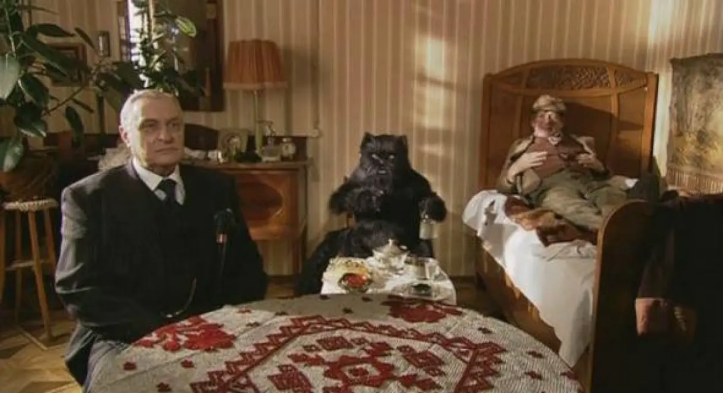
Fortunately for Margarita and the Master, Satan himself rolls up to Moscow to have his once-in-a-century Spring Ball, and for plot reasons he needs a hostess named ‘Margarita.’ But of course, you can’t have Satan and a handful of deliciously delinquent demons (including a huge, talking black cat called Behemoth who drinks vodka, cheats at chess, shoots with infernal accuracy and torments the NKVD with his antics) enter the claustrophobic, paranoid, deeply corrupt and bureaucratically hide-bound Soviet Capital and not expect… shenanigans. And Bulgakov delivers on the shenanigans front with hilarious brilliance.
Thus, the second layer of the book – social satire poking savage fun at the power structures of the time and the place.
And the third layer? Why, that would be the substance of the Master’s novel itself, the tale of the meeting between Pontius Pilate and the itinerant philosopher Yeshua Ha-Nozri, better known to you as Jesus of Nazareth. For indeed, scenes from the Master’s novel are woven into Bulgakov’s tapestry with a rare, beautiful and delicate touch.
The interplay between these entwined, interdependent strands of story gives expression to a myriad of themes and ideas, mostly touching on ideas of authenticity versus authority – being true to oneself versus obeying (and even profiting from) the conflicting and often idiotic demands of contemporary existence. Bulgkov’s prose and imagery is brilliant. His characters are absolutely wonderful, and the book is without question a masterwork.
So where does that leave Viktor Bortko and his people? For you see, this is not a Dune that you can dumb down and sell to the popcorn crowd, for you would lose the heart of the work and you still wouldn’t have a big, shiny, explodey cinema adventure. Nor is it a Lord of the Rings, where you can subtly strengthen certain character arcs, cut a few extraneous elements, and dazzle everyone with a near-perfect vision of an impossible fantasy. The Master and Margarita works as fantasy, yes, but it does so in a thoroughly prosaic Moscow of the 1930s, and to lean into the wish-fulfilment fantasy stuff would be to gut the bittersweet and tragic elements that give the book so much power.
To the credit of the 2005 TV miniseries team, they took the task seriously. There are 10 episodes of a little over 45 minutes each, totaling seven-and-a-half hours of screen time. Peter Jackson’s theatrical release of the LOTR trilogy ran for a bit over nine hours, but Tolkien’s epic runs to more than a thousand pages, while Bulgakov’s tale is closer to three hundred, in paperback form. So seven-and-a-half hours of screen time would seem plenty, and Bortko makes good use of it.
Visually, it’s polished and some clever decisions were taken. The special effects (all Russian, apparently. They deliberately kept it in-house, and didn’t bring the big American FX powerhouses into the game) are effective – and if from time to time they seem to invoke the clumsier efforts of old-school cinema, that doesn’t harm the storytelling. Indeed, it helps. The story is set in the 1930s, and one of the clever decisions was to put much of prosaic Moscow of that time on-screen in sepia, recalling the faded tone of early filmstock.
Not only does the sepia-look support old-style effects, but it allows Bortko’s production some extra leeway: when he needs to invoke ancient Jerusalem as part of the Master’s novel, Bortko shoots in full colour. Likewise when the magics and hijinks of the Satanic crew are brought to the screen, again it is in full colour. Thus we get a staid, worn Soviet Moscow – but at the same time, the clarity and colour of old Jerusalem helps convey the brilliance of the Master’s novel, and the colour and vigour of the magical elements makes the power and danger of Woland (Satan’s name in the piece) and his crew all the more real.
Musically it’s very fine. There’s an excellent orchestral soundtrack used with restraint and effect, and a particularly nice sort of ‘Satanic Chorus’ main theme which recurs at appropriate moments. I’m going to have to find a copy and get it onto a playlist, I think.
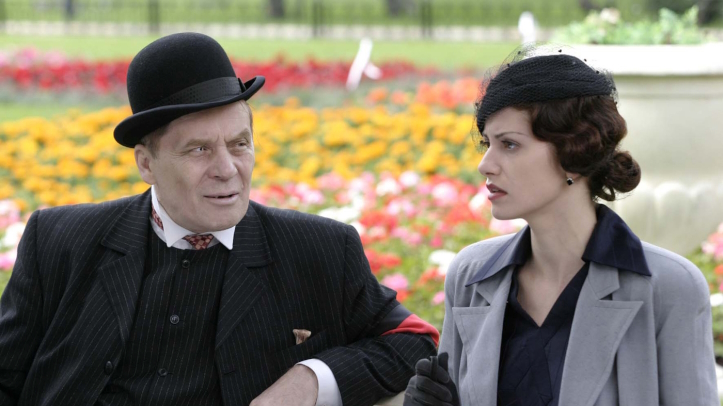
I can’t fault the actors or their work either. Admittedly, I don’t speak Russian and the whole thing is subtitled so it’s entirely possible that to a native speaker they might sound dreadful – but there’s a solid emotional context that comes across in most of the performances and it feels right. Oleg Basilashvili is particularly effective as the aged and patricial Professor Woland (Satan), delivering a real sense of gravitas with his role. Anna Kovalchuk is a fine Margarita, with plenty of strength and sadness. Aleksandr Galibin is a suitably worn and saddened Master, the various demons are played with panache and effect, and whoever they put into the complex black cat costume to be Behemoth does a fine job. Even Yeshua himself is delivered with touching honesty, naivete and pathos, just as demanded by the novel – and if he’s a remarkably white sort of Roman-era Jew… well, I guess that’s only to be expected.
Altogether, I feel this is one of the sharpest novel-adaptations I’ve ever seen. The question which remains is this: is it genuinely good TV/Cinema? Or am I so in love with the novel that I simply don’t see elements that would be disastrous flaws if there was no brilliant book behind it? Pacing, for example: the story is delivered in ten parts, and we don’t even encounter either the Master or Margarita until perhaps four parts in. The book, after all, has no clear protagonist. Does the TV adaptation suffer for the lack? I can’t say. It doesn’t feel that way to me. I enjoy watching the different elements work together to build a bigger picture. Does it lack ‘narrative drive’? I don’t think so: there’s so much going on, so many different characters and agendas at work that the screen is always busy, always delivering. But it is certainly unconventional, and because I do love the book so greatly I’m unable to be sure.
I can say this: I have enjoyed the series, and I have gone back and re-read the book (for the nth time!) as a result. If you haven’t read the book – well, give this series a try, if you can find it. But for the love of sanity, definitely read the book.
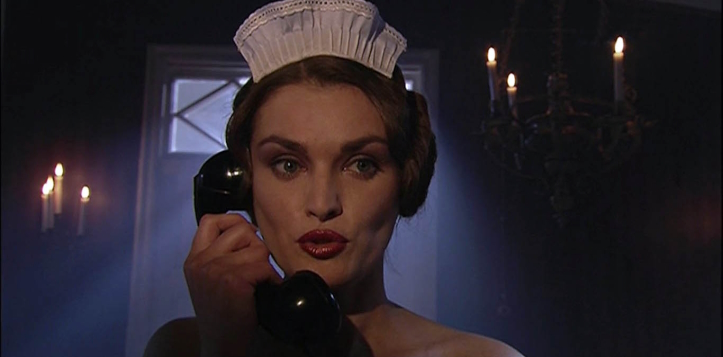
Oh – obligatory warning: there’s rather a lot of (mostly female) nudity in some of the episodes. I wouldn’t call it sexualised… but there is a lot of it and if that’s a problem for you, consider yourself forewarned.
 Mutant Reviewers
Social satire AND Satan? I think I want to see + read this. Thank you.