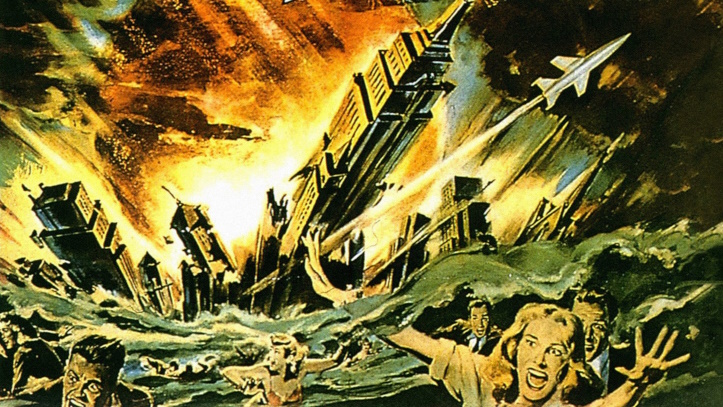
“Waste anything except time. Time is our shortest material.”

ZombieDog’s rating: 3.5 Belluses
ZombieDog’s review: Talking about science fiction is much harder than you think it would be. The real problem is putting it in context with other types of storylines. There have been dramatic and comedic plays throughout history, but how many plays had performances dealt with extraterrestrials? To complicate the matter even further, what are we even considering “science fiction?” Do we want to say that science fiction started with A Trip to the Moon in 1902, or when Mary Shelley wrote Frankenstein in 1816? Or how about Homer’s Odyssey that was written in the eighth century BC, which had a Cyclops and Sirens that would lure sailors to their death?
I would argue that science fiction, in whatever form it has taken, has been with us since the beginning. They are stories that are told when imaginations run wild. And what makes a better story than the world coming to an end.
When Worlds Collide is based on a 1933 book written by Edwin Balmer and Philip Wylie that deals with a rogue solar system colliding with our own and destroying Earth in the process. Unlike the campy giant monster movies from the ’50s, this movie is deadly serious with a heavy doomsday vibe.
The movie starts off with astronomers discovering a star (Bellus) headed towards Earth. In order to be sure of the imminent collision, they send all their collected data to be verified by their peers. Transporting that data is David Randall (Richard Derr), basically an everyday Joe who has found himself dead center in the greatest threat humanity has ever encountered. As happenstance would have it, he seems to fit in perfectly well with the group elite scientists.
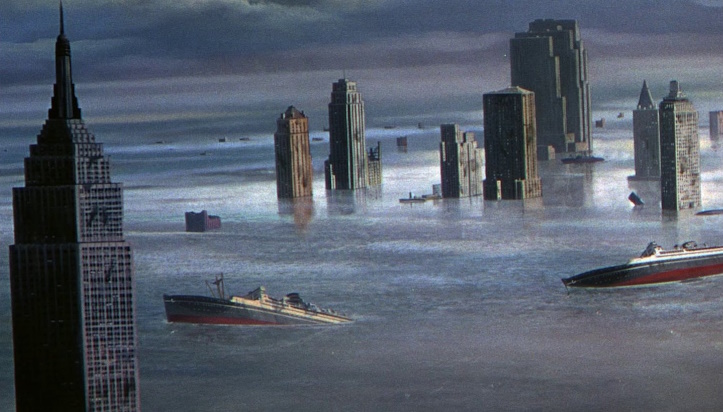
It doesn’t take them long to confirm that the data is correct, followed by the scientists trying to convince the rest of the world that the end is near. Predictably they face resistance and denial, becoming laughingstocks. However, not everybody thinks they’re wrong, and we soon see that there are people who are willing to hedge their bets and prepare for the inevitable.
While not a melodrama by any stretch of the imagination, When Worlds Collide portrays the full range of human emotions fairly well. There is greed, fear, denial, and — above all — hope. Hope comes in the form of a rocketship that they believe will take them to a planet (Zyra) orbiting the star that is headed towards them. As it turns out, there is no shortage of people willing to fund a “life-boat” without actually knowing if this will work. At this time, all doubt about the apocalypse is absolutely erased when massive earthquakes, due to gravity from the incoming star, affect the entire planet.
If my first love is philosophy (I’ve dedicated my life to it), my second love absolutely is history. I’ve long since come to the conclusion that the bulk of history teachers have done an incredible disservice to their students by not communicating the shear awesome wonder that is, “stuff that happened in the past!” Like movies, history is stories, in a greater sense though history can help us understand who we are, and where we have been.
When Worlds Collide was filmed five years after World War II, 10 years after the greatest economic depression we have ever experienced, and just at the beginning of the Korean War. It’s fair to say that people who were around when this movie was made understood danger, death, and suffering. They also understood to overcome these obstacles required hard-core effort and determination along with epic levels of cooperation.
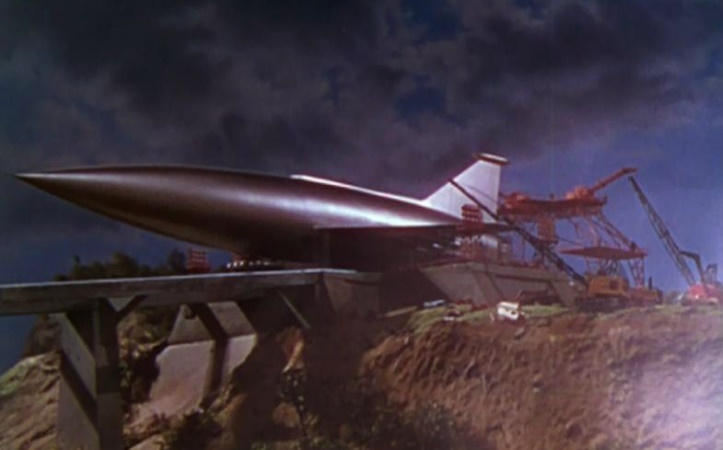
The atmosphere of the time bleeds into the movie itself. As we watch humanity prepare and build the rocket, it could easily be a newsreel or a documentary from the time. It’s clear that the director felt no need whatsoever to emphasize large numbers of people were required to accomplish megaprojects.
The spaceship in question is one of the most awesome parts of this movie. The ship is pure sci-fi goodness, and the beauty is that we get to see it put together piece by piece. The model work and matte paintings really make this movie shine in a way that only works from that ’50s monster movie perspective. More importantly, special effects are used as a means to propel the story forward not as a central focus. This sets it apart from its ’50s counterparts which were basically composed of “squish the bug!”
I suppose it’s impossible to escape the fact that I am an older viewer and I really do appreciate story over spectacle. Although, I do love those ’50s monster movies and any cheesy action-packed thrill ride, it’s just from time to time give me something to think about.
So, is When Worlds Collide good? Yes, but must be ready for a slow burn. What’s more, we kinda do know how the movie is going to end based on the title and pretty much everything else. It also has a pretty heavy doomsday feel. I would really compare it to War of the Worlds (1953) with respect to the complete devastation of our planet and confronting of forces that are simply out of our control. Be aware, though, this is not a ’50s monster movie — this is a movie that’s aiming for a more mature audience. So grab the Blu-ray version (it really improves the quality), someone you love, sit down one late night and indulge.
 Mutant Reviewers