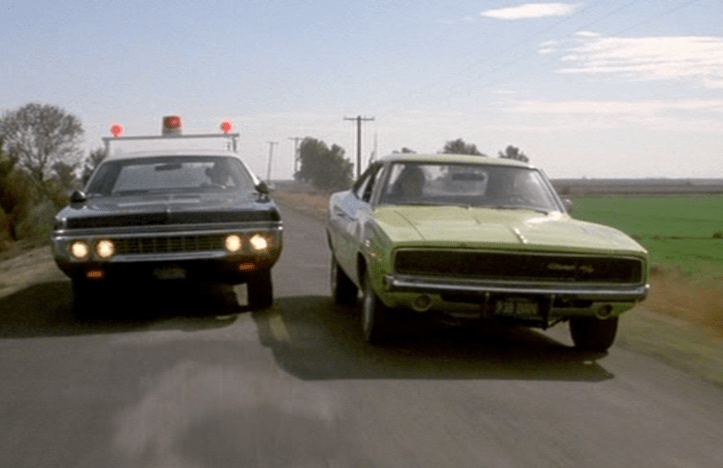
“Now what did that billboard say?”

Drake’s rating: Why don’t they look?
Drake’s review: In 1972 James H. Nicholson left the company he had co-founded, American International Pictures, with the intent to produce independent films under his own label. Unfortunately, Nicholson’s untimely death meant that his new company, Academy Films Corporation, only turned out two films. One of these was a Gothic haunted house horror movie and the other was an outlaws-on-the-run car chase flick.
Dirty Mary, Crazy Larry is the latter film, by the way. I just wanted to be clear on that up front.
A textbook drive-in exploitation flick, Dirty Mary, Crazy Larry keeps things simple. Larry (Peter Fonda, son of Henry, brother to Jane, father of Bridget and star of Easy Rider) is a race car driver looking to buy his way into NASCAR. His partner and mechanic, Deke (Adam Roarke, Frogs), holds the wife and daughter of a supermarket manager hostage so that Larry can strongarm the manager himself into handing over all of the cash in the store’s safe. What neither man counts on is Mary (Susan George, Straw Dogs), a local girl that Larry had a one-night stand with, inviting herself along for the ride.
From there, the trio of outlaws tear through rural farm towns and across dirt roads and two-lane highways, with a tenacious cop (Vic Morrow, Humanoids from the Deep) in hot pursuit. Along the way they bicker and argue, outrun the slower police cars with their souped-up Chevy Impala, then trade up for a lime green ‘69 Dodge Charger R/T and start the chase all over again.
Like I said, this is a simple movie: Cars race, chase and crash, and occasionally things come to a halt long enough for the actors to get in a bit of dialogue.
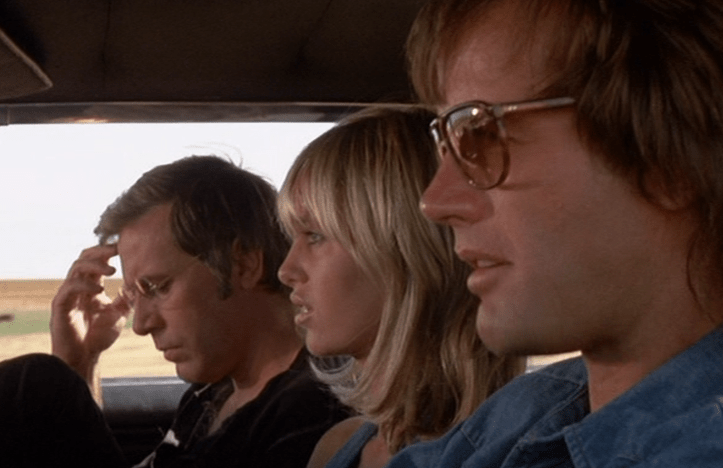
The characters themselves are fairly thin sketches. Morrow substitutes intensity for personality, Fonda plays a self-serving rogue with single-minded intent, and George alternates between sympathetic outcast and crazed hellion with frenetic abandon.
Adam Roarke is the quiet one of the bunch, either huddled in the back seat figuring out their next move or laid out under the car, working his repair magic after Larry gets a little bit too crazy. His performance keeps the movie grounded. Lose Deke and the whole flick would devolve into a frenzied affair minutes after the opening credits, and Roarke wisely underplays the character, keeping his emotions bottled up as the rest of the cast indulge in gritted teeth and wide-eyed frenzy.
Car movies weren’t a new thing, of course, but Dirty Mary, Crazy Larry changes up the formula a bit by stressing the difference in power between the six-cylinder police cars and Larry’s V8-powered rides. The Impala and the Charger supply throaty roars, booming down the highway like bellicose lions with no restraint. Each turn of the key ignites a menacing rumble, and every corner is a tire-squealing event. You can see the groundwork being laid here for future movies such as Smokey and the Bandit and Mad Max, where the car itself is a veritable co-star.
It’s interesting to see the differences in every day technology from fifty years ago as well. Larry walks calmly into the supermarket to steal the money because there aren’t any cameras watching him. Deke is shown to be tech-savvy by simply using a police scanner to keep track of their pursuers. Lacking surveillance equipment of any type, the sheriff sends a deputy up a watchtower with a pair of binoculars to scan the highways in search of Larry’s car. It’s a good reminder of how different things were in the ‘70s.
There are also no cell phones and zero social media. Because the ‘70s were awesome.
Dirty Mary, Crazy Larry was a surprise hit, embedding star Peter Fonda in the action movie genre for the next few years and cleaning up at drive-ins across the nation. It also reinvigorated the “young outlaws in love” sub-genre of exploitation flicks that had been kickstarted by Bonnie & Clyde a few years earlier, leading to movies such as Bobbie Jo and the Outlaw and Aloha, Bobby & Rose taking their turns on the drive-in circuit.
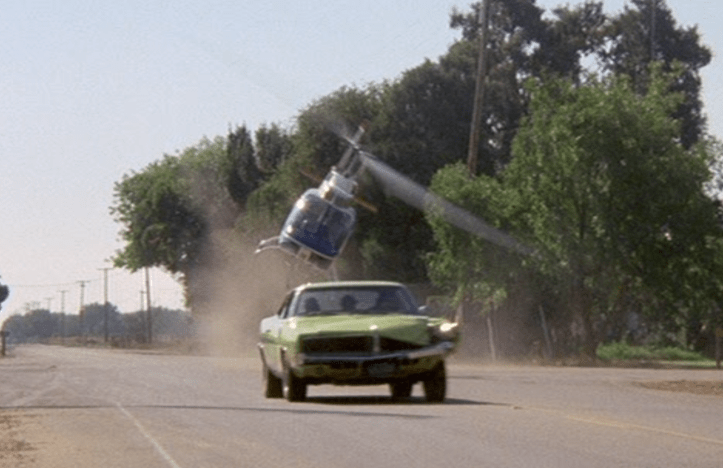
Neither of those films have a gutsy stunt sequence with a helicopter engaged in close pursuit against a bright green ‘69 Charger, however, so watch them at your own risk.
Intermission!
- Academy Films’ other picture was The Legend of Hell House in 1973. John Hough directed both AFC movies before moving on to Disney to direct Escape to Witch Mountain.
- I mention those movies down here because I don’t think I have to review them if they’re in the Intermission section. The Mutant Contract is a bit blurry on that. And by blurry, I mean the ink ate through the paper.
- A second generation Morrow stalked after a Fonda as well, when Jennifer Jason Leigh, Vic’s daughter, got all kinds of creepy with Bridget Fonda in Single White Female in 1992.
- Co-screenwriter Leigh Chapman split her time between acting and writing. Appearing on the small screen in the Man from U.N.C.L.E., the Monkees and the Wild, Wild West, she was also busy writing both TV episodes and movie scripts, including the Chuck Norris action flick The Octagon in 1980.
 Mutant Reviewers
Obligatory MST3K Connections. Adam Roarke was Harris in Women of the Prehistoric Planet. Vic Morrow was the cab driver in The Bubble. Roddy McDowall was Dr. Mellon in Laserblast.
I am totally blanking on The Bubble right now. I am going to have to dig through my MST3K collection and dig that one up.
The Bubble is from Season 13