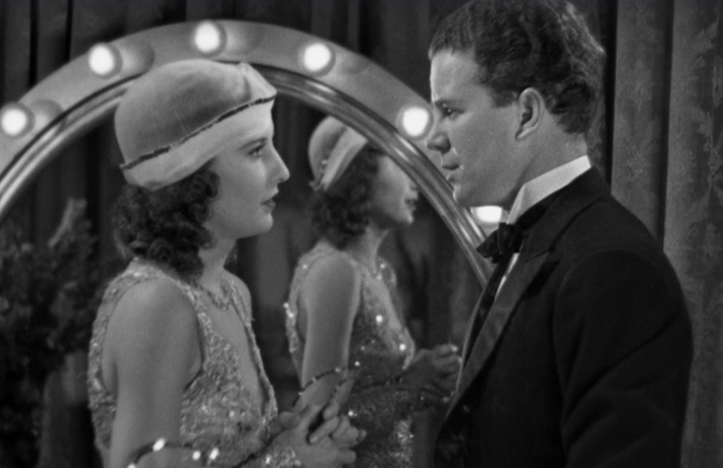
“If that’s being rich, I’m glad I’m cheap, and I’m gonna stay cheap! Because no matter how cheap I am, I’m not for sale!”

Drake’s rating: Dial M for Melodrama
Drake’s review: I made mention in a review not long ago about sound changing the movie business and ending the Silent Era. The end of that era saw the demise of many a film career as well. Some actors had voices that didn’t match their onscreen silent personas while others just never adapted to the new filmmaking techniques. But even as the stars of a previous generation faded away, “the talkies” saw new stars come to the fore. And one of the most prominent of these stars was Barbara Stanwyck.
A Ziegfeld chorus girl at 16, Stanwyck moved up the ladder quickly and was a Broadway star by twenty. Moving to Hollywood, she quickly established herself in the movies and, despite a few cinematic flops early on, was soon a big screen star. And part of what made Stanwyck such a formidable screen presence was her voice. Deep and husky, she could use it to coolly control a scene and then, in a sudden explosion of emotion, belt out her lines with a fearless ferocity that left audiences on the edge of their seats. As much as any other actor whose voice gave them a distinctive presence on the big screen, Stanwyck benefited immensely from the advent of sound in the movies.
In 1932, Stanwyck was still on her way up in Hollywood, establishing herself as an actress and a star on the rise. Shopworn, a pre-Code melodrama directed by B-movie stalwart Nick Grinde, is indicative of many of her early films and of the type of character she would become known for: a tough, working-class girl who runs face-first into the socialite set.
Here she’s Kitty Lane, a young woman who’s grown up on the construction sites her father works on. When he’s killed in a demolitions accident, she goes to live with her Aunt Dot (ZaSu Pitts, It’s a Mad, Mad, Mad, Mad World) and Uncle Fred, and works at their diner. Hit on by all the men who walk through the door, Kitty repels their advances with her acerbic wit. But one young man does catch her eye: David Livingston (Regis Toomey, The Big Sleep), a studious sort who’s more interested in his medical textbooks than he is in Kitty. His indifference doesn’t last long, however, and soon enough the two are dating.
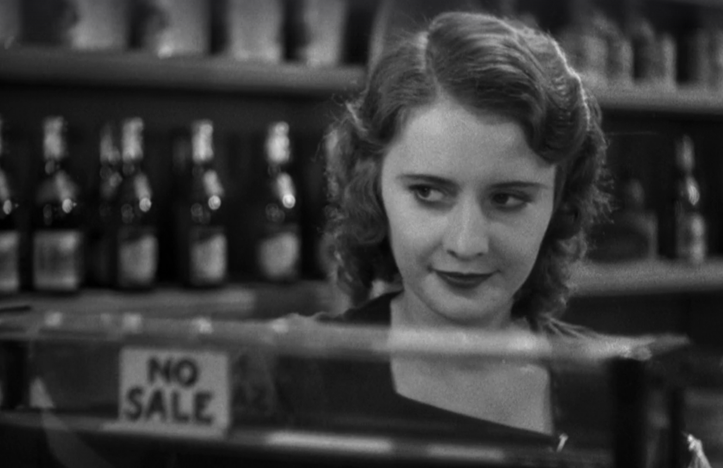
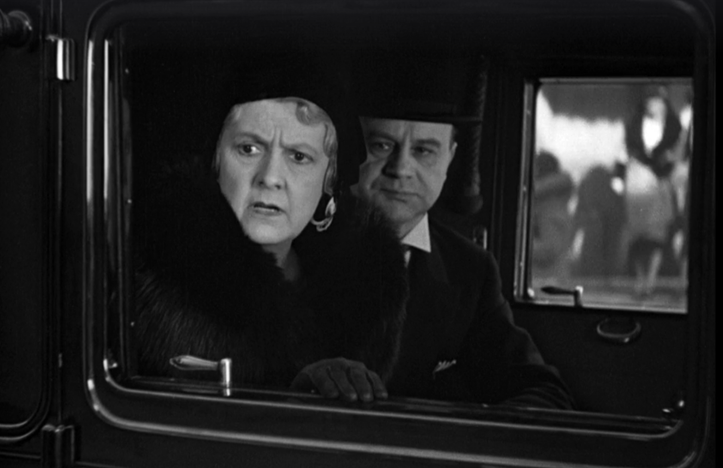
And that’s where the problems start. Mrs. Livingston, David’s high society mother (Clara Blandick, The Wizard of Oz), has no interest in seeing her son consorting with a commoner. Manipulative and twisted, when she realizes that one of her fake heart attacks won’t pry David from Kitty’s side, she goes to even greater lengths to separate the duo. Enlisting the help of her good friend Judge Forbes (Oscar Apfel), the duo concoct a scheme to rid themselves of Kitty by hook or by crook.
The hook is an offer of $5000 to leave David and the town they live in. When that doesn’t work, they employ the crooked means of having Kitty arrested on a trumped-up moral indecency charge*, and have her sent to a reformatory for three months. The Judge and Mrs. Livingston tell David that she took the money and left town, while Kitty goes to prison.
Three months later Kitty’s released and, having no other options, she manages to get herself a job as a chorus girl. In a quick montage worthy of an ‘80s comedy, Kitty rises to fame on Broadway (somewhat mimicking Stanwyck’s own meteoric ascent) and, six years later, is a bona fide star. David finds her again and tries to apologize, but is heatedly rebuffed in true Stanwyckian** fashion. David’s not giving up, but then again, his mother is still lurking about, and she’s the stubborn sort as well…
As I remarked earlier, this is a pre-Code film, and so there are elements of it that would no doubt surprise those who haven’t seen a movie from this era. The Motion Picture Production Code, more popularly known as the Hays Code (named after Motion Picture Producers and Distributors of America president Will Hays), was initially a set of fairly toothless and overly moralistic guidelines that studios freely ignored. But with the threat of governmental censorship looming, the Code was given teeth in 1934 and dictated cinematic content for the next 30 years, and movies like Shopworn were the reason why. For instance, the word “ejaculate” is not only shown in print, but uttered onscreen! My goodness! And it’s also pretty much spelled out that Kitty and David had sex… before marriage!!! I’m feeling faint. Could one of you get my smelling salts?
Seriously, though, this was material that would have been either merely implied or simply written out altogether just two years later, and it’s likely that Stanwyck’s own performance would have been toned down. The early sound films, like their silent predecessors, were running around in a playground with few rules, and they made the most of it. Shopworn itself is an average-to-good film: Stanwyck is great, her co-stars are all capable, but the story itself starts to lose steam by the end of the second act and never quite recovers. In fact, the finale comes out of nowhere and ends with a pat little bow that’s simply out of sync with the majority of the movie.
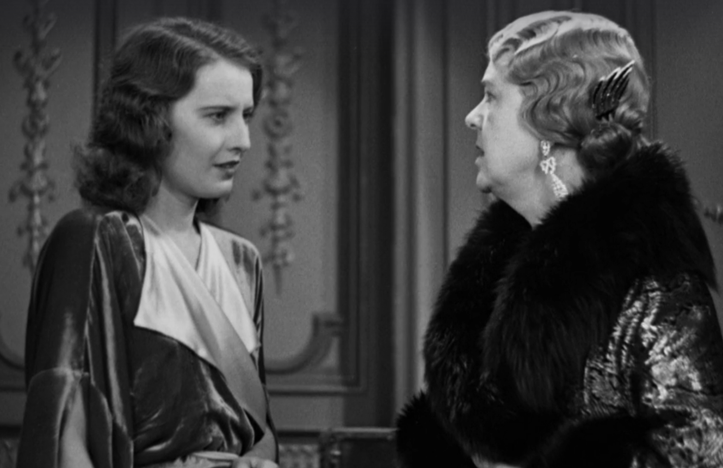
At the same time, it’s a worthwhile peek into the short-lived pre-Code era of sound, when the production rules weren’t yet set in stone. Barbara Stanwyck is really allowed to go full-tilt as Kitty, and while her performance is still raw, it nonetheless showcases her talent and is a glimpse into the redoubtable actress she would soon become. A true melodrama of the time, Shopworn may be more than a bit histrionic but it also relies on timeless themes such as class warfare and the abuse of power, showcasing them in a way that would have been forbidden within a few short years.
*Not very hard to do in the 1930s. Women were arrested in shocking numbers under the abusive American Plan laws. Even more frightening? Those laws still exist in some states today.
**It’s a word. Don’t look it up, just trust me.
Intermission!
- If you recognize Clara Blandick, it’s because she played Auntie Em in The Wizard of Oz.
- ZaSu Pitts was a Silent Era actress who did go on to have a lengthy and popular career after the silents died out. She had a distinctive voice herself, and used it to great comedic effect in the movies and on the radio.
- Surprisingly, given Stanwyck’s own background on the stage, there are no musical or dance numbers for her Kitty Lane character. Disappointing!
 Mutant Reviewers