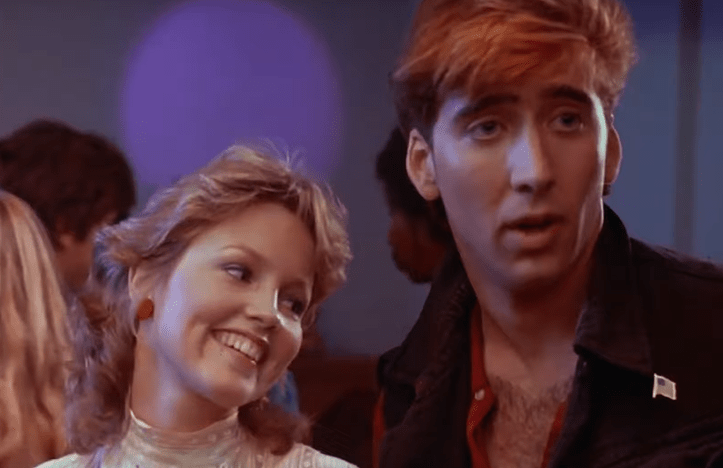
“We were young once. Your mother still is!”

Drake’s rating: Totally tubular
Drake’s review: In 1982, legendary musician Frank Zappa teamed with his daughter Moon Unit on a song called “Valley Girl” for his Ship Arriving Too Late to Save a Drowning Witch album. Although Zappa himself disliked the San Fernando Valley area and wrote the song as a criticism of the culture there, it became a surprise hit and was the only single off of the album. If you were around at the time, you were definitely aware of the song. It received fairly heavy play on the radio for a few months and popularized the so-called “valley girls” who lived in the area and their distinctive “Valspeak” slang.
At the same time, teen comedies were on the upswing, with Bob Clark’s Porky’s setting the stage for all sorts of adolescent mayhem in the decade to come. Many (far, far too many) of the films were fairly simplistic and interchangeable sex flicks featuring horny teen-age boys looking to “get lucky” and having misadventures along the way. And that certainly could have been the fate of Valley Girl if the film had been entrusted to less skilled hands. Instead, the writer/producer team of Wayne Crawford and Andrew Lane, a pair who would produce the cult classic Night of the Comet a year later, set their sights on former documentary filmmaker Martha Coolidge to helm the film.
It was an inspired choice, as Coolidge was less concerned with the hormonal surges of teenage boys and more interested in what the girls were up to. And, sure, a lot of what they’re interested in is shopping and parties and boys (they are teenagers, after all), but that’s not the whole of it. Julie (Deborah Foreman, April Fool’s Day), having just broken up with her knuckle-dragging boyfriend Tommy (Michael Bowen, Night of the Comet), catches the eye of Randy (Nicolas Cage, Ghost Rider: Spirit of Vengeance) and soon enough the two are dating.
Which would be all well and good, except that Randy isn’t from the Valley. In fact he’s from (gasp!) Hollywood, a neon-lit land to the south where punks rub shoulders with lowriders and music blares out of the open clubs. As far as Julie’s friends are concerned, Randy might as well be from Mars, and they’re less than happy that their friend is breaking the unspoken Val rules by dating outside of her zip code.
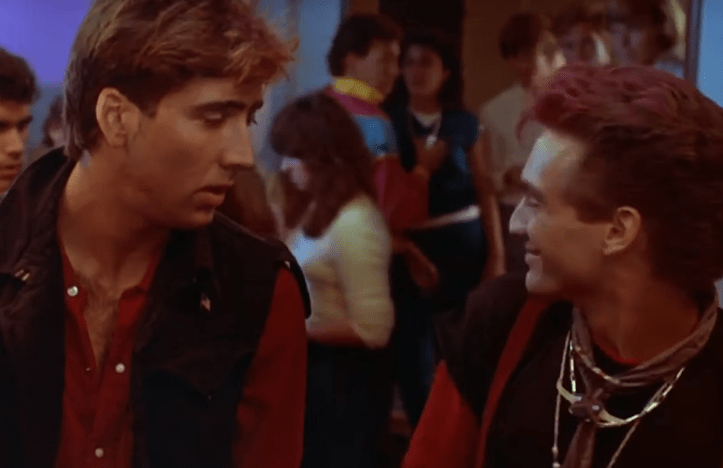
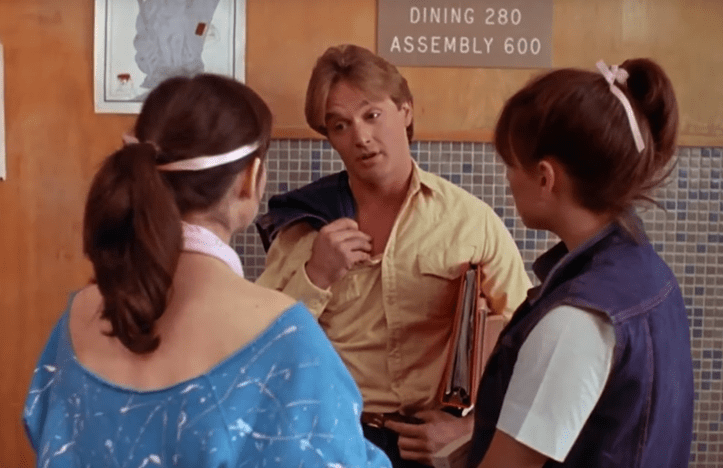
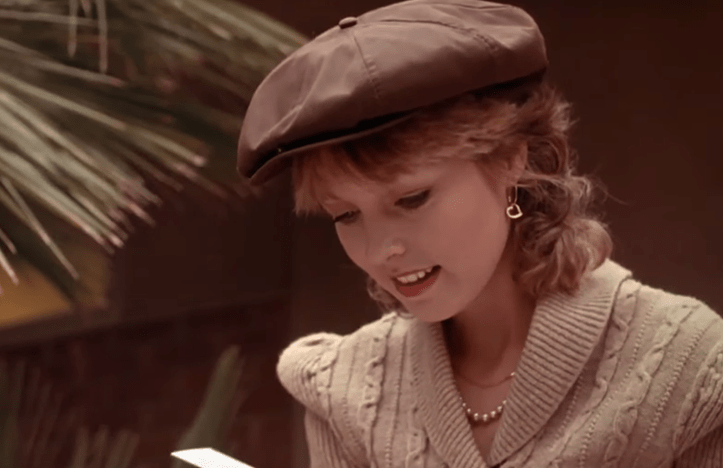
Sure, it’s basically Rome and Juliet, albeit with less bloodletting and a body count of zero (sorry, spoiler), but oft-told tales resonate for a reason. Everyone knows the power of peer pressure, and to a teenage girl used to being part of the in-crowd, being shut out is like being banished to Siberia. Or even Long Beach. But the friends have their own issues as well. Suzi (Michelle Meyrink, Real Genius) is interested in the same boy that her mother has an eye on, and Loryn (Elizabeth Daily, Streets of Fire) is being blackmailed by Tommy after an ill-advised hook-up. But the problems themselves are less important than the fact that the actresses get actual screen time as they deal with them, communicating the fact that, “Hey! Girls are people, too!”
No exactly a revolutionary message these days but again, this was 1983 and this was a movie aimed at a primarily teenage audience.
Less attention is paid to the boys in the movie overall, with Randy being the notable exception. He and Julie have a dating montage because it’s the ‘80s and movie montages were a legal requirement, and when they inevitably break up as her friends pile on the pressure, he alternates between trying to win her back (in ways that would likely engender a restraining order today) and moping around Hollywood Boulevard and listening to the Plimsouls.
And here I will make my one criticism of the movie: Randy is supposedly a punk (although his appearance is less punk and more “I slept in my clothes and rushed to school”) but he pines away for Julie while listening to the Plimsouls? I mean, look, the Plimsouls were a great L.A. club band and they had a hit song (thanks to this movie), but they were about as punk as John Mellencamp. Or John Cougar. Either one of those guys. Granted, L.A. punk is in disarray by 1983. The Weirdos have gone their separate ways, the Go-Go’s have gone mainstream and the Screamers are gone, period. But still, Randy couldn’t have drowned his sorrows while listening to Social Distortion? Maybe catch a set from the Plugz? I’m telling you, it was a missed opportunity.
Still, this is a very enjoyable movie. Martha Coolidge keeps the plot moving along and never gets mired down in melodrama, and she also avoids any dreaded lowbrow comedy that would have been sorely out of place in what was, all in all, a fairly grounded teen romance flick. For anyone wondering what the early ‘80s looked and sounded like (at least on the West Coast) I generally recommend two movies, and Valley Girl is one of them. It’s a veritable time capsule for 1983, and a good time in general. If you were there, check it out and bask in the nostalgia. And if you weren’t, feel free to watch it and make fun of what your parents were probably wearing back then.
Intermission!
- Look for a cameo by WKRP’s Les Nessman himself, Richard Sanders, as a beleaguered driving instructor.
- Granted, the movie misses out on the punk bands of the era, but it did have some great music by Josie Cotton and also leaned into New Wave artists such as Modern English, the Payolas and the Psychedelic Furs.
- Ironically enough, Zappa’s own “Valley Girl” song is nowhere in the movie, and he himself attempted to stop the making of the film. Like, grody to the max, Frank!
- The other early ‘80s movie I recommend is Fast Times at Ridgemont High. I just wanted to have a suspenseful pause before I told you that.
 Mutant Reviewers