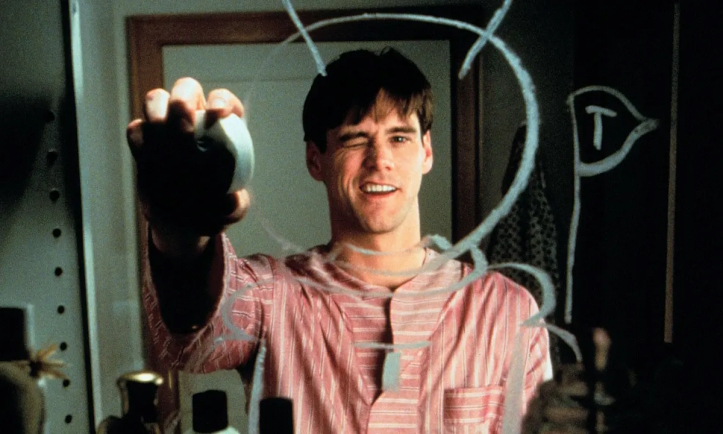
“We accept the reality of the world with which we’re presented. It’s as simple as that.”

Justin’s rating: Every time I watch this, I think, “Poor EDtv…”
Justin’s review: One of the really interesting things about the scifi movie genre is how rapidly it was assimilated into popular culture. It was lurid in the ’50s, for geeks only in the ’70s, became popular in the ’80s, and transitioned into being commonplace in the ’90s. So many of the huge blockbuster movies of the decade — such as Jurassic Park, Independence Day, and Armageddon — were crowd-pleasing scifi spectacles. Scifi wasn’t sneered at anymore, especially when it was paired with other, more socially acceptable genres.
I don’t know if many people even think of The Truman Show as a scifi flick, but it totally is one. What else would you call a setting where a giant artificial world is created (“the largest TV set in history,” we’re told) to house and raise a single corporately owned individual who is unaware that he’s being filmed 24/7? Scifi often creates wild scenarios to examine everyday issues, after all, so those fluent in the genre shouldn’t blink when they see this.
Truman (Jim Carrey) is an affable guy who has absolutely no idea that he was born and raised in an artificial environment for the entertainment of the world on the outside. Everyone he interacts with, including his wife, are paid actors who reinforce this “reality,” and the Florida-esque town that surrounds him is one of comfort and beauty. Unbeknownst to him, cameras are everywhere, recording his every waking and sleeping moments, and everyone is coached by the control room to adapt to any situation where Truman might throw things out of whack.
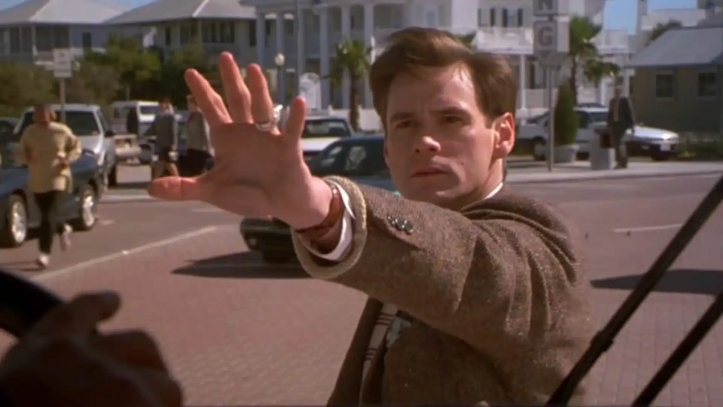
But one day his world comes crashing down — literally, as a light falls from the sky — and he starts to suspect that something isn’t quite right in his Mulberry universe. He’s also alienated from his product-shilling wife and secretly in love with an extra he bumped into years before.
Scifi and vacation vibes easy pass a baton back and forth in this movie, keeping us entertained in any given moment with either eye candy or a bit more of this scifi premise. I applaud how audacious it is, because there’s absolutely no way that this setup could actually happen on this kind of scale. And so much of it frays at the edges if you think about the logistics too long — including a woman who agrees to marry and presumably sleep with this subject while on camera. Or the very real possibility that the one guy that this entire show is based on didn’t turn out to be boring, a pervert, or even a criminal.
The Truman Show has something interesting in common with one of my favorite scifi space operas of all time: Star Trek II: The Wrath of Khan. In both movies, the primary protagonist and antagonist never actually physically meet or have their characters shoot scenes in the same spaces. The “Khan” of this movie is Christof (Ed Harris), the director of the program and a not-too-subtle god figure up on high. As Truman begins to plot his escape, he finds himself in a battle of wits and wills between his unseen creator who appears to have all the power.
Scifi also is strongest when it’s a running commentary on our contemporary world, and here The Truman Show delivers a satire of our reality programming, Tik Tok, YouTube-obsessed planet — just years before the reality boom exploded with Survivor and its ilk. We are not just addicted to watching other people’s lives; too many of us wish that we were Truman, at the center of a show and the adoration of billions. Yet with all of the cameras turned on you all the time, how much would you yearn to be free from that gaze and enjoy privacy and normalcy?
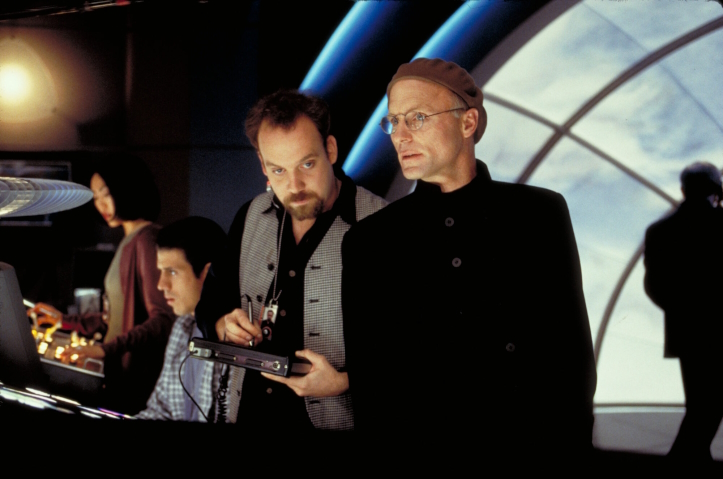
It’s really clever for the movie to use a variety of these “hidden” cameras to show us Truman’s world. Even as sunny and cheery a place that it is, even though it’s been fashioned to be as comfortable as possible for its subject, there’s a creepy, malevolent undertone to all of this. Truman is being lied to, manipulated, and held against his will. Christof even installed a deep-rooted phobia of water to keep him trapped (“killing” his dad, even, only to have the actor sneak back on set to try to reconnect with his foster child). Anyone with a conscience would stop feeding on him as entertainment and start rooting for his escape — which is exactly the arc this movie takes with the external audience.
I’m sure a lot of people think of this as nothing more or less than a breezy comedy, but The Truman Show really is kicking around as high a concept as you might see in other less goofy genre pieces. It also messes with your head a little bit and makes you paranoid that the world in which you exist might be an artificial creation for the entertainment of others.
Upon rewatching it recently, I was struck by how this movie isn’t actually that funny. Maybe we mistook the light-hearted tone for comedy, but it’s not really out to make us laugh. It’s more like a theater of the comically absurd with a lot of drama and satire. There are also some bold narrative choices, such as introducing the film as the title sequence of the show (complete with Christof’s voiceover), then immersing us in Truman’s world for a good length of time before taking us out of it again to feature the control room and people outside of the mammoth set.
Of course, you could chuck all the social commentary to the wind and simply enjoy this for an unusual prison break movie — to which it holds up the conventions of that genre pretty well. In any case, maybe it’s time we took the cameras off us, stopped being overly fascinated with videoed celebs, and started experiencing life for ourselves.
 Mutant Reviewers
Read a book. Go outside. Look at a real sky.