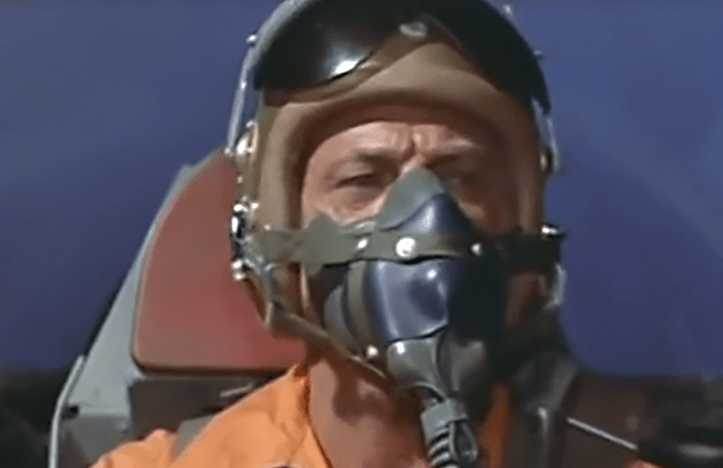
“Matt, best of luck from all of us.”

Drake’s rating: So. Many. Crewcuts.
Drake’s review: During the 1950s and early ‘60s, a race was on to develop the first manned space flight. And that race wasn’t just between the United States and the Soviet Union, but between competing projects in the U.S. itself. Even as the rocket program that would lead to the Mercury flights was being developed, so too was an alternative that would see a rocket-powered plane enter space and return, under the complete control of a pilot.
That was the X-15 and, although it was eventually ruled an unfeasible spacecraft as it lacked the velocity and altitude to attain orbit, it nevertheless was vital in collecting information about supersonic flight and the conditions of the upper atmosphere.
Now if you somehow found my rather dry introduction a compelling read, then do I have the movie for you!
One part NASA promotional film and one part soapy drama, X-15 tells the story of the trials and tribulations surrounding the rocket plane, as the pilots and ground crew attempt to get it into space. Mixing NASA footage with scenes directed by Richard Donner (Superman), what we get isn’t The Right Stuff. In fact I would say that this is 107 minutes of the wrong stuff.
We start with an introduction by James Stewart, who was himself a pilot in World War II, assuring us that the X-15 is the key to the future of space flight. Dry exposition follows, and then we’re introduced by Stewart to characters whose names we’ll never remember. We’re assured that they highly qualified, however. Top men. And there’s nary a woman-type lady person to be found. Because this is 1961.
Segueing into an actual flight, we get even more stock footage of a B-52 with an attached X-15. They’re getting ready to drop the rocket plane and have it blast off into space but suddenly the countdown is halted! There’s been a pressure failure! It’s a “no-go!” Horror of horrors! How will we ever beat those godless Commies to the moon now? Probably by relying on German scientists grabbed up during Operation Paperclip, but I digress…
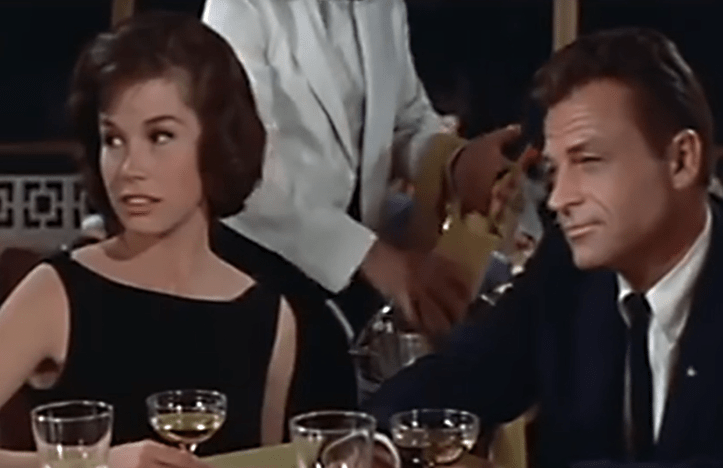
The B-52 is forced to make a landing with the X-15 still attached. This leads to literal seconds of tension as… it does just that. The plane lands, the pilot’s fine, and then Charles Bronson flies by in the chase plane and moons everyone.
OK, that last bit doesn’t really happen. I just wanted to see if you were still reading this.
Bronson is in the movie, however, as is James Gregory (Beneath the Planet of the Apes). They’re the two recognizable actors we see until the music softens, the string section kicks in and… it’s Mary Tyler Moore! Well, she’s certainly a lady person! She drives into the movie and hangs out with the other lady persons waiting for their menfolk pilots to come home after a hard day of flying.
And before you ask, no, there are no lady person pilots. Don’t be absurd. Repeat after me: Nineteen sixty-one.
From there we get reporters lobbing softballs, James Gregory throws shade at the Mercury program, and there’s much concerned talk about anxiety and performance issues. I actually had to pause the movie to make sure I wasn’t watching one of those erectile dysfunction ads.
The second half of the movie is basically just more of the first half, except with a possible pregnancy (that’s never mentioned again), even more stock footage and a father-son moment between Bronson and Chip Douglas from My Three Sons. And in the end we get badly blue-screened footage of an X-15 entering space. Which, outside of this movie, it never did. And as it drops back into the earth’s atmosphere, James Stewart affirms that all is well with the world once again.
Well, for everyone but Bronson, that is. After all, sacrifices must be made to appease the bad movie gods.
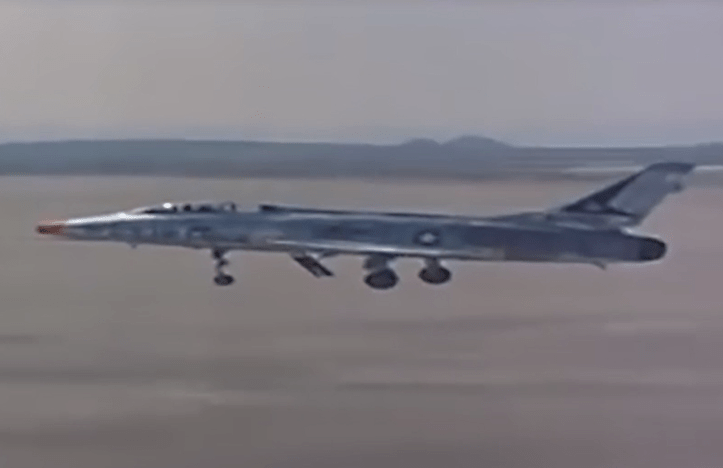
Intermission!
- The movie was originally meant to center around the Bell X-2, an earlier experimental plane, but the Pentagon recommended the X-15 instead.
- Mary Tyler Moore stated that the film was shot in about two weeks. It shows.
- Several pilots flew the X-15, including Neil Armstrong and Scott Crossfield. Armstrong was of course the first man on the moon, while Crossfield was a very successful test pilot who was the first pilot to fly twice the speed of sound.
- This movie dropped off the face of the earth pretty quickly after its release. It didn’t hit television until 18 (!) years later, in 1979.
 Mutant Reviewers
Sounds a lot like The Starfighters from Season 6 of MST3K, right down to the brazen lies printed in the poster art.
If X-15 and The Starfighters aren’t siblings, they’re at least kissing cousins.
And I think The Starfighters just might be the better movie…!