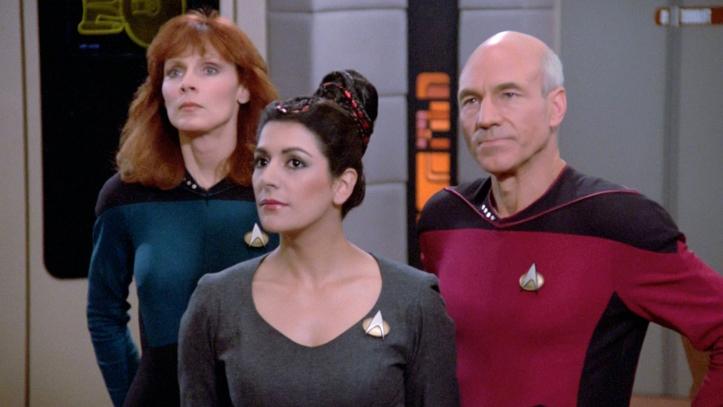
When recommending Star Trek: The Next Generation to friends, the usual approach is to urge them to skip past seasons 1 and 2 to go right to the point where the show hit its stride: Season 3. This is what I used to say all the time, but now? Now I’m not so sure.
I’ve been toying around with an ambitious project of watching and reviewing every season of Star Trek, starting with the two series (TOS and TNG) that defined my childhood. And so when I subjected myself to the first season of The Next Generation, it was with the heavy sigh of someone who must suffer before being rewarded.
Except that it wasn’t as painful as I anticipated. In fact, Season 1 is downright fascinating and even entertaining for all of its well-known flaws. But before we get into why I think this is so, I do want to be fair and acknowledge that there are so many problems with Season 1 that you can’t just hand-wave away. For starters, the cast and writers are still finding their footing, as is the tone of the show. The Next Generation’s debut was the first live-action Star Trek series since the ’60s, and it was difficult to bring that to the era of 1987 without some significant adjustments. Gene Roddenberry wouldn’t let them create interpersonal conflict, decades-old scripts were dusted off to be used here, and every character is still ill-defined and finding their footing with their respective actor.
And yes, it is absolutely silly (and so very ’80s) to have a therapist be a member of the bridge crew, not to mention that the much-hated character of Wesley Crusher still offends the viewing senses today with his smirking “I know better than everyone else because I’m a Gene Roddenberry surrogate.” Picard is way too grumpy, Tasha and Worf basically the same interchangeable person, Crusher shoved to the background, Data is trying too hard to be quirky, and they have something like sixteen chief engineers over the course of these episodes.
Story-wise, there are far more bombs than hits. It’s a very uneven season of television with only a few episodes that you can hold up as TNG’s better outings, and a couple that are downright racist or sexist. In fact, you could easily get away with watching the pilot and then going right past the rest of the season without missing too much in terms of character or plot development.
And yet. And yet you WOULD be missing out, because TNG Season 1 offers a bonanza to the fan. We may like to dunk on it, but it’s always a fond, shared-joke kind of dunking rather than an acerbic, we-all-hated-this-piece-of-trash rant. So if I may, I’d like to present a list of 10 highlights of watching Season 1:
It eased us into the 24th century and the new crew of the Enterprise
Consider what a daunting task it was for the show’s makers to pick up this 20-year-old beloved legacy show and create a sequel. It raised a lot of questions right out of the gate. Everyone knew Kirk, but who was this bald French dude? Why does this new starship have curves everywhere — and kindergarten classes? Why aren’t we seeing any of the old crew?
Season 1 was always going to be rough for the fact that it had to pioneer a trail into a brand-new century with revised and updated everything. And when you consider that task, Season 1 becomes admirable how much ground it lay for the many seasons and shows to follow. It got us past the Kirk era into a fresh setting, gave all the tech a much-needed upgrade, introduced us to a rather hefty ensemble, brought a Klingon (!) onto the bridge, made flatscreens a standard control/viewing format, devised uniforms that were pretty sharp-looking out of the gate, and so on.
It’s some of the only ’80s Star Trek TV we ever got
While The Next Generation, Deep Space Nine, and Voyager all owned the ’90s Trek scene, we must remember that TNG actually existed for two-and-a-half years in the ’80s. To me, that’s significant. This is the only ’80s Star Trek on the screen — aside from the four TOS movies — that we got. So while it’s totally hokey and dated at points, it’s also a product of the ’80s scifi scene, which was booming at the time with lots of creativity.
I always get an affectionate chuckle out of the Hotel Hilton design of the Enterprise’s interiors, or the “let’s talk about our emotions a lot” psychotherapy, or the guys wearing the uniform “skants,” or the special effects that predated CGI. With The Next Generation, Star Trek managed to continue a trend of featuring at least one show per decade — a trend that’s continued from the 1960s through the 2020s.
It introduces a lot of fun concepts that would be refined later
One of this season’s great gifts to the Next Generation and Trek in general is that it helped to lay the foundation for much better things to come. Almost every introduction of characters, concepts, races, and technology aren’t that good — but now that they appeared on the scene, the writers could now take those ideas and greatly expand and refine them.
In this regard, Season 1 is bountiful: We get Q, the Ferengi, Lore, Miles O’Brien, Benzites, Lwaxana Troi, Geordi’s VISOR, Wesley starting his Starfleet career, the Crystaline Entity, holodeck episodes, the return of the Romulans, Data’s fixation with Sherlock Holmes, and so on. Later seasons have much to thank the critically panned Season 1, I say.
Some of those “bad” episodes make for amazing memes and long-lasting lore
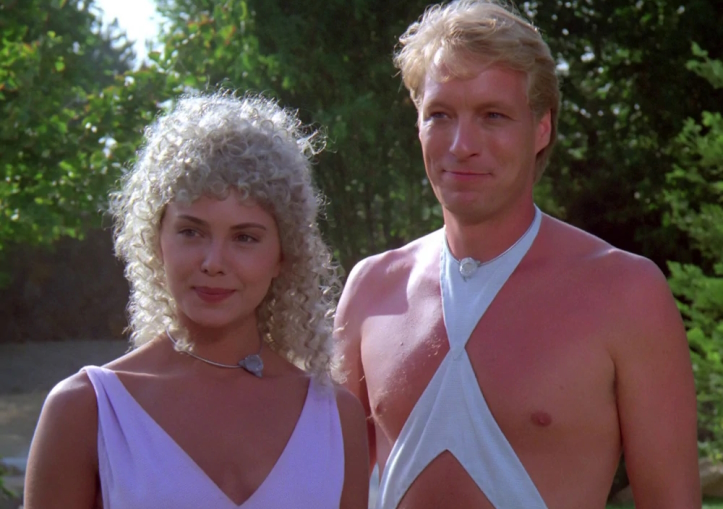
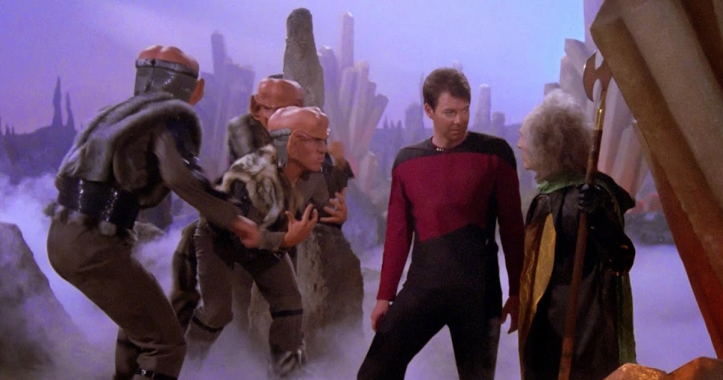
Let’s face it: Sometimes it’s a hoot to have truly bad and awkward entertainment as fodder for group mockery. It’s pretty much why Mutant Reviewers exists, some days. Season 1 gives us some legendary moments that have gone down in Trek history as laughably bad. I mean, who doesn’t like to take jabs at Wesley’s sweaters or Tasha taking Data to bed while high on a space virus? Or what about that planet where everyone wears a napkin, jogs all the time, and executes people for stepping on flowers? Or Picard’s wonderfully grumpy attitude toward kids? Or “Shut up, Wesley!”? Or the cavorting Ferengi and their laser whips? Or Q’s various disguises every time he shows up?
Some of this stuff is so, so bad — yet so bad it’s often enjoyable. Yeah, we roll our eyes at the racist episode where those guys steal women and fight to the death in a goofy gym… but we remember and reference it decades later, too. Star Trek: Lower Decks particularly loves to poke fun at this season in its parade of callbacks and franchise in-jokes, which is an indication of how much Season 1 has gone down in the history books.
Tasha Yar’s death is still genuinely shocking
With Denise Crosby’s disillusionment with the (admittedly) poor stories and character building she was given, she elected to bail on the show. Thus, the producers were given a rare opportunity to outright kill off a main character of a Star Trek series — and they did so with “Skin of Evil.” While the villain (a tar-covered trash bag) and actual moment of death was underwhelming, the event was given significant weight due to its aftermath. Tasha’s funeral is perhaps one of Denise Crosby’s finest moments on the show, as is the reactions of the other crewmembers.
In this situation, the “reset button” wasn’t pressed. Tasha stayed dead, Worf moved up in position to head security, and the foundation for future stories with Tasha Yar and her daughter was laid. While I think Crosby deeply regrets getting out of TNG right before it got good, it benefitted the show overall and gave this season some much-needed weight.
There’s an edge to some of these episodes
Jonathan Frakes went on record praising Season 1 for taking risks with its stories, which makes sense to me. TNG didn’t know what it wanted to be at this point, so it was trying a lot of things — and some of it was far more adult than we’d get in subsequent seasons. Sex was a frequent element — thank the ’80s and Gene Roddenberry for that — as was some icky moments of gore. We really didn’t know what to expect with this show, so when it skewed more adult than TOS, there was no reason to believe that it wouldn’t stay in that arena indefinitely.
Ron Jones’ evocative score
While the later seasons and series of Trek — right through Enterprise — featured bland, perfunctory soundtracks, one cannot say that of Composer Ron Jones. Jones was one of the key composers for the series from Season 1’s “The Naked Now” through Season 4’s “The Drumhead,” and his work is far above and beyond what the other composers did. His synth-laden soundtracks were pure imagination fuel, a character in itself that would infuse a scene with a scifi feel. It’s a very ’80s score but lovely in the vein of Flight of the Navigator. Listen to “Tasha’s Goodbye” and tell me I’m not wrong. He was an absolute treasure, and it was a shame the series ditched him midway through Season 4.
“Conspiracy” is an incredibly creepy and gory entry
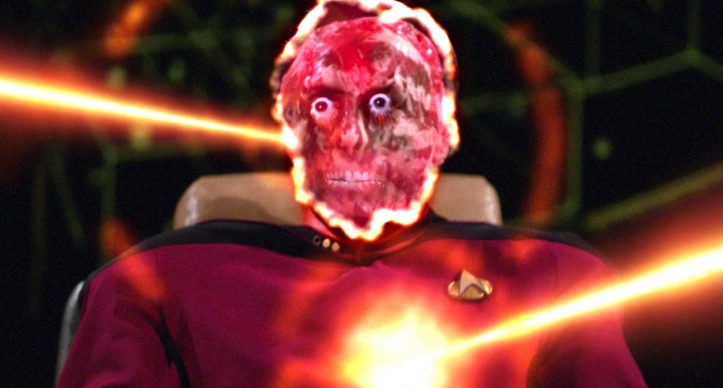
I’d argue that there is only one truly great S1 entry, and that is “Conspiracy.” This went down in Star Trek lore as one of the darkest stabs at true horror that the show ever did — and it does it well. Plus, you get parasitic bugs, a genuine sense of creepy paranoia, and Picard and Riker outright phasering a guy so bad that he explodes in a mountain of giblets.
The Enterprise is a ton of fun to explore
The first season really enjoyed showing us around this brand-new Enterprise, and even when the stories were bad, sometimes we got some fun sets like the holodeck, medical, the battle bridge, and engineering. Plus, this season contains two of the only three times that the Enterprise performs a saucer separation in the entire series, so you’ve got that going for you.
It makes you appreciate how far the show went after this
If TNG was canceled after season 1 or 2, chances are that we’d only remember it — if we remembered at all — as a sad, pale imitation of a much greater show. Instead, Paramount stuck with this until the series could gain its legs and truly aspire to greatness. Seeing Season 1 makes you appreciate the journey TNG made from an underwhelming scifi sequel to one of the most beloved shows ever made.
 Mutant Reviewers
I finished re-watch of TNG earlier this year while listening to a podcast about it as well. One host is a huge Trekkie and has watched every episode a bunch of times, the other was watching for the first time. They had a segment where the new guy comes up with theories about what the heck is going on. The theorized that Data was just screwing with everyone the entire time, which would explain his season 1 shenanigans.
What podcast?
sounds like Star Trek: The Next Conversation. Matt Mira and Andy Secunda are entertaining.
That’s the one
Star Trek the Next Conversation