
“Let them eat cake!”

Chad’s rating: Kirsten Dunst is a vixenish delight as the original Mean Girl
Chad’s review: If you paid attention in history class, you may have heard about the life of Marie Antoinette, the last Queen of France, before they abolished their monarchy in 1792. Depending on which version you were told, little Marie was a Paris Hilton-style, hard-partying heiress or a lonely teenager isolated at the Palace of Versailles, unaccustomed to her new decadent life. Either way, both her and King Louis spent an obscene amount of money that caused crippling debt, one of the triggers of the French Revolution. And she’ll always be associated with the rich rallying cry “Let them eat cake,” even if historically she never uttered those words.
Marie Antoinette and her controversial reign at Versailles is a tale ripe for cinema, with many screen versions over the decades. In 2006, the teenage monarch received a lavish, playful, and slightly anachronistic retelling courtesy of director Sofia Coppola. At this time in her career, Coppola had enormous capital after her first major commercial hit with the Bill Murray starring and Oscar-nominated Lost in Translation. The success of that film proved she had the talent of her famous filmmaking dad, Francis Ford Coppola, and helped her secure her first large-scale budget feature.
Marie Antoinette is, on one level, a straightforward biopic of the young queen. We’re introduced to Marie as the 14-year-old archduchess of Austria who is betrothed to Louis-Auguste, the future heir to the French throne. During the 1700s, England and France were the two big superpowers in Europe, and Austria decided to align themselves with the French by offering the monarch’s beautiful daughter in an act of political brinkmanship. It was an odd match as the awkward and not-very-attractive Louis was ill-suited for his young teenage bride.
But as Marie settles into her new, ultra-lavish lifestyle at Versailles, she finds herself under intense pressure to quickly produce a male heir to the throne. This is complicated by the fact that Louis is more interested in discussing his fascination with keys and locks than having fun with his new, gorgeous, and very horny wife. So, Marie does what many teenage girls do in this situation: start partying and spending a fortune on all manner of material goods with her new Versailles girlfriends.
But this credit card lifestyle runs its course when France teeters on financial ruin, with the elite monarchy underestimating the anger of the peasant class. Soon, the French Revolution kicks into high gear with the storming of the Bastille as the pampered King and Queen face an unruly mob breaking the gates of the Versailles palace, ending their unpopular reign.
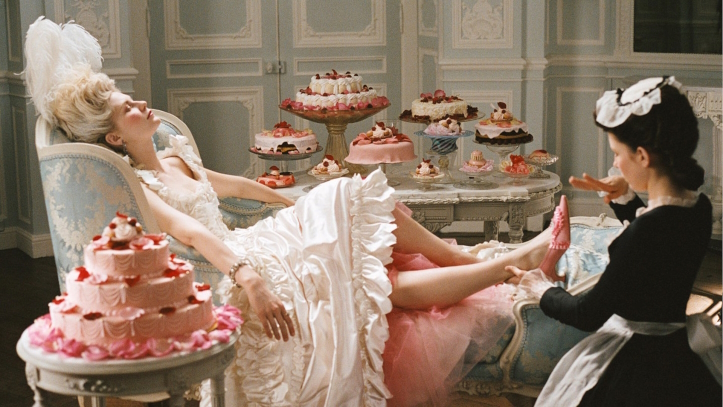
At first glance, Marie Antoinette may look like your plodding, stuffy biopic, but Coppola brings a fresh coat of paint to the standard period tropes. She infuses the picture with teenage brat-pack energy, portraying the Palace of Versailles as the ultimate Mean Girls high school full of gossip and secret affairs. The piece is slightly anachronistic, like the dashing Count Axel Ferson, one of Antoinette’s suitors, bearing an uncanny resemblance to ’80s pop-punk rocker Adam Ant. There’s even a quick shot of blue Converse sneakers during one of the teen monarch’s wild shopping sprees.
And the film is sprinkled with a new wave, alternative soundtrack featuring needle drops from New Order, The Cure, Gang of Four, and Siouxsie & the Banshees. This gives an extra kick to many scenes, like the montage of Marie and her entourage shopping for high-end shoes and jewelry while feasting on pastries, sweets, and champagne set to Bow Wow Wow’s “I Want Candy.” At times, the film has the feel of a music video, effectively showing the sugar high of a teenager being corrupted by this opulent lifestyle. A lifestyle that would ultimately end her young life.
Yet Coppola’s playful tone never diminishes the real-world drama and the tense political atmosphere that Antoinette had to navigate. The director was granted extensive access to the Palace of Versailles and filmed on location where the actual events took place. And when paired with the sumptuous costumes, this gives the film an immersive, documentary-style quality that is rare for a period piece. Coppola has a light touch behind the camera, with naturally lit shots that create a languid atmosphere. This keeps the picture from dissolving into an overt cartoon mess that takes its characters seriously.
This tone is helped by the perfect casting of Kirsten Dunst in the title role, going from a tween girl who matures into a confident young Queen. In 2006, Dunst was starting to grow into a dynamic actor, and she brings a sympathetic take to a historical figure that has been villainized throughout the years. Matching Dunst is Jason Schwartzman as King Louis, who does a socially awkward version of the young French royal. In real life, Louis was a disastrous king and quite the bore, but Schwartzman plays him like a socially inept nerd forced to hang out with the cool kids at high school. He’s going through the motions as a ruling monarch, much more interested in playing with his keys and locks than governing his faltering country.
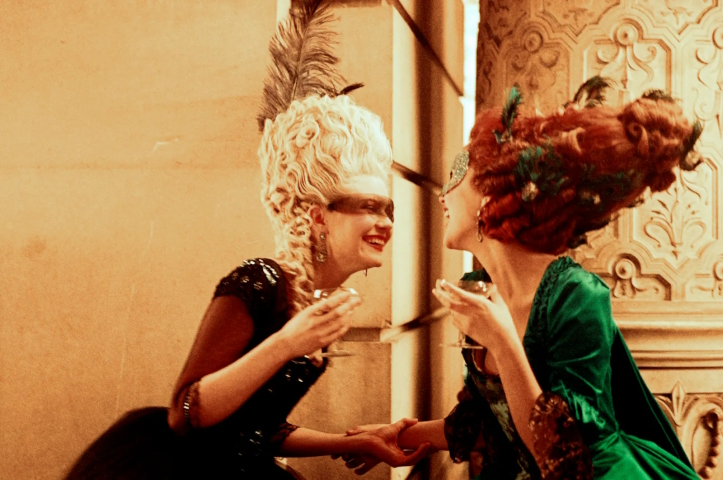
And Marie Antoinette goes out of its way to dispel many historical inaccuracies that have plagued these doomed monarchs. While Marie was quite the spendthrift, Louis was just as bad, as his government helped fund the American Revolution in the 1770s to weaken their English rivals. And the actors show that Louis and Marie had a warm and loving marriage, despite Marie taking on many side lovers and dalliances. Apparently, Louis had a medical condition preventing him from performing in the bedroom. But he figured things out as the couple did produce four children.
And yes, Coppola cleverly inserts the famous “Let them eat cake” line into the narrative, although Antoinette never said the phrase. Many historians attributed the quote to angry reporters covering her disastrous reign.
If the film has any fault, it’s the POV, which is strictly from the royal’s point of view. The picture never leaves the walls of Versailles, where the lower classes were living in immense poverty. Without this contrast, the narrative lacks teeth, leaving audiences unsure how they should feel about these pampered elite figures. The only glimpse we get is when Marie lays her head on the Versailles balcony as she confronts a torch-filled mob. It’s an operatic beat that foreshadows Louis and Marie’s eventual death by guillotine.
Marie Antoinette is a faithful retelling of the hard-partying Versailles queen, embellished with many new-wave flourishes. The film has a punk spirit but is also a historical nuanced portrayal of the doomed Queen of France. One wishes director Coppola focused on the fascinating political dynamics that were happening across Europe. The ideas of equality and democracy were taking root, and this was a monarchy unprepared to handle this new reality. While at the same time, ironically, they helped fund the American Revolution, a country fighting for its democratic independence.
 Mutant Reviewers