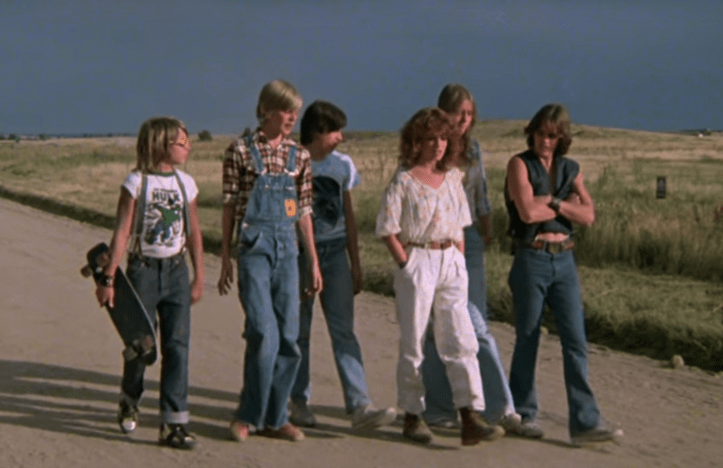
“Seems to me like you all were in such a hopped-up hurry to get out of the city that you turned your kids into exactly what you’re trying to get away from.”

Drake’s rating: Like I’m gonna tell you. I ain’t no snitch!
Drake’s review: I moved around quite a bit when I was a kid. Between moving from one state to another, and from rentals to the houses my parents would own for a year or two before switching states again, I ended up moving nine times between the start of grade school and the end of high school. So I saw quite a few different suburban areas during those years, some better than others. Now, we never moved into one of those remote housing developments that somehow sprung up like weeds in the middle of a deserted wasteland, but my parents certainly looked at houses in those areas.
And they were depressing.
Generally located right smack in the middle of nowhere, these “planned communities,” as they were called, offered housing free from the hassle of the city, but lacked anything in the way of character. Or a downtown. Or anything, really, except more houses. Yet families were understandably drawn in by the promises of inexpensive housing free of traffic and crime. So they packed up and brought their children and then just expected the kids to somehow amuse themselves with literally nothing to do and nowhere to go.
And that’s the setting for Over the Edge, a remarkably on-topic film from director Jonathan Kaplan. Inspired by a newspaper article titled “Mousepacks: Kids on a Crime Spree” which detailed a juvenile crime wave that plagued Foster City, CA in the early 1970’s, Over the Edge gathered a cast of unknown actors who were all in the age range of the characters they were portraying. It was a brilliant casting decision, giving the film an almost pseudo-documentary feel as it follows the travails of the kids growing up in New Granada, a planned community in Colorado.
This being the ‘70s, the kids hang out in basements, smoke weed, and drink beer. They’re also hassled incessantly by Sgt. Doberman (Harry Northup), a cop who busts them for crimes real or imagined because he’s really just as bored as they are.

Focusing on Carl (Michael Kramer) and Richie (Matt Dillon), Over the Edge continually ratchets up the tension. The kids have a party, and it gets busted by Doberman. They hang out at the rec center, their sole retreat from the adult world, only for Doberman to again show up to harass them. And they strike back. At first it’s just in little ways, and sometimes the violence is directed against each other. But then the unthinkable happens: a tragedy that no one comes back from unscathed. And that’s when things truly go over the edge.
Over the Edge is not an upbeat movie, and it’s somewhat surprising that it was even made. Teen angst movies had been been a draw since Rebel Without a Cause, but rarely had they been as honest and unapologetic as Over the Edge. And it’s not necessarily an only child of its era: if you squint a bit, it could well be considered a distant cousin to Adrian Lyne’s Foxes and Penelope Spheeris’s Suburbia. But where the former cast known actors and highlighted the lives of troubled teens in the San Fernando Valley and the latter leaned heavily into its punk rock ethos, Over the Edge is very much a look at what could be the teens of any given community that makes the mistake of ignoring them and leaving them to their own devices.
Little seen in its day thanks to the lack of a wide release, Over the Edge has gained quite a cult film following in the decades since. And that fandom is well-deserved. Over the Edge rewards its audience for their attention by giving them an exploitation picture with some real meat on its bones. Well-written and directed with a pragmatic eye and genuine performances from a cast largely made up of unknowns and non-actors, Over the Edge stands out even today as both a solid film, and an indictment of valuing property over people.
If you haven’t seen it, I recommend a watch. And if you somehow don’t like it, don’t worry. I won’t tell anyone. After all, “a kid who tells on another kid is a dead kid.”
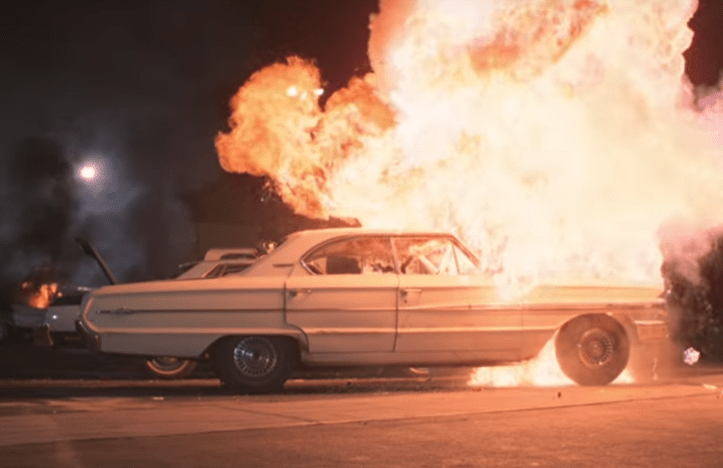
Intermission!
- Over the Edge had a quick, limited release in theaters before it was pulled by the studio, who feared riots in the theaters. Because studio bigwigs are a pretty thick lot.
- Shot as On the Edge, the film’s title was changed after a studio screening.
- This was the feature debut for both Matt Dillon and Vincent Spano.
- Director Jonathan Kaplan’s father is Sol Kaplan, who was blacklisted in the 1950’s. The elder Kaplan scored the music for this film.
- In addition to Sol Kaplan’s score, the film features music by Cheap Trick, the Cars and the Ramones, among other popular bands of the time. It was one of the first films to utilize a rock & roll soundtrack, which became a commonplace element of teen films by the early ‘80s.
- Much of the dialogue was ad-libbed by the young actors, to keep the tone of the film current and realistic.
- Planned communities were also used by Steven Spielberg in a couple of his early ‘80s films to help create an aura of separation and alienation.
- The partially-built house the kids go to is a metaphor for the entire film. The builders are running out of money and the house is left incomplete and ignored, just like the kids.
- Over the Edge not only influenced Richard Linklater’s Dazed & Confused, it was a favorite movie of Kurt Cobain’s. Guns N’ Roses’ guitarist Slash also mentions it in his autobiography.
 Mutant Reviewers
Saw this on Sho years ago. I was an early not late 70s suburban kid and my crowd weren’t nearly that bad (though pot was ubiquitous) but it caught the era pretty well. Also the final shot where a kid is on the bus to Juvie they are playing Ooh Child – one of my All Time Favorite Old Songs.
It felt very timely when I caught it in early 1980 as well.
For the end song, they originally wanted to use the Who’s “Teenage Wasteland,” but couldn’t afford it. I honestly prefer the music they did use as well. It felt much more in tune with the movie (and is just a great song in any event).