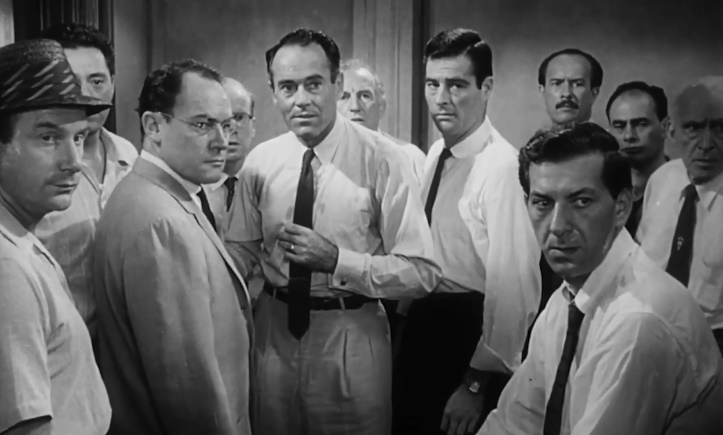
“Supposin’ you talk us all out of this and, uh, the kid really did knife his father?”

Justin’s rating: I find this film GUILTY… of being entertaining!
Justin’s review: Going back to see a movie “classic” can be challenging. After all, my generation was bred on snappy dialogue, quick cuts, spectacular stunts, mega stars, and identifiable pop culture references. Picking up a black-and-white tale from the forties or fifties with stars that are either now decrepit or dead, pacing that’s as slow as rush hour traffic, and references to a whole way of society that’s long since gone… well, it’s just not the first thing I go for at the video store. Yet it’s good to stretch yourself from time to time, which is why I popped in 12 Angry Men the other night.
12 Angry Men is a ’50s adaption of a ’50s play with a starkly simple set up. You have twelve hot and sweaty jurors on a recently concluded murder trial locked in a small room and debating the verdict. The case involves an 18-year-old kid with Bambi eyes accused of stabbing his father to death — and the evidence seems overwhelming in favor of a guilty verdict. This is as open-and-shut as it possibly could be. So everyone thinks… with the exception of one stubborn man to has an objection to voice.
The majority of the film takes place inside a sauna pit of a boardroom. It’s the whitest group of males you’ll ever see, but on closer examination, there’s quite a variety in the bunch. If you get really bored watching this, make a game of watching their sweat stains grow and retreat over the course of the film. Aside from a slow first few ten minutes or so (I’ve never been a big fan of plays that feel the need to sketch out characters thoroughly before any action occurs), I doubt you’d be bored. I can’t properly express the feelings 12 Angry Men pulled out of me, but there was a lot of tension, suspense, and wide-eyed fascination as things unravel.
And unravel they do. While the characters and setting might be slightly archaic, it’s really not as dated as you’d think. In fact, 12 very opinionated guys disagreeing on everything without any noticeable results… well, that’s a college project group to me. Who hasn’t known a loud-mouthed brute who uses his (or her) sheer bellow to get their way? Or a meek yet frustrated nerd, or a jokester that just can’t get serious, or the silent thinker in the corner, or the prejudiced jerk? Sure, it’s kind of funny to see a big deal made out of prejudice against teens (as some sort of ultimate menace of the era), but make a mental adjustment to bring it up to our times, and the discrimination exists the same.
As one man (Henry Fonda) sets out to prove that there is “reasonable doubt” in the case, he stands alone and is not even sure why he disagrees. He’s just certain that something is a bit off about the case. This theme of not bowing to popular opinion, when everyone is telling you that you’re stupid and alone, yet you know you’re right and can’t betray yourself — I think I admire this the most about the film. We’ve all been there, and so many times we took the easy (and perhaps the wrong) way out.
In any case, Henry Fonda’s character holds his ground, and the debate begins. Every new vote reveals the change between the ratio of guilty-to-not guilty, jacking up the tension to near-unbearable levels. Nothing about the ending comes as a shocking twist of a surprise, but it still pays off in a quiet but tremendous climax. I don’t know what kind of mood you need to be in to see 12 Angry Men, but young and old alike should gather at the glowing tube to share in a classic of civilization as we know it (naturally, not that “Atlantian” civilization… those perverts).

Drew’s rating: 12 angry men, 12 great performances.
Drew’s review: I am an optimist. That may come as a surprise to those of you who remember my scathing reviews of It’s A Wonderful Life or A Chipmunk Adventure, but it’s true. I’m not blind to the fact that many people do horrible, disgusting things to each other out of ignorance or fear or jealousy. But I also believe that most people are inherently good at heart, and if given half a chance and there’s nothing good on TV, will try to act accordingly. I honestly believe that.
But I also believe that people are flawed creatures who often think we know more than we really do. It’s human nature — we like feeling smart, and we like feeling in control. And so do the members of the jury depicted in this film, who’ve just heard a murder trial and have to decide whether they’re sure enough of his guilt to send an 18-year-old boy to the electric chair. Most seem quite sure enough indeed, but a lone holdout, Juror #8, isn’t convinced. He freely admits that the kid might be guilty, but there are a few points still bothering him… and so begins our movie. Before it’s over tempers will fray, prejudices will be laid bare, and switchblades will be shoved into tables. And who knows, you just might walk away with a few thoughts of your own — positive or negative — about the American legal system.
As Justin pointed out, this is an old film. I’m not one of those guys who claims that all old movies are outstanding and an over-reliance on special effects is ruining cinema, I mean what is this “Star Wars” crap anyway? But at the same time, I can respect what filmmakers were able to accomplish back in the day with limited resources, and 12 Angry Men is about as spartan as it gets. 12 actors, a room, a table and chairs, a couple of props. That’s not a movie, it’s a play, and it would be incredibly easy for an audience to get bored in such a setting. Instead, we’re unequivocally gripped by the drama unfolding before us, all thanks to some tight cinematography and the talented cast spearheaded by Henry Fonda. As the one dissenter on an otherwise decided jury, Fonda has the unenviable task of making his character seem pensive and willing to stand his ground, but without coming across as contrary just for the sake of it. And to his credit, he succeeds: Juror #8 projects as compassionate without being sappy, earnest but not cloying, soft-spoken but secure in his convictions.
It’s a great performance, but one man does not a film make, and that’s where the rest of the actors come in. The worst thing you can say about the characters in 12 Angry Men is that they’re a bit stereotypical — there’s the old bigot, the meek bank clerk, the obnoxious sports fan, the hesitant but wise immigrant, etc. Part of that can be chalked up to our never finding out their names, since anyone whose name you don’t know will naturally come to be defined by their primary personality trait. But even so, they can still surprise you… one of my favorite characters is Juror #4, who despite agreeing with them regarding the verdict, takes pains to distance himself from the bigot and the sadist at every opportunity. Speaking of whom, Lee J. Cobb is perhaps even more impressive in his role as the sadist (aka Juror #3) than Henry Fonda is as the voice of reason. Cobb’s emotional outbursts and self-righteous anger play excellently off of Fonda’s cool, logical approach to the proceedings.
Even if you’re generally not a fan of older movies, I still urge you to check out 12 Angry Men. If it helps, think of it as the precursor to very dialogue-heavy modern films like Reservoir Dogs or Clerks. You may very well walk away feeling like it’s the cat’s ass; and if not, hey, at least you’ve gotten some valuable tips on how to get out of jury duty. Give it a shot, you can’t go wrong.
 Mutant Reviewers