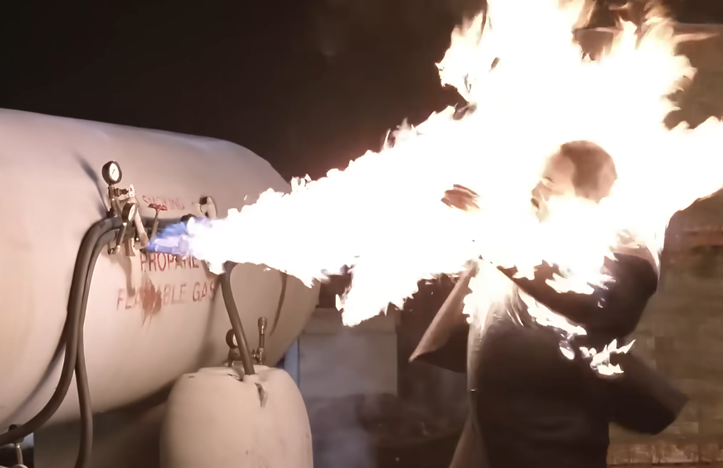
“I’m gonna light you up!”

Drake’s rating: Sadly, the car chase might be the best action sequence in this karate flick
Drake’s review: Although martial arts movies never really went away, they had become a bit moribund by the late 1980s. Still, Cannon Films had embraced the genre throughout the decade and weren’t ready to give up on it yet, and their perseverance paid off in 1988 when Bloodsport catapulted Jean-Claude Van Damme to international fame while pulling in big box office numbers on a very meager budget.
Follow-up efforts Cyborg and Kickboxer proved that the Belgian star was no flash in the pan, and martial arts flicks were suddenly on the theater marquees once again instead of merely sitting on a shelf at your local video rental store.
So with that in mind, Paramount Pictures decided to take their shot at launching a martial arts action hero of their own. Which, I think we can all agree on, is easier said than done. After all, while there might be scads of martial artists out there, practicing a wide variety of styles, the history of the martial arts movie has taught us that it’s the rare few who can act their way out of a paper bag, and even fewer who have the charisma to lead a film.
Still, Paramount forged ahead, inking a deal with American Kenpo practitioner Jeff Speakman, a student of the renowned Ed Parker who had been taking acting classes for several years. Surrounding Speakman with some decent talent, Paramount produced The Perfect Weapon, which put Speakman’s character, Jeff Sanders, in the middle of a gang war in Los Angeles’s own Koreatown, which is where Jeff* learned his martial arts skills.
Even though Kenpo Karate is Japanese in origin.
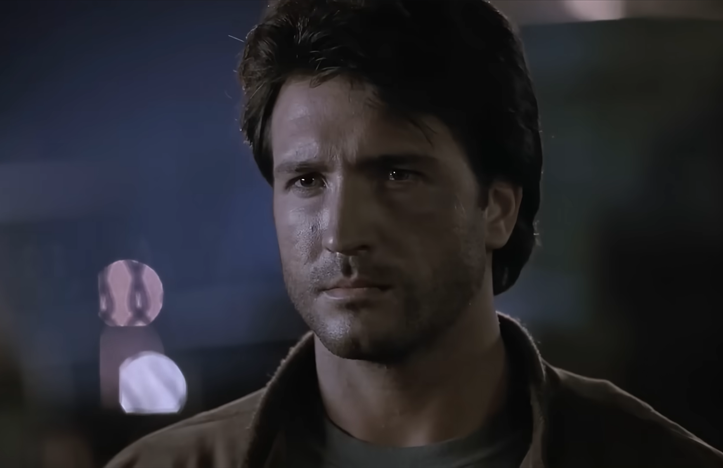
Still, Koreatown is where Jeff reunites with his old friend Kim (Mako, Conan the Barbarian), a shopkeeper being menaced by what he calls “the Korean mafia.” Even though Mako was Japanese-American, and not of Korean descent.
Yeah, it’s unfortunately of one of those movies. Everything remotely Asian is lumped together under one generic label and just stirred together, and aside from one “My Kenpo can beat your Taekwondo” sequence there’s little thought given to the fact that the movie’s dealing with people and customs from very diverse cultures.
Still, it was 1991. At least the filmmakers realized that Korea wasn’t just the setting for M*A*S*H.
As Kim comes to a bad end, Jeff undertakes a mission of revenge, which is something I’ve NEVER EVER seen happen in a martial arts movie, aside from the first one or two hundred times before this. This brings him up against James Hong, who we all know is the bad guy since we’ve all seen Big Trouble in Little China at least a dozen times,** and his hulking sidekick and former professional wrestler Prof. Toru Tanaka. Cary-Hiroyuki Tagawa also gets a blink-or-you’ll-miss-it bit cameo, which I mention as I was a big fan of his.
You’ve probably seen The Perfect Weapon before, even if you’d never even heard of it until reading this review. It’s a very by the numbers martial arts movie with exactly zero surprises, with a plot that could have come directly from an old Golden Harvest production.
The thing is, it’s not all bad. In fact, this is a fairly average martial arts flick, with some strong fighting sequences that really show off Speakman’s skills and especially his impressive hand techniques. The veterans among the supporting cast are a welcome sight, and Speakman himself is not without charisma.
But, and here’s the rub, it’s the wrong kind of charisma for the role. Jeff Sanders is written as a man with anger issues stemming from the loss of his mother at a young age. Tempered somewhat by his martial arts training, that anger nevertheless manifests itself once again when Kim is killed, and we’re supposed to believe that Jeff could go off at any time and let his emotions run wild.
Except, we can never buy into that because Speakman is not that kind of actor. He doesn’t have that kind of edgy charisma. What he does have is Nice Guy Charisma. If he’s the dad that’s taking your kids to soccer practice that week, you know they’re in safe hands. If he says he’ll water your plants while you’re on vacation, you know you’re going to come home to a house full of green ferns. If you need a ride home from the airport, you know he’ll be there 20 minutes early and stay to pick you up even if the flight has a delay.
He’s a Nice Guy.
Which is great, and there’s definitely room for that kind of character in the movies, but it’s probably not in what’s supposed to be a revenge-driven action flick.
Unfortunately, Speakman’s time at Paramount ended after The Perfect Weapon, although he did continue to star in action movies throughout the ‘90s for smaller studios, including a Cannon Films that was on the verge of bankruptcy. Unlike JCVD, he never had a breakthrough role, and while Chuck Norrris kept grinding his way through the ‘90s and Steven Segal inexplicably became an action star, Jeff Speakman faded into filmic obscurity.
Maybe it’s true, after all. Maybe nice guys really do finish last.
*The movie Jeff, not the real Jeff.
**Some of us even saw that one in the theater. Hi, Al!
Intermission!
- Man, Jeff’s timing is impeccable. He arrives back in town just as Kim’s store is getting destroyed by the bad guys.
- And then he karates them, as one does.
- Chasing a car on foot really only works if you’re the Flash.
- Lots of shirtless men fighting in this movie.
- Petulant box kicking. Jeff’s brother is a pissed-off cop and he’s gonna kick some boxes.
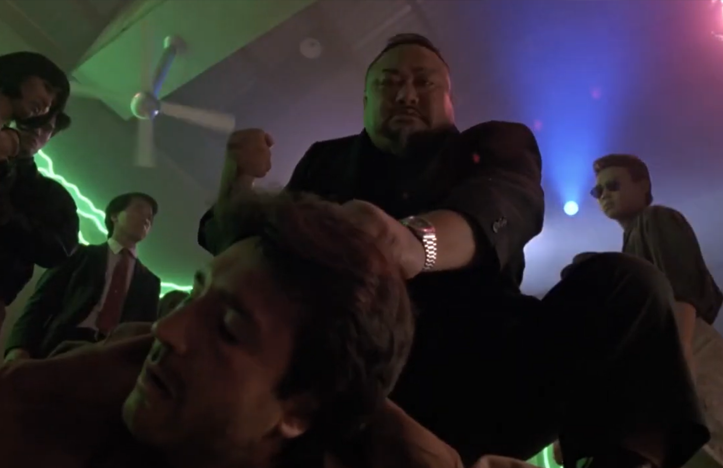
- Jeff goes clubbing, in the most well-lit club I’ve ever seen.
- Aw. Prof. Tanaka looks all sad when he doesn’t get to kill Jeff.
- Because what’s a martial arts action movie without a car chase?
- He brought a knife to a Kenpo fight.
- Yes, that’s Mariska Hargitay. No, she doesn’t even have a single line.
- Sure, they’re just standing around looking at each other as the movie ends. But then I think they go out for ice cream.
 Mutant Reviewers