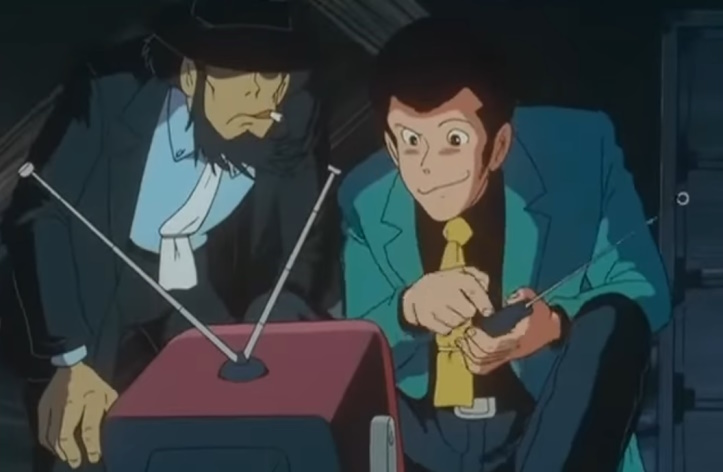
“Dig to your heart’s content. This is government land. Any gold you find will be turned over to the Treasury Department and used to reduce my taxes!”

Sitting Duck’s rating: Eight out of ten gold roof tiles
Sitting Duck’s review: The Lupin III franchise has a problem, and that problem’s name is Goemon Ishikawa.
I should probably clarify. Let us begin with a core cast comparison between the Lupin III franchise and what is arguably its source inspiration, Diabolik. At the center, we have Lupin and Diabolik, both as the master thieves pulling off outrageous heists while frequently disguising themselves using the elaborate face masks more commonly associated with Mission: Impossible. Representing the opposition are Inspectors Zenigata and Ginko, both as the persistent yet sometimes hapless police detective determined to have their quarry locked away. Things get a bit weird, as while Jigen is Lupin’s ever reliable partner-in-crime and Fujiko is the sultry femme fatale, Eva Kant fills both of these roles for Diabolik.
So how does Goemon fit in to all this? The unfortunate truth is that he doesn’t really. Particularly in the movies, he often won’t arrive until around the halfway point to provide some extra muscle for a caper. Sometimes it seems that his only purpose is to provide an overtly Japanese character (even though Jigen, Fujiko, and Zenigata are all implied to be Japanese), what with his wearing a hakama and his wielding an absurdly sharp katana. This fifth wheel status was especially apparent in the 1996 TV movie The Secret of Twilight Gemini, where his handful of appearances were random and completely irrelevant to the plot.
But sometimes a bone is tossed to Goemon and he gets to take the center stage. And nowhere is this more apparent than The Fuma Conspiracy, which opens with him getting married. But this being a Lupin III movie, there has to be a complication. And since we’re in Japan during the 1980s, this involves wedding crasher ninjas from the infamous Fuma clan. But they’re not here to do something as cliché as kidnapping the bride Murasaki Suminawa. No, all they want is the Suminawas’ antique heirloom vase which is present at the ceremony. But while the Fumas fail to obtain the vase during the hectic battle, they do snatch Murasaki. Because some traditions must ultimately be observed.
In quick order a ransom demand is received, insisting that Murasaki will be returned in exchange for the vase. However, the Suminawa clan elder considers the vase to be too valuable to give away in such a fashion and refuses to negotiate with ninjas. This doesn’t sit well with Lupin, whose first instinct regarding damsels is to rescue them. So later that evening he swipes the vase from its hiding place and arranges a meeting for the tradeoff.
Obviously Lupin has no intention of giving away the vase. But then the Fumas weren’t planning to play fair either. The meetup quickly devolves into a scuffle that becomes even more confused when Inspector Zenigata barges in. The end result is that Lupin’s gang regains Murasaki but loses the vase to the Fuma clan.
So what’s the big deal regarding this otherwise unremarkable vase? Turns out it’s a figurative and literal key to the Suminawa treasure which the Fuma clan covets. And it’s an actual treasure of gold rather than some “The real treasure was the friends we made along the way” malarkey. However, it’s stashed away in a vast underground complex riddled with traps that would do an Indiana Jones movie proud. Now it’s a question of who can smash and grab their way in and out first before the whole place self-destructs, because of course there’s a self-destruct.

The Lupin III movies tend to adhere to a particular formula which The Fuma Conspiracy doesn’t stray from much. The only deviation of particular note is how Goemon has such a central role. But it’s a good formula, so long as you don’t botch the execution. And for the most part, they manage to pull it off.
Something that is occasionally touched on in the Lupin III franchise is the question of whether Zenigata really wants to capture Lupin. The short answer is that he doesn’t. While he likely wouldn’t admit it to himself, for Zenigata the chase itself is the whole point. So what would happen if Zenigata were to believe that Lupin was dead? Here it is posited that he would become a Buddhist monk, continually praying that Lupin reincarnate as a more law abiding individual. Which is good for a cheap laugh.
Now I’m sure some of you are asking the question, “How much of a damsel is Murasaki?” The answer is, “Not as much as she could have been.” Let’s make one thing clear. Murasaki is no secretly badass waif fu who can take out a dozen ninjas with a flick of her pinky. However, neither is she a Load. One of the smarter narrative choices was to have her be released from her captors early on, thus sparing us from scenes of the Big Bad dangling her just out of reach of the heroes as she cries out, “Help me! Help me!” Instead, she gets to prove her worth, especially in how she aids them in navigating through the potential hazards of the Suminawa underground complex. This sort of support role is valuable yet doesn’t really get the respect it deserves anymore.
However the production does have its share of hiccups. One that could throw off potential new fans is the tonal dissonance. On one hand, the movie is quite violent (as befitting a storyline where Goemon is front and center) and can sometimes get pretty brutal. On the other hand, there are many sequences (in particular the big chase scene) which feature straight up Looney Tunes slapstick. Now I personally have no problem with the presence of the latter. That chase scene is a masterpiece, and I suspect that nothing else in the franchise has equaled it before or since. Still, it feels like it would have fit better in a Pink Jacket era production. And I wouldn’t blame rookie viewers for being put off when it goes from Keystone Kops tomfoolery to mooks getting skewered with bamboo poles.
One notorious issue involves the voice acting. On the Japanese end, there was a minor scandal over how the regular Lupin III franchise voice actors were not cast in their usual roles as part of a cost cutting measure. Unsurprisingly, this engendered considerable ill will and it’s been claimed the performances didn’t properly match the characters. As someone who isn’t exactly fluent in Japanese, I cannot personally confirm or disprove this.
I can however judge the quality of the English dub. For the most part it’s competently performed. But there are a couple that are off. First there’s Jigen, who performance lacks the world-weary pessimism that is a defining trait of the character (something better captured in the Red Jacket era features dubbed by Funimation). But it’s Lupin where things get really questionable.
Particularly after The Castle of Cagliostro, Lupin’s voice in English tends to have a goofy tone to it. Even in the recent Blue Jacket series which harkens back to the more hard-edged vibe of the original manga, there’s still a certain mischievous whimsey that is retained in the performance. But here it goes way over the top. There’s no getting around it. Lupin here sounds kind of like Charles Nelson Reilley. Though I suppose we should be grateful that Fujiko didn’t have a Brett Somers voice.
If there’s any consolation, the producers don’t appear to have blown the saved money on epic lunches. Because the overall quality of the animation is fantastic. The fluidity and attention to detail (in particular how they manage to keep all the license plate numbers of the police vehicles chasing Lupin straight) is a site to behold. Certainly above and beyond the call of duty for a 1980s TV movie.
If you want a movie to introduce a friend to the Lupin III franchise, this is not the one. The Castle of Cagliostro with its Miyazaki connection would be a better bet in that regard. However, if you think said friend can roll with the potential issues, this is a decent choice for a second or third screening.
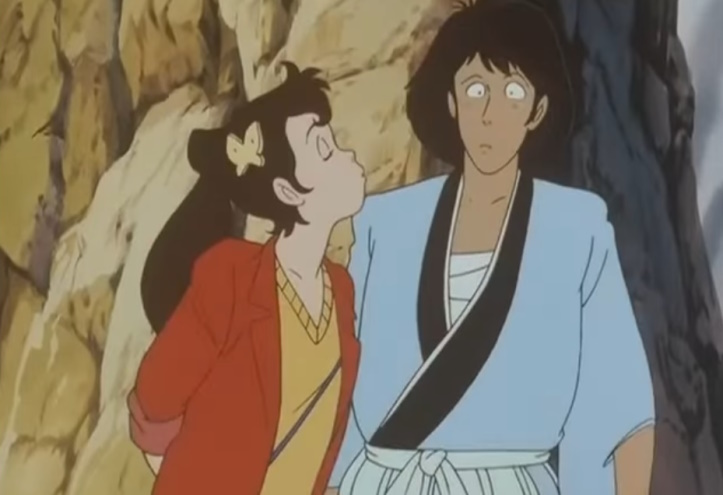
Intermission!
- Stupid Jetpack Ninjas
- “What a tragic loss this is. May your soul rest in peace. Okay, let’s get going, Jigen.”
- Since when do ninjas use submachineguns?
- You can never trust anyone with teeth like that
- I mourn the state of Zenigata’s lungs
- You’ve just guaranteed his survival, idiot
- That’s cold, even for mooks
- What’s with the Golden Axe opening screen music?
- “Let them go, Inspector. They didn’t take anything.” “No, I can charge him with police interference, traffic violations, and destruction of pottery!”
- Lupin’s name is an homage to the gentleman thief Arsène Lupin, a character created by French author Maurice Leblanc in 1905. The Lupin III manga debuted in 1967, so the III appended to his name that implied that he was the original Lupin’s grandson would have been plausible (not so much in more recent fare). As the copyright for the Lupin stories expired sooner in Japan than in America (or at least had been less rigorously enforced), the earlier English dubs would rename the lead character to keep the Leblanc Estate off their necks. These alternate sobriquets include Rupan (the one used in The Fuma Conspiracy dub), Wolf, and Cliff Hanger.
- Daisuke Jigen is a pastiche of characters that had been portrayed by James Coburn (particularly Britt from The Magnificent Seven). In fact, his voice actor Kiyoshi Kobayashi was the official voice of James Coburn in Japanese dubs of films he appeared in, further cementing the connection for Japanese audiences. As an additional point of interest, Kobayashi was cast as Jigen starting with the first TV series and (aside from The Fuma Conspiracy) continued to voice the character in every Lupin III TV series, feature movie, OVA, and TV special until his retirement about fifty years later.
- Fujiko Mine’s name is more Bond Girl-ish. Fujiko is Japan’s most famous mountain with the -ko suffix frequently seen in female Japanese names, while Mine can mean summit. So her name in essence is Titties Galore.
- Goemon Ishikawa is also the name of a Sengoku Period outlaw who has over time become something of a Robin Hood-style folk hero in Japan. Portrayals in modern media will typically have him possess supernatural abilities.
- Inspector Koichi Zenigata alludes to Heiji Zenigata, the protagonist of a series of detective novels by Kodō Nomura that take place during the Edo Period of Japan. The character is particularly known for his trademark gimmick of using coins (known at the time as zeni, hence his name) as projectiles.
 Mutant Reviewers