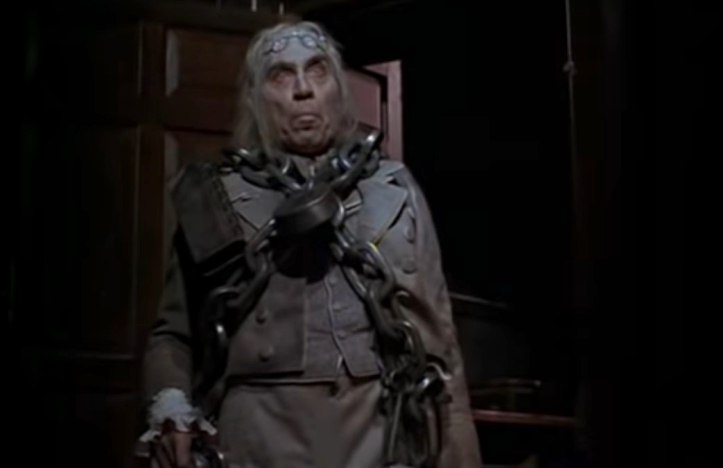
“Would it be too much to ask that you get back to the work for which I pay you so handsomely?”

Sitting Duck’s rating: Nine out of ten yards of spectral chain
Sitting Duck’s review: When it comes to standalone literary works, there aren’t many that are as frequently adapted to film and television as A Christmas Carol. Certainly it’s the most successfully adapted thanks in part to its novella length, sparing it from the gross padding seen in short story adaptations not part of an anthology film or the ruthless trimming and condensing that comes with adapting a novel.
There are the straight adaptations featuring the likes of Alistair Sim, Albert Finney, and Patrick Stewart as Scrooge. Then you’ve got the franchise variants, where characters from properties like the Muppets, Disney, and the Smurfs are inserted into the appropriate roles (though I still don’t buy Goofy as Marley). In a similar vein, shows like The Real Ghostbusters, Upstart Crow, and WKRP in Cincinnati have used the structure of A Christmas Carol in their Christmas episodes.
To keep things interesting, there are off-beat alternatives such as the all-black John Grin’s Christmas starring Robert Guillaume (which when I saw as a child intensified my fear of being in a dimly lit room with a mirror) and Rich Little’s Christmas Carol (where the title performer does his impressions of various celebrities in a one man show). And what is the Grinch, really, but Scrooge being more active in his hostility towards Christmas?
Though if you happen to be the sort who regards Scrooge as a worthy banker who devolved into a sentimental chump, there’s always Blackadder’s Christmas Carol. Fair warning to those unfamiliar with Blackadder — this one is quite meanspirited in tone.
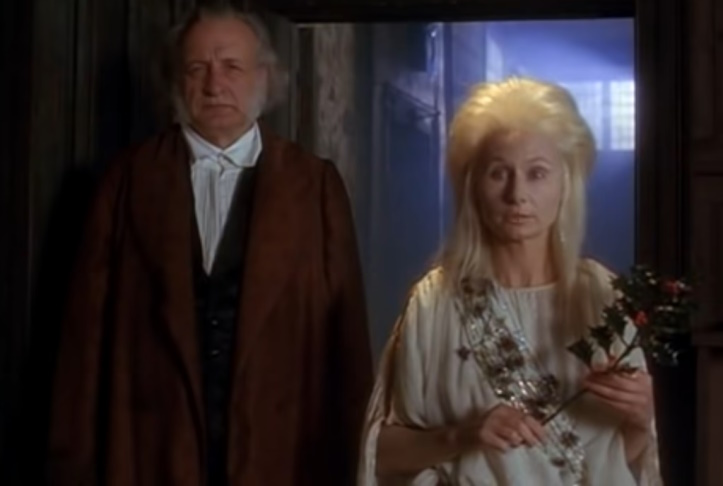
Yet even with this wide selection, there is no question which version our family preferred, viewing it year after year: the 1984 TV movie adaptation starring George C. Scott as Scrooge. Unfortunately, once the switch from VHS to DVD was made, A Christmas Carol was one of the titles for which we never got around to obtaining a DVD version. So, with Justin insisting on a Christmas movie review for the month Or Else, now is as good a time as any to revisit this old favorite to see how well it has held up.
There’s not much point in writing up a plot summary, as the basic storyline is so familiar. Since this adaptation is reasonably faithful to the source material (with the bulk of the dialogue being used verbatim), it’s simpler to just note the deviations. The first major change is an added scene where Scrooge visits the London Exchange to discuss business with the trio of investors that later show up during the Christmas Yet to Come sequence. The two charity solicitors also have their scene moved to this point. When Marley enters Scrooge’s chambers, the door opens on its own rather than him walking through it, because this is being done on a 1984 TV movie budget.
Fan is now Scrooge’s older rather than younger sister, so he can have caused his mother’s death by childbirth that earned his father’s resentment. His would-be fiancée Belle gets introduced during Fezziwig’s Christmas party rather than when she dumps Scrooge, though many other adaptations do this. The tour of the various Christmas celebrations in the Christmas Present sequence is more or less cut and would have been difficult to pull off even as a montage. Fred’s Christmas party features different party games, though both end with a jape at Scrooge’s expense. A scene in the Christmas Yet to Come sequence where a couple in debt to Scrooge are relieved as how his death gains them a reprieve (even if they feel a bit guilty over it) is excised. The scene where the char is having the stuff she looted from Scrooge’s place fenced and the scene with the corpse in repose have their order switched. And of course, any scenes where Scrooge is not present are pure conjecture.
For the most part, these are trivial alterations of little consequence. However, there are one-and-a-half changes of greater significance. The full alteration (and the one that really grates my cheese) is how it gets implied that the whole experience Was All a Dream. Though at least it was much more ambiguous than how it was done in the 1939 version of The Wizard of Oz. The half-alteration is technically not an alteration at all. The idea that Scrooge went on his excursion in his nightgown is not something that occurs in the book (at least not explicitly). But thanks to movie versions showing Scrooge romping about in the bitter 19th Century winters in his jammies, we have been Screaming Skulled into believing that this is a book original aspect. Whether they were trying to get closer to the book or because no one makes George C. Scott wear a dress, the 1984 version bucks this trend.
With the actual narrative mostly intact and the changes being minor irritants at worst, it is characteristics like the acting and the production values that’ll distinguish it from the rest. And on this point the feature mostly succeeds.
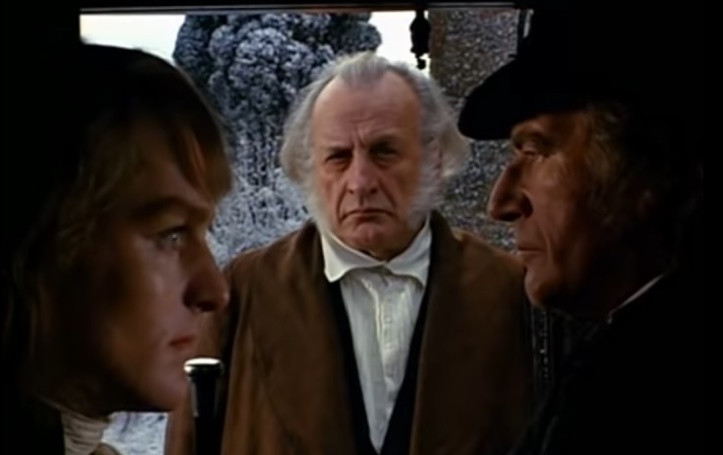
One of my issues with other adaptations of A Christmas Carol is how Scrooge often comes across as whiny, which makes it difficult for me to take him seriously. George C. Scott is not one to demean himself in such a fashion and presents the character with a gruff meanness that makes him more convincing as a cruel miser.

Then there’s David Warner as Cratchit, who infuses the character with incredible warmth. This can be especially startling for those who are only familiar with his villainous roles. In particular, his scene in the Christmas Yet to Come sequence where he talks about Tiny Tim’s death actually got me a bit misty-eyed. And I speak as someone who is more likely to react to such brazen emotional manipulation with rolling my eyes.
Of the three Christmas spirits, the one who really stands outs is Edward Woodward as the Ghost of Christmas Present. Part of this is due to how bombastic the character is. But there’s also how the actor is able to switch between joviality and sternness and back without it being jarring.
Another aspect worth noting is the cinematography and how it themes to each segment. During Christmas Eve, the ever-present fog minimizes the lighting, giving it a mildly grim feel. Christmas Past a rather washed-out look to it. Christmas Present (as well as Christmas Day Proper) is very bright and vivid and full of good cheer. Finally, Christmas Yet to Come is all dark and shadowy and utterly devoid of hope.
Something that proved to underwhelm were the scares. Back when I was a kid, I recall being terrified by the scenes featuring Marley and the Ghost of Christmas Yet to Come. But seeing them now, it just doesn’t have the same impact. Perhaps I’m just getting jaded in my old age. Or it could be that playing it on a tablet while bumming off library wi-fi makes for a less than ideal viewing experience.
Even with these minor issues, it’s not too much of an overstatement to regard this as one of the Top Ten adaptations of A Christmas Carol. And while I would hesitate to declare it the Best Adaptation Evah (in part because I’ve only seen a small fraction of the adaptations out there), labeling it one of the Top Five would be minimally hyperbolic.
Intermission!
- Why must the poor kid be saddled with an “And Introducing” credit?
- Historically, love has jack squat to do with marriage
- Caroling is no reason to obstruct foot traffic
- Turlough as young Scrooge!
- Well that’s embarrassing
- Maybe it really is a snake
- It’s not really Christmas until the quarreling starts
- Her time allotment was rather generous
- Flasher Alert!
- So we’re going with Discworld Librarian communication
- Truly denial is not just a river in Egypt
- You’ll slip a disc doing that
- Now they can pay off their debt to Moose Moran
- MST3K Connections: David Warner (Bob Cratchit) was both Baydool and Lord Vultare in Quest of the Delta Knights. Frank Finlay (Jacob Marley) was H.W. Manfred in The Deadly Bees. There are also a couple of secondhand MST3K Connections. Angela Pleasance (Ghost of Christmas Past) is the daughter of Donald Pleasance, who was Prosser in Warrior of the Lost World, Kobras in The Pumaman, and Vanet in Circus of Horrors. Then there is George C. Scott himself, whom the Bots have frequently mimicked, mostly alluding to his roles in Patton and Hardcore.
 Mutant Reviewers