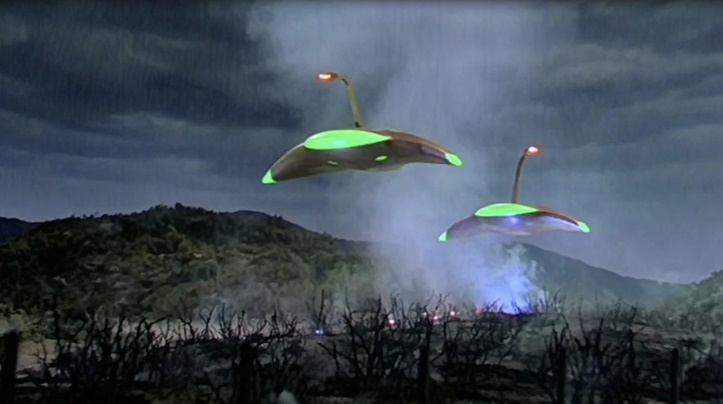
“Welcome to California.”

ZombieDog’s rating: Five awesome earth bacteria!
ZombieDog’s review: Halloween is one of my favorite holidays of the year. I enjoyed it as a child, and I still enjoy it as an adult. It’s good-natured fun, and it’s so rare to see something that survives the generations. Scary movies can be watched anytime, yet they add a special flavor to the Halloween season. There’s something life-affirming about good-natured jumps and scares.
At least I’m guessing that’s what Orson Welles thought he was doing when he broadcast the War of the Worlds in 1938 on October 30. The broadcast had limited commercial interruptions and presented itself as a live event broadcast to over five million people, many of whom thought a real invasion was underway. One thing is for certain, Orson Welles showed us the sheer power of broadcasting.
H. G Welles’ The War of the Worlds was originally written in 1898. It’s arguably the first novel to refer to extraterrestrials and their civilization. What’s more, the extraterrestrials have absolutely zero interest in making contact with us, only conquest. From our perspective, the aliens are a threat, yet we have no idea what their motives are. It’s this lack of knowledge, the lack of understanding that is the source of terror. When it can be anything, our brains run wild. Orson Wells understood this, and Byron Haskin (director of 1953’s War of the Worlds) must’ve had some idea of the gripping notion of H. G. Wells’ work as well.
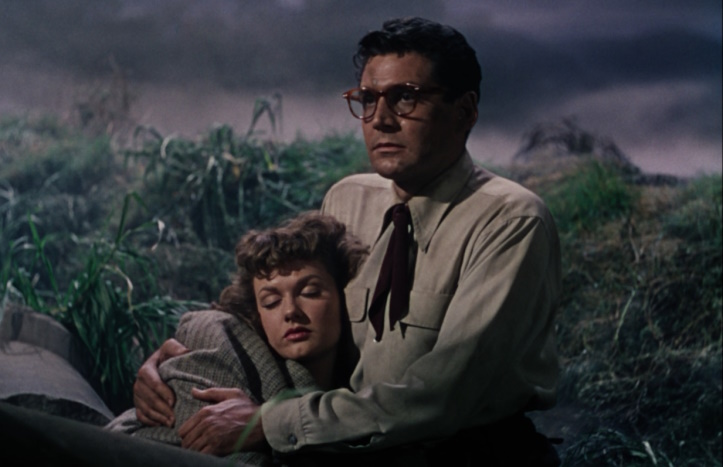
In my opinion, War of the Worlds is a rare trifecta of achievements in film. It’s a B-movie, a cult movie, and, above all, a seminal work. Haskin also directed two of my other loved films, Arsenic and Old Lace (1944) and The Seahawk (1940). I’ve watched the 1953 War of the Worlds at least 50 times. Conversely, I have watched the Tom Cruise and Steven Spielberg adaptation twice. I don’t think I would say this under any other circumstances, but I don’t think Spielberg understood the material he was filming. The War of the Worlds is a monster movie. It has to be seen as a monster movie, the same way children imagine monsters under their bed.
For the most part Haskin nails it. After the initial prologue, which is taken straight from Wells’s book, the first spaceship lands. From somebody who loves sci-fi, this part of the film is kind of awesome. There’s a lot of brain candy here because the aliens don’t immediately pop out. They take some time to do something… alien stuff, I suppose. Although we the viewers know that the meteors are extraterrestrial spacecraft, it creates tension and excitement for when the invaders finally reveal themselves.
The slow buildup also allows us some time to get to know the two primary characters. Dr. Clayton Forrester (Gene Barry) and Sylvia Van Buren (Ann Robinson) are friends, colleagues, love interest, and/or completely ambivalent. Something along those lines, it’s never clearly defined.
While muted in some areas, the aliens are absolutely on a rampage. They kill everyone they meet, including incinerating a priest. We do actually see the aliens at one point and the characters even acquire some of their technology. None of this though gets humanity any closer to understanding why the aliens doing what they’re doing or who they are as a civilization.
In the face of total devastation, the military decides to drop a nuclear bomb. There seems to be a heavy dose of restrained anticipation — and deservedly so as the aliens aren’t phased by the blast. Any hope of resisting the invasion falls by the side. There was even some hope of a scientific solution, however even that collapses in the face of panic and mobs running amok. This is a strange part of the movie because there is absolutely no hope. There is no plan to fly to the mothership and upload a virus into their mainframe, no plan of firing a photon torpedo down the exhaust port.
It’s just over.
Keep in mind this movie was released just a few years after World War II and the sheer devastation that was brought to the European continent. H. G. Wells is absolutely putting us in our place here with the reminder that we may not be as powerful as we think we are. Even more than that, other races, other cultures, other civilizations in the universe may be indifferent towards us.
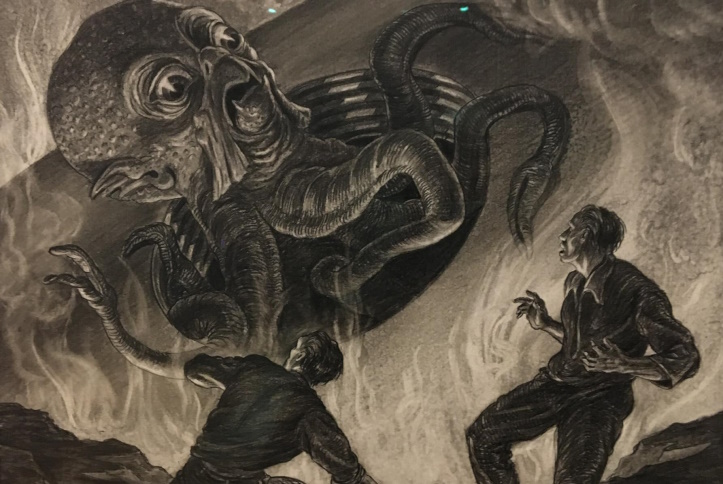
The War of the Worlds was made during the birthplace of the drive-in and B-movie. Viewers frequently witnessed hostile aliens or gigantic animals hell-bent on destroying our cities. However, this movie does stand apart thanks to being in color with special effects were decent for the time. Prior to the 1953 version, claymation master Ray Harryhausen produced a test reel and sent it to producers in Hollywood with the goal to shop some ideas around for what a film based on Wells’s book would look like. Haskin (the director) must’ve caught wind of the short film, because we do see some similarities in the ’53 version.
All I can say is if you are a lover of the B-movie genre, then this film is absolutely for you. It’s a fun film. There have been several attempts to remake this movie and even a couple of TV shows based on the H. G. Wells’ book. None of them capture the essence of what Wells was trying to get across the way this film does. The ’53 version is not perfect, relying heavily upon stock footage and obvious sets. Yet tight budget and limited special effects actually helps the film. The lack of seeing any detail lets your mind fill in the blanks and that works better than if we had seen behind the curtain.
If there ever was a film to include in a Halloween movie marathon, The War of the Worlds was tailor-made for the purpose.
Intermission!
- The main character, Dr Clayton Forrester, was the inspiration for his namesake in Mystery Science Theater 3000
- The lead female actor Ann Robinson at 95 in 2024 is still kicking alien butt. Send a little love out there for those who are still with us.
 Mutant Reviewers