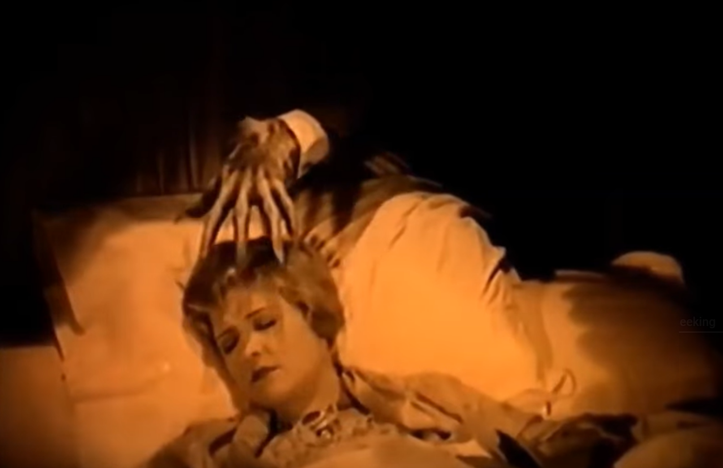
“I always look under the bed but I’ve never found anything yet.”

Drake’s rating: Justin loves it when I review movies that are almost 100 years old. He LOVES it.
Drake’s review: Paul Leni is a name likely unknown to the average movie-goer. And that’s somewhat fair, considering his work in film is nearly a century old and his output in Hollywood consisted of a scant four films. Leni was a highly influential director, however, with a stylized approach to film that still resonates all these years later.
Starting out as a prolific art director in Germany, he began his directing career there several years later before Universal Studios owner Carl Laemlle convinced him to come to America. The Cat and the Canary was Leni’s first film for the studio, and it’s a good one.
Based on the play of the same name, The Cat and the Canary is a comedy-drama that set forth the template that so many “old, dark house” films utilized for decades afterward: A spooky mansion, a budding romance and the promise of a huge inheritance. Along the way, a mysterious figure threatens the heroine from hidden passages in the manor, a prison guard warns of a madman known as the Cat who’s on the loose, and greedy relatives make plots of their own to get their hands on all that sweet cash that was left to our imperiled heroine.
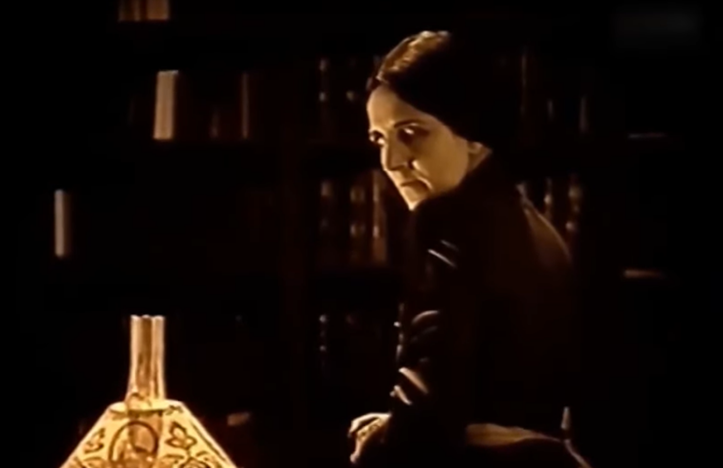
Said heroine, Annabelle West (Laura La Plante, Universal’s most popular star in that era), has been the lucky beneficiary at the reading of the will of her distant relative, Cyrus West. The old man died 20 years before and, frustrated by his fortune-seeking relatives, left instructions for the will to be read only after a full two decades had passed. Not everyone is happy about the situation, but tempers are quelled when it’s revealed that the heir must also be judged sane by a medical doctor and if they are not, then the inheritance must go to whoever is named in a second, sealed document. So begin the travails of Annabelle as strange things begin to occur, leaving her relatives to hope that her sanity is indeed questionable.
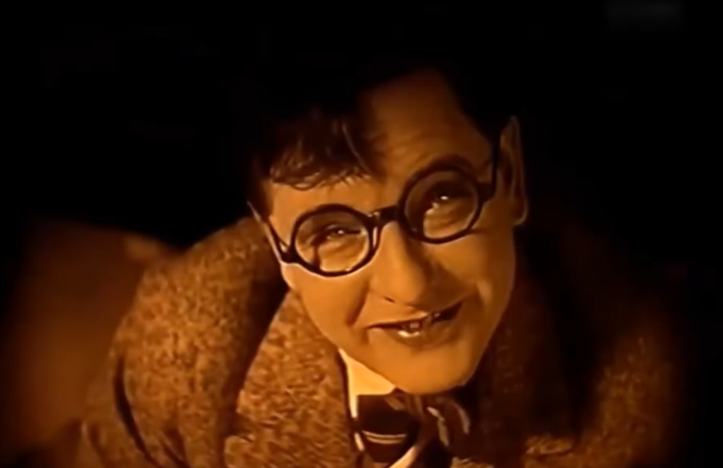
The comedy bits are primarily supplied by veteran actor Creighton Hale (Orphans of the Storm), whose Paul Jones is constantly finding himself in odd situations. Timid at the film’s beginning, a blown tire has him convinced that he’s under fire and his troubles only grow from there. But Jones nonetheless ultimately finds himself in the hero role, protecting Annabelle from the dangers of mansion and relative alike.
The Cat and the Canary set the stage for the “mystery house” films and TV shows to come, which include everything from The House on Haunted Hill to the Scooby Doo cartoons. Under Leni’s direction, the mansion is dark and foreboding, acting much as a prison to the relatives gathered under its roof, especially after they’re told to stay inside by the guard. Hidden panels open to capture the unwary as large, gnarled hands reach out to steal away precious jewels, and a secret passage leads Paul into a dangerous confrontation with the Cat.
As Scooby Doo might say, “Ruh-roh!”
The Cat and the Canary is somewhat dated, of course, but the concepts and characters involved are instantly recognizable even now, nearly a century after its release. Granted, Annabelle’s character is meant to be saved rather than take matters into her own hands, but that’s an unfortunate relic of many a Silent Era mystery film. Taken as a whole, however, The Cat and the Canary is an entertaining, well-made film. It boasts a star at the top of her game, a director with a unique visual flair, and some surprisingly animated intertitles. Give this one a try sometime when you’re in the mood for a light mystery that you won’t need to turn up the volume for.
Intermission!
- Although Leni died in 1929, his influence was still felt for years afterward, especially on the Universal lot. Leni created the set designs for The Cat and the Canary, which were constructed by Charles D. Hall. Hall then went on to a career as an art director, famously working with James Whale on several films, including Frankenstein and Bride of Frankenstein.
- Paul Leni’s influence on popular culture goes beyond film. In 1928 he directed The Man Who Laughs, which featured Conrad Veidt as the purposefully disfigured son of a disgraced nobleman. A photograph of Veidt as that character was the basis for Batman’s greatest nemesis, the Joker.
- Creighton Hale’s roles shrunk as sound entered movies, and though he worked for years afterward until the end of the 1950s, many of his roles were either minor or uncredited.
- Star Laura La Plante also saw her career fade with the advent of “the talkies,” although I personally don’t think this had anything to do with her voice, which was very nice. Instead, it was likely her well-publicized look, with her dyed, bobbed hair, that saw her popularity fade. Like Harold Lloyd, her appearance was very much that of a Roaring ‘20s star, which fell out of fashion about five minutes past midnight on January 1st, 1930.
- And on a deeper trivia dive, La Plante’s son Tony Asher was a writer and composer who worked in advertising, and in fact created the “You can tell it’s Mattel” slogan. You guys know that one, right? You don’t? OK, I’m outta here. I’ve gotta go yell at some clouds now.
 Mutant Reviewers