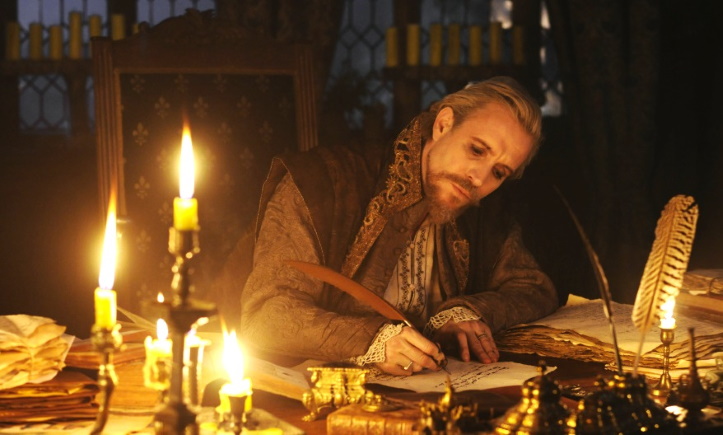
“All art is political, otherwise it would just be decoration. And all artists have something to say, otherwise they’d make shoes.”

Anthony’s rating: Fills a rainy afternoon just fine.
Anthony’s review: I was eager to finally see Rolland Emmerich’s Anonymous, having been curious about the topic for many years, and glad to finally know what the once strictly-blockbuster director can do with an actual story that doesn’t rely on visuals. And I have to say the visuals are amazing for a period piece.
The film aims to explore the wildly controversial Oxfordian Theory of Authorship, which proposes that William Shakespeare’s plays were not written by the Bard himself but rather bestowed on him. The real author would then be Edward deVeer, 17th Lord of Oxford who’s immediate entourage disapproved of staged entertainment which pushed him to write anonymously, only for a certain bard to swoop him and claim to have written them. And it is indeed an interesting theory due to the fact that actually very little is truly known or tangibly proven regarding Shakespeare’s private life; after all, if there is truth to it even in the slightest, wouldn’t the actual author deserve that we at least consider the alternative?
The truth is I was expecting a low budget Emmerich film, low as in “independent-cinema low.” Thirty million isn’t quite it unless you compare it to what he was given to work with on Godzilla, and the man just can’t shake his tendency for brain-light entertainment which he scores on here much more than he did with a few of his previous grand spectacles. The sets and costumes here are absolutely gorgeous, same for the locations and photography for which a keen eye for the grandiose did wonders. It’s a lively fable with palpable atmosphere which sweeps you along and never feels the weight of its 130 minutes. Much.
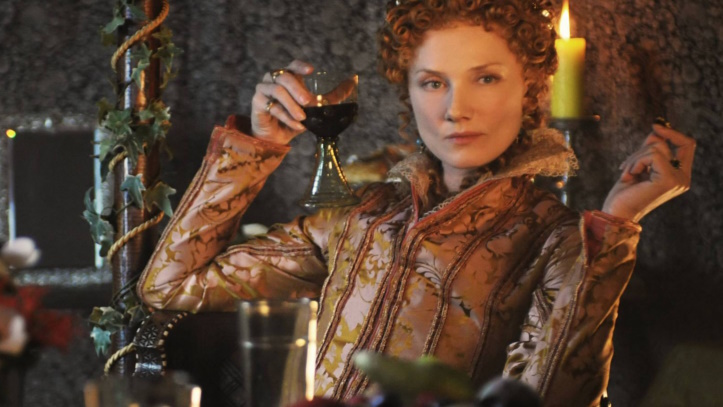
The story however trips itself up when it stops in its tracks and tries to argue its case, which both disappoints and fails at every turn. There are actual historical facts here that are butchered for the sake of drama, while the story presented is at times so lurid that any truth goes spectacularly unnoticed — or we simply don’t care for it. Nobody truly believes the “Virgin” Queen Elizabeth went her whole reign without getting some, but here she is said to have simply caved to her entourage who refused to let her — da friggin QUEEN — marry Edward after he knocked her up. And then banished him from the court when he boinked another as an act of revenge. At which point I was expecting “Edward” to rip his shirt off and show everyone he sparkles under sunlight.
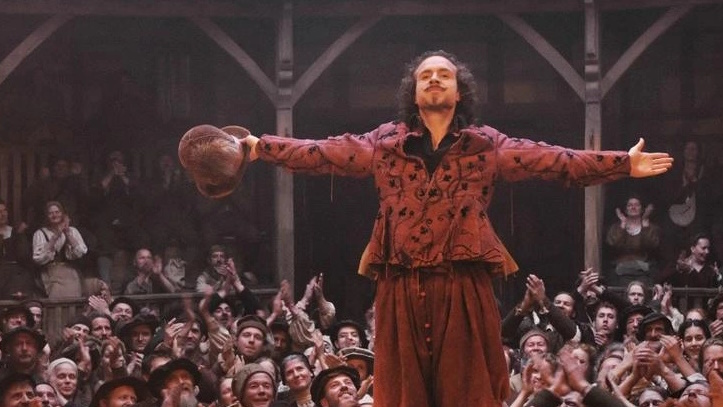
And what about Will the bard himself, here presented as a grotesque buffoon so decidedly gutter-bound that he can’t even spell his own name let alone write it? If that’s really the kind of person he was, how could anyone back then believe THAT is the person who wrote some of the greatest verses in all of the English language? The actors all seem to know this is a two house piece of terrible tabloid gossip, and accordingly ham it up with no restraint. Can you blame them?
Kudos to the mother-daughter team of Joely Richardson and the great Vanessa Redgrave, each playing different stages in the life of Queen E, both setting the tone for overindulging in what little they were given to work with as quality of dialogue and intrigue. Rhys Ifans still manages to show a side of him no one suspected back when first noticed him in Notting Hill, and Rafe Spall (Timothy’s son) takes the cake in pulling all the stops to make his Shakespeare caricature deliciously deviant. A big raspberry however blown in the general direction of Derek Jacobi who once again shows up for a quick paycheck-only part (of course he would, he’s one of the greatest proponents of the Oxfordian Theory).
No actual proof or credible argument will be found here regarding whether Shakespeare was a Fraud, but as far as having a good time with a big buttery bag of popcorn, mission accomplished. It’s a fun if sometimes dark film, but it won’t win it’s central cause any further support, except maybe from the demographics who can’t resist falling for a good conspiracy theory.
Al’s rating: Not to be. There is no question.
Al’s review: Disclaimer — In the real world, I’m an English teacher. This means I reserve the right to be long-winded, pretentious, and stuffy for the duration of this review.
I love William Shakespeare. I know that’s something that teachers are kind of required to say, but–lucky for me–it also happens to be true. He can be brilliantly subtle even within the broadest humor and I think his words can offer real insight into the wispy, nebulous, indefinable things that make us human. He’s written some of the greatest characters and speeches in the English language and I think it’s sad that so few students get to read him or see his plays the way they were intended. Generally speaking, I believe that anything encouraging discussion or awareness of his works is something worth the public’s time.
So, with that said: I have a serious, serious beef with the premise of Anonymous. I knew this going into the movie and I knew it would color any other feelings I might have towards it. The theory it posits, circulated by people known as Anti-Stratfordians, is this: William Shakespeare didn’t write what we say he wrote. He was the son of illiterate parents from a poor, rural area of England, yet his plays deal extensively with classes and countries he would have had no particular interaction with or knowledge of. Therefore, Shakespeare must have been a frontman for some lord or lady or other famous playwright who did not want to be acknowledged.
I HATE this theory. Hate it, hate it, hate it. At its core, “Shakespeare wasn’t Shakespeare” is really all about this: a guy from That Area with Those Parents can’t have done something that was this good. It’s insulting, elitist garbage propagated by overeducated academics who won’t allow themselves to believe that they could have spent all that time and money on higher education and still not be as talented as someone who was the son of a glovemaker. It must have been someone more like themselves. I saw that attitude in high school and in college, stopping kids who were deemed too poor or too girly or too brown from thinking of themselves as too smart. I don’t want to see that agenda furthered at my movie theater, whether it was the filmmaker’s intention or not.
Despite knowing all of this, I still felt compelled to see Anonymous. I figured if I’m going to die on this hill, I should at least know what I’m talking about. The story centers on the life of Edward de Vere, the 17th Earl of Oxford and leading candidate for the “real Shakespeare” among Anti-Stratfordians. Edward (Jamie Campbell Bower) has an extraordinary gift for words. After being orphaned at a young age, he is raised by William Cecil (David Thewlis), the closest advisor to Queen Elizabeth I (Joely Richardson). William provides Edward with the best education money can buy, but abhors the “sinful nature” of plays and poems. For years, Edward writes in secret as he develops a rivalry with Robert, William’s brainy but dour son, and is forced into marriage with Anne, William’s uptight daughter, all while having a torrid but doomed love affair with Elizabeth.
As an adult (now played by Rhys Ifans), Edward possesses volumes of plays, poems, and sonnets that he keeps hidden from the world. He recognizes that a man of his station cannot contribute to something as “base” as the theater, so he enlists the service of playwright Ben Johnson (Sebastian Armesto), offering him money to put his name on what Edward has written. Ben agrees to stage one of Edward’s plays but instead chooses to leave it’s authorship as “Anonymous.” When the play is enthusiastically received, however, Ben’s oafish, opportunistic friend Will (Rafe Spall) claims all the credit and writes himself into history.
The rest of the film deals with the rise to fame of de Vere/Shakespeare amidst the political intrigue surrounding the successor to the now elderly Elizabeth (Vanessa Redgrave). It’s all sort of interesting, though never quite as interesting as it thinks it is, and the whole “Game of Thrones” thing is peppered with enough actiony bits to keep the narrative moving forward at a decent clip, but Anonymous can never really escape the trappings of its premise. The low-class, illiterate Shakespeare is greedy, gluttonous, and amoral (y’know, just like people with Those Parents from That Area tend to be). Queen Elizabeth isn’t a fearless, savvy political leader; she’s a lovesick, overemotional, easily manipulated chess piece for the men in her life (after all, she’s missing some important equipment down there, if you know what I mean, heh heh heh). It permeated every second of this film for me. Even the best scenes couldn’t quite escape it.
Loathe as I am to admit it, there was one thing in Anonymous that I really liked. The film does a great job showing off the power that Shakespeare’s words can wield. I loved watching the crowd burst into cheers during Henry V and swoon during Romeo and Juliet. So many of the words Shakespeare created have become ingrained in our language and culture to the point that they have almost lost the power to move us. Seeing people react for the first time to an amazing speech or a perfect turn of phrase is a genuine joy for me, and I really appreciated the way it was done here.
Of course, there’s a much better way to experience what Shakespeare can do to you. You don’t need revisionist drivel like Anonymous (or, to a lesser extent, Shakespeare in Love). Go see a play. Or pick up a book. And none of that paraphrased crap either—you want to go right to the source. You haven’t experienced Shakespeare until you’ve read him in the original Klingon.
Intermission!
- As much as this film irritated me, the “backstage” opening is a pretty clever way of saying ‘chill out, this is just a movie.’ It’s very JC Superstar.
- The opening monologue is delivered by Derk Jacobi, a noted English stage actor and outspoken supporter of the “de Vere-was-Shakepseare” theory
- The two unnamed playwrights watching in the stands are supposed to be Thomas Dekker and Thomas Nashe, contemporaries of Shakespeare, Johnson, and Marlowe.
- Rennaisance Raquetball!
- Edward’s “practice signatures” as William Shakespeare mirror some of the curiously dissimilar Shakespeare signatures that have survived into modern day
- I really try not to nitpick historical accuracy, but nobody in 1597 would be crowing over Romeo and Juliet being written “entirely in iambic pentameter.” By the time that play was released, it had been standard practice for almost thirty years.
- Did Shakespeare remind anybody else of Quark from Deep Space Nine? I know it’s weird, but I can’t shake the comparison.
 Mutant Reviewers