
“Sheriff, they’re armed with deadly ray guns! Your men can’t handle them!”

Drake’s rating: Twelve-year-old James Cameron was all about this movie
Drake’s review: So imagine I came running up to you and told you about a movie where the hero travels back in time to prevent a terrible future from happening, and that he’s being chased by cyborgs from said terrible future. You’d probably say, “Yes, Drake, we’ve all seen The Terminator. Now please stop dripping toxic waste on my carpet.” I would then tell you that, no, I’m not speaking of James Cameron’s 1984 cult classic here. I am in fact talking about Cyborg 2087, a film made in 1966 which evokes elements not only of The Terminator but its sequel as well.
I’d also tighten the lid on my mason jar of toxic waste, of course.
So, the world of 2087 is not a pleasant one. It’s a world with a populace under mind control, thanks to a breakthrough in “radio telepathy” by one Professor Sigmund Marx in 1966. From that future comes Garth (Michael Rennie, The Day the Earth Stood Still), a cyborg who wants to prevent such a future from happening, and so he travels back to the sixties to prevent it. Which, yes, would of course create a paradox, which is why I subscribe to the idea of alternate timelines rather than a mutable future. But what do I know? After all, I also subscribe to Mutant Life Weekly. The things I’ll do for a free jar of toxic waste.
Garth swiftly locates Dr. Sharon Mason (Karen Steele), Marx’s assistant, and convinces her that he’s indeed a cyborg from the future and that radio telepathy is a remarkably bad idea. Unfortunately, Garth is pursued by two other cyborgs from the future who are just fine with the way things are in 2087. They don’t steal a motorcycle like some future cyborgs are wont to do, but instead run around town in their green unis and silver boots, their trackers beeping incessantly. Honestly, they look a bit like professional crossing guards on the lookout for a crosswalk to protect.
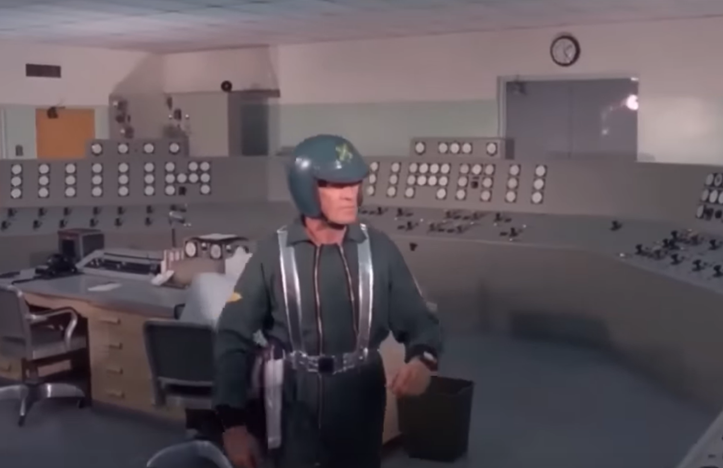
As the film progresses we get some chases and a bit of action here and there as the cyborgs clash, but all in all this is a very tame flick even by the standards of the time. And as it turns out, Cyborg 2087 was one of eleven films that United Pictures Corporation churned out over a two-year span with an eye towards the television market*, and it shows. Produced and directed like a TV show, Cyborg 2087 is full of safe medium shots (interrupted by the occasional close-up), safe and bloodless fights, and safe though solid performances by a mostly-veteran cast.
It’s safe, in other words.
Which, really, science fiction should not be. Good science fiction explores themes that resonate because they push the envelope of the imagination to embrace new ideas. Cyborg 2087 has a great initial concept about a dystopian future that can be altered by present-day actions, but then just sits back and lets the mediocre action take over. Considering the potential, and what James Cameron was able to do with the idea less than two decades later, that’s a shame.
Decent but decidedly unspectacular, Cyborg 2087 isn’t a horrible time-waster, just a rather ordinary one. Save yourself the 86 minutes and watch The Terminator again instead. Or Cyborg. Or, hey, a double-feature! Can I come? I’ll bring the toxic wa… Er, I meant guacamole.
*Cyborg 2087, as well as some of the other UPC films, evidently had a theatrical release as well as showing up as TV movies through CBS.
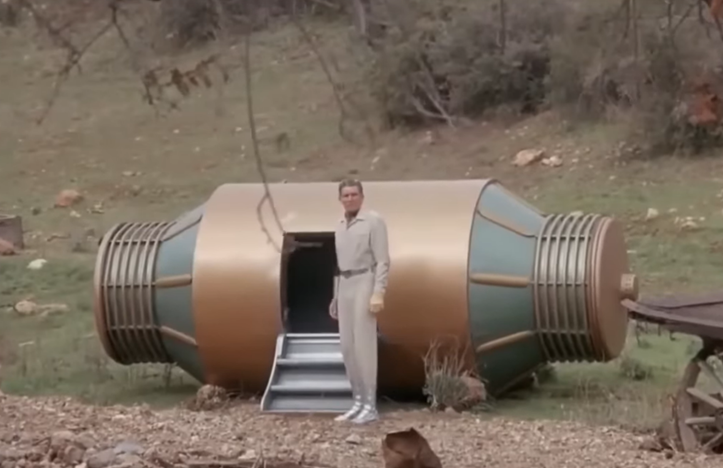
Intermission!
- Garth’s future zap gun just makes the cutest cartoon sound.
- Silver boots. The height of 1960’s future fashion.
- Future Industries, Inc. That’s as generic sounding as United Pictures Corporation.
- Because of course the movie needed a hot rod.
- And dancing twenty-somethings masquerading as teens.
- Cyborg fight! Cool!
- Except they don’t do any cool cyborg stuff. Bummer.
- “We’re going back… to the future!” OK, they don’t say that, but you really wish they did.
 Mutant Reviewers