
“There is truth, and there is untruth. To be in a minority of one doesn’t make you mad.”

ZombieDog’s rating: Big Brother watched it.
ZombieDog’s review: Normally everybody on the site picks their own reviews. It’s actually part of the beauty of belonging to this group because it gives you an incredible amount of freedom to pursue whatever moves you. Except for this movie. This movie was part of a challenge among group members to exchange movies, to take somebody out of their comfort zone. I traded with Justin for Yakuza Apocalypse, and I do believe I got the better trade.
1984 is the movie adaptation from George Orwell’s book of the same name that was published in 1949. This is one of those great and influential books of the 20th century that everyone was forced to read in high school and then promptly forgot. The thing is, society didn’t forget, and it’s influenced everything from The Matrix, V for Vendetta, Hunger Games, and dozens if not hundreds of other movies. Orwell tapped into a primal fear of oppression and paranoia and along with the events of the 20th century wrote a cautionary tale which seems to be just as relevant now as it’s ever been.
1984 takes place in London, now called Oceania, where a constant state of war exists with Eurasia. It’s here we meet our hero, Winston Smith (John Hurt). Smith works at a newspaper and is responsible for what is and is not be released to the public. We see firsthand that information is being manipulated or outright changed to make the state look better. This is needed, as the world Winston lives in is war-torn and disintegrating all around him.
Orwell’s theme is that Big Brother is watching all the time and we do see evidence of this during the mandatory work out where the instructor calls Winston out for not being able to touch his toes. The way Winston reacts is as though this is common and not a big deal. Wherever he goes, prisoners on TV screens confess to all kinds of crimes meant to undermine the state.
We also constantly hear the name Emmanuel Goldstein, who may or may not be real but nevertheless is an enemy of the state and responsible for all evil that happens to the people who live in Oceania. The term “Thought Crime” is used to describe these people who are lured into Goldstein’s world. Their punishment, the only punishment that is available, is death. In fact, public executions are a major event enjoyed by all.
The simplicity of this world is why it is so powerful. You are being watched constantly, you can trust nobody, your only hope of salvation is through the state. The mantra, “War is peace, freedom is slavery, ignorance is strength” precisely shows the type of mindset it’s fostering in its people. It’s not a paradox, it’s a less-than-subtle way to coerce the public’s view to believing whatever they’re told. There is no objective reality here, only the reality you’re told — and that reality changes whenever Big Brother needs it to.
There are really only three actors in the movie. Everybody else is mostly a background character: John hurt who plays Winston, Susanna Hamilton who plays Julia, and Richard Burton as O’Brien. Both Hurt and Hamilton are playing their parts with class and skill. However, Richard Burton takes the show when he’s on-screen. When his character is torturing Winston, he speaks in such a calm and deliberate way it is menacing to say the least. The truly sad thing is this would be Richard Burtons last film and he died shortly after its release. In some of the production notes it talked about how he was having tremendous physical and mental problems. I went back and watched his scenes, and you couldn’t see a single trace of anything that was outside of his character. It shows a genuinely powerful actor.

1984 is one of those odd movies where you simply know it before you see it. Orwell’s book is so pervasive in the minds of human culture that we know all the important points before they’re even made. On one hand, this aspect truly shows the power of great literature. However, on the other hand, the applications that this idea has been used for showing its ultimate weakness.
For example, Orwell never considered that those who were watched would watch back such as in our society. Those in power would be held to the same degree of scrutiny (if not more) than an average member of society. I realize that there are those who would instantly disagree with me and say that the Orwellian view has become overwhelmingly true, yet at the same time those same people would talk about the pervasiveness of crime and other activities that they deem distasteful.
This easily translates into a criticism of not only Orwell but the movie as well. There’s one thing that the movie sorely lacks and that is an overwhelming sense of paranoia. Basically, these people know they’re oppressed, they know there’s nothing they can do about it, so they take pleasure where and when they can find it. They also seem to know that their number will be up eventually, and there’s little if any attempt to avoid that fate.
This is an aspect of our own society where people would say we are watched constantly, or that the lizard people are in control or whatever. It’s a palpable sense of paranoia that comes with these kinds of perspectives. There’s also a legitimate fear that police forces and other government agencies have misused the authority that was given to them. I am not certain that these two are equated to Orwell’s view of the world because one is simple abuse of power, greed, or just outright malevolence. It’s strange that nobody entertains the possibility that managing a civilization of 360 million people efficiently may be an impossible/extremely difficult task filled with mistakes and folly.
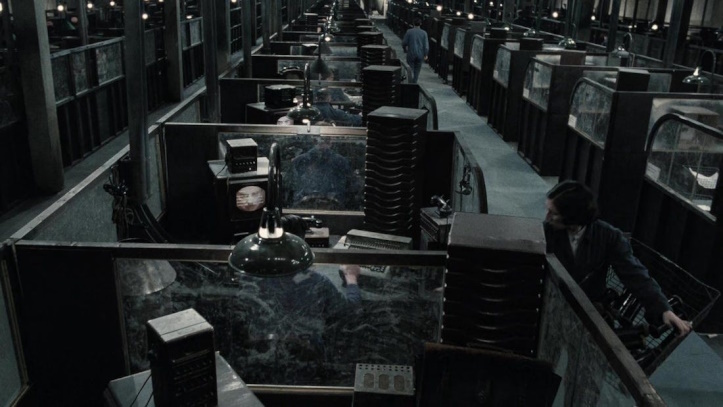
The film is solid sci-fi and does a wonderful job of world building. To see a little bit of its influence, revisit Apple Computer’s famous Macintosh ad. I would say the real crime of this movie and the book is that it simply describes a crappy world. Humans are still human and the people in power are still struggling to maintain their power.
Orwell wrote this in 1949 being well aware of what Hitler was trying to do and what Stalin did in the Soviet Union. To say it’s a cautionary tale is to say that in the most literal sense. Orwell was trying to describe the aims and effect of a totalitarian society when the real-world examples were overwhelmingly adequate. If I would offer a single constructive criticism, it would be to emulate something like Dark City (1998). Where the paranoia and uncertainty created a visceral effect and almost a manic level of disorientation. This movie puts its characters under tremendous stress and causes them to question their reality at every turn. 1984 also put its characters under stress, but instead showed the resilience of humanity to resist that oppression. I think this was the opposite of what Orwell was intending.
So, is this movie any good? It would be impossible to talk about the movie without making reference to the book, and as I pointed out it is basically considered part of human culture at this point. Is it a good adaptation of the book? Yes, it absolutely is. The movie is gritty, and the dialogue is spot on probably because it’s from a powerful source.
This may not be as fun as a campy B-movie, I do think though it should be interesting for anybody who embraces sci-fi, literature, and 20th century history.
 Mutant Reviewers
“You are being watched constantly…” Looks at her cell phone; turns it over so its camera is covered.