
“College man. They’re kind of rare in Texas, aren’t they?”

Drake’s rating: Will someone please take Stuckey’s gun away?
Drake’s review: So what do you do when you want to shoot a war movie but don’t have a war? If you’re director Walter Hill, you simply start a conflict in the swamps of Louisiana.
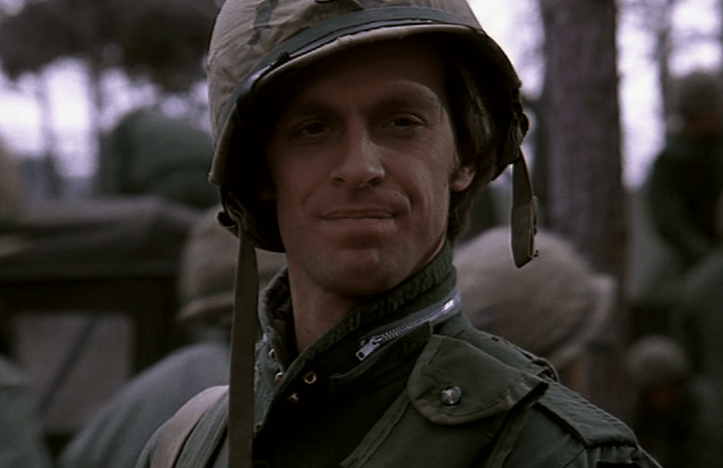
That’s the basic gist of Southern Comfort, an action flick that pits a squad of weekend warriors on a practice maneuver against Cajun trappers in the depths of the bayou. The story centers around Hardin (Powers Boothe, Sin City), a Texas transplant who ends up on the Louisiana National Guard. He’s the outsider, unsure of how things work in his new setting and ambivalent about the men he’s serving with. A friendship sparks with Spencer (Keith Carradine, The Duellists) however. Spencer is the easy-going sort, seemingly well-liked by everyone, especially after he reveals that he has a celebration planned for the end of the maneuver, complete with prostitutes.
A married man, Hardin has no interest in Spencer’s plans, yet the two hit it off anyway. Neither man seems to take the Guard or their weekend maneuver very seriously, but neither do they goof around like some of the other Guardsmen. That goofing around soon costs the unit dearly as, deep in the swamp and anxious to get through the maneuver, they “borrow” three canoes they find on the water. When the Cajun trappers return to find the Guardsmen rowing away, Stuckey (Lewis Smith, The Adventures of Buckaroo Banzai Across the 8th Dimension) gets his kicks by firing off a burst of blanks from his M-60, sending the Cajuns scattering. One of the trappers returns fire, instantly killing squad leader Sgt. Poole and sending the others into a panicked run for cover.
The tone of the film instantly becomes deadly serious at this point, as the survivors realize the trouble they’re in. These guys are in the Guard, but aside from the deceased Poole, none of them have real combat experience, and they’re living their normal civilian lives for the majority of they year. Now they’re lost in decidedly hostile territory with no real leadership and under the threat of an unseen enemy. When the opportunity arises, they act like an invading army even though they’re on home soil, rousting a trapper (Brion James, Blade Runner) and raiding his cabin before burning it down. Which of course doesn’t do anything to endear them to the rest of the Cajun trappers out there.
The Guardsmen soon come across dire warnings, and then fall prey to fierce hunting dogs, hidden traps, and the dangers of the bayou itself. And to tell the truth, they’re not even safe from each other. As their numbers dwinde, the guardsmen trek through the swamp searching for a way out — but all they find is danger and death.
The bulk of Southern Comfort’s narrative falls on Carradine and Boothe, and fortunately the two have a natural onscreen chemistry. Boothe’s Hardin is a no-nonsense type (revealed early-on to be a college graduate and a chemical engineer) while Carradine plays Spencer as sardonic but genial. Neither one is interested in either Stuckey’s shenanigans or in pursuing the vengeance the other Guardsmen seek after Poole’s death, and instead they are intent on getting out of the situation in one piece.
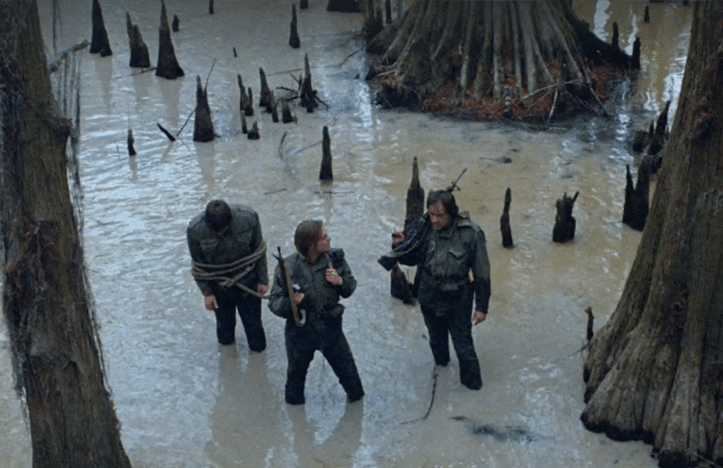
For his part, Walter Hill directs this one with an earnest eye. Shot in an actual Louisiana bayou, the setting is dank and unpleasant, and the actors are at times palpably uncomfortable trudging through the mud and slime. Everything is dark greys and greens, with the rare dots of color coming from the flannel shirts of the trappers as they stalk the Guardsmen through the trees. It’s something of a claustrophobic movie, even though the lion’s share of it is shot outdoors.
Southern Comfort was a flop at the box office, so much so that Hill later said, “Sounds so trite but I was proud of the film. Sometimes they don’t get to where you think they will get. But I was disappointed in the lack of response.”
Admittedly, 1981 was a year in which the movies were changing, with the grittiness of the ‘70s giving way to the blockbuster action movies of the ‘80s, and Southern Comfort very much belongs in the territory of the former. It’s bleak and unsettling, with no clear heroes or villains, just normal men making an escalating series of mistakes that end in sudden violence, and trying to survive against ever-increasing odds. It’s not for everyone, but if you’re a Walter Hill fan then you’ll likely want to seek this out and see what he was up to just before the massive success of 48 Hours.
Intermission!
- Credit to the film’s claustrophobic look also has to go to cinematographer Andrew Laszlo, who had as good an eye for the Northwestern wilderness as he did for the Louisiana swamps when he lensed First Blood a year later.
- Sharp-eyed viewers will spot several up-and-coming actors in the cast, including Fred Ward (Tremors), T.K. Carter (The Thing) and Sonny Landham (Predator).
- There’s a decent mix of action and bloodshed here. There’s enough of the former to keep the film moving, and the latter is sparse enough to be more of a shock when it occurs. Be warned, however, that there is real animal violence depicted in the film. It’s not exactly exploitative, being shown as part of the daily lives of the trappers rather than a random occurrence, but it might be disconcerting for some viewers.
 Mutant Reviewers
Had to dig deep for MST3K Connections. Rerecording mixer Donald O. Mitchell was rerecording mixer for Starcrash (incidentally he also won a Best Sound Oscar for Glory). Stuntman Conrad E. Palmisano was stunt coordinator for The Incredible Melting Man. Grip Tom D. May was key grip for Mitchell and Mac and Me. Score engineer Mark Ettel was rerecording mixer for Mac and Me. Keith Carradine of course has a couple of indirect connections. Papa John was Dr. Charles Conway in The Unearthly and Mr. Wilson in Red Zone Cuba, while loser brother David was the Dark One in Wizards of the Lost Kingdom II.
I try to throw you a curve ball now & then. The next review might be a little easier…