
“What are you, stupid?”

Flinthart’s review: I missed Neon Genesis Evangelion when it first hit Australian TV (not long after it’s original Tokyo run in ’95 through ’96) and never quite caught up with it through DVD release, largely because I’m really not much of an anime fan. Oh, sure, the occasional hit of Miyazaki (love me some Porco Rosso) and if you don’t like Cowboy Bebop you are wrong and I will fight you until we are both dramatically dead… but by and large, anime mostly annoys me.
Nevertheless, I kept hearing about NGE, and over the years it became apparent that it’s something of a nerd/otaku/geek touchstone, so when it rolled up on Netflix and I had nothing much better to do, I took it on board.
Whoa.
Damn, that is some savage, bleak-ass stuff!
The ‘storyline’ is pretty off-the-wall. In the world of Neon Genesis Evangelion, a catastrophe called the Second Impact in the Antarctic has detonated the whole region, shifted the planetary axis, and caused massive destruction all over the world. In its wake, the rebuilding of human civilization comes under attack by weird bio-mechanical beings called “Angels.” The only thing that humanity’s got which can stop these Angels are giant bio-mecha of their own called Evangelions, which must be piloted by – well, kids about 13 to 15 years old.
Now, if you want to dig around on the web you can get all kinds of complex backstory on the ‘Second Impact’ and the ‘First Impact’ which is never identified or even much discussed in the actual series, plus an explanation of the mythology of the whole series which really does help make sense of it. But none of that useful stuff is available through the actual animated series, so I’m just going to review what I saw, okay?
Anyhow, these Evangelions (there are two functional versions at the start, joined by a third a few episodes in) are maintained and operated by a group called NERV. They operate out of a rebuilt Tokyo (Tokyo-3), which is designed to be able to be pulled underground in times of Angel assault. And one of the more important characters in NERV is Misato Katsuragi, a sometime-drunkard who winds up as caretaker to the series protagonist Shinji Ikari (a dysfunctional and depressed teenage boy who has the genetic markers that let him pilot an Eva, as they’re called… and it’s no coincidence that his father Gendo Ikari is both a total bar-steward and one of the very high-ups in NERV and Eva operations) and later to Asuka Langley Soryu, a teen girl from Germany who also pilots an Eva. The third pilot, a teen girl called Rei Ayanami, lives alone in bizarre squalor for reasons which, even after being revealed, remain kind of hazy.
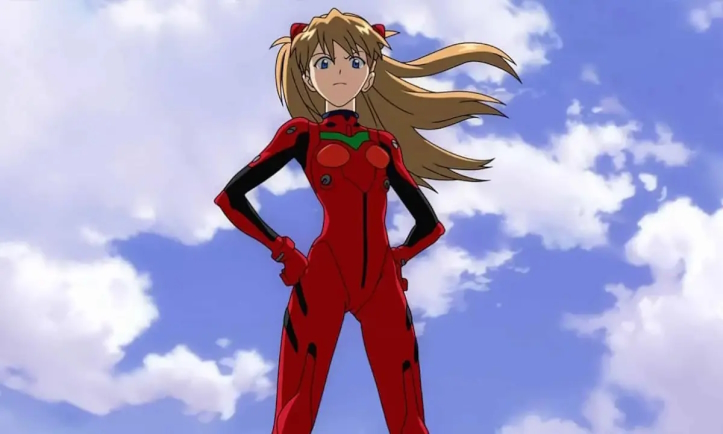
So far, so very classic Japanese giant-mecha-fight-the-giant-alien-threat stuff. But the farther you go with the series, the farther it goes off the rails.
For starters, apparently Hideaki Anno actually set out to kind of deconstruct the giant-mecha thing that Japan’s got going on. So while we do get stories in which Shinji gets out there in his Eva and fights with the Angels, all of those stories really serve only to develop and expose the bigger “conspiracy” plotlines behind NERV, the Angels, Gendo Ikari, and more as well as acting as a source of stress and trial, both physical and emotional, to the characters of the series.
This latter part is the real core of the storytelling, and honestly, it’s some of the most sad, bleak, desperate, and bitter stuff I’ve ever seen from anything animated. The three kids at the core of it all – the Eva pilots – are all broken to begin with. Shinji’s mother died (maybe even in front of him as a child, we find out later) in the NERV project. His complete turdburger of a father has absolutely abandoned him on every emotional level except as a tool to use in piloting the Evangelions and thereby bringing forward his own personal conspiracy-agenda.
In the process of fighting the Angels, Shinji is aware that he is literally the only hope of the entire human race. He’s also frequently blown up, wounded, emotionally maltreated, and his personal relationship with his own Eva-mech comes close to killing him, or at least absorbing him into the biology of the gigantic thing. Oh, and when the Eva kind of ‘takes over’ from him, it attacks one of the other Evas which has been contaminated by the Angels, and comes damned close to killing one of Shinji’s only friends who was conscripted into piloting the thing. (And I use the word ‘friend’ loosely. At least he only punched Shinji once…)
Meanwhile, Asuka is a total attention-whore and a whining beeyotch out of hell who makes Shinji’s life a misery and spends much of her time trying for an inappropriate relationship with another NERV guy (an ex of Misato Katsuragi’s) but gradually we discover that she’s been groomed from early childhood for the Eva job – and the day she found out, she ran home to tell her mother only to find her mother hanging dead in the lounge room, a suicide. Now Asuka’s entire self-esteem and self-image depends on her ability to pilot an Eva… and as that is systematically taken away from her, she descends into a suicidal spiral of her own.
After that you’d imagine that whatever was up with Rei Ayanami, it would have to be a relief but no. Turns out that Rei is some kind of a clone put together by Gendo Isaki from genetic material taken from some mysterious giant “Adam” that his expedition found in the Antarctic (just before, yes, it triggered the devastating ‘Second Impact’. Of course, Gendo knew that was gonna happen, so he took off the day before. Mind you, he didn’t warn Misato Katsuragi or her mother, did he? Misato was catatonic for months after that.) So ‘Rei’ dies and gets replaced more than once in the series, and spends rather a lot of her time understandably trying to figure out who she is and what she’s there for, while inexplicably retaining her loyalty to the appalling Gendo Isaki, all the while being completely unable to form any kind of connection with the humans around her (or even understand the concept.)
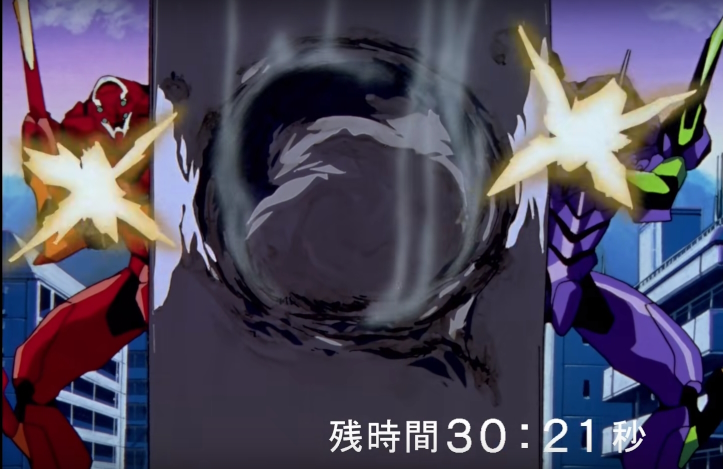
As the series grinds forward, the Angel battles get more and more harrowing. The kids fall apart in all directions. Katsuragi winds up seemingly killing her ex (while they both still love one another, maybe?) in the course of her investigation into Gendo Isaki’s conspiracy*. Various other characters die, crumble, or otherwise fail, until finally the Last Angel shows up, gives Shinji the Tick of Approval, and ushers in the final two episodes which are, frankly, absolutely the least sane and least approachable things to hit the screen since the final episode of The Prisoner went full 1960s psychedelic at Patrick McGoohan. (Don’t know the reference? Go watch the series! It’s great!)
All up?
I’m not watching this again. But it was interesting to see it once. It’s so very much the antithesis of the material that it mines and mimics that it’s fascinating in its own right. And the way that Hideaki Anno invokes and plays with Christian and Jewish mythology, symbolism, iconography and vocabulary to create a myth-structure and a meaning of his own is pretty neat – a kind of counter-cultural appropriation, wherein the dominant paradigm is pulled apart and reconstructed for the purposes of another form of storytelling altogether.
If you’re a fan of anime at all, you should probably see this. If you’re interested in seeing the staple ideas of giant mecha stuff deconstructed, undermined, and repurposed in bleak but interesting psychological ways – again, worth seeing. On a purely superficial level, the animation is fine and the visuals are sufficiently rewarding.
But if you want to actually understand what the hell is going on, you’ll need to do some background reading. And if you expect an animated feature to cheer you up or make you feel hopeful… you’d better go back to Disneyland, because there’s absolutely no shelter for you in the Tokyo-3 of Neon Genesis Evangelion.
*Note: Apparently Hideaki Anno insists this isn’t correct, and apparently released a ‘director’s cut’ of episode 21 to end that line of argument. Hideaki Anno is an idiot who should have written that entire sequence more carefully, then, because when you have to go public and even do a big retcon to debunk the single most popular fan theory about a character’s death, you’ve definitely screwed the pooch. Sorry, buddy, but as one writer to another you dropped the ball, there.
Intermission!
- There is no hope. Humans are doomed by loneliness and futility. Everyone is going to die and nobody will ever even understand the reasons they lived in the first place.
- And what the hell is up with that penguin in the bathtub?
 Mutant Reviewers