“There are times when it is necessary to abandon our humanity to save humanity.”

Chad’s rating: Now this is the Apes done right.
Chad’s review: It’s rare for a classic franchise to capture lightning in a bottle twice, but that’s precisely what happened when 20th Century Fox rebooted its classic Planet of the Apes series in 2011 with Rise of the Planet of the Apes. Both Rise and the grittier 2014 sequel Dawn of the Planet of the Apes had no right to be as good as they turned out to be. Both films were big hits with audiences and critics thanks to strong writing and a nice collection of actors ranging from James Franco, Jon Lithgow, Kerri Russell, and Gary Oldman.
The new Planet of the Apes reboot is a far different (ahem) beast than the quirky five-film series that started in 1968 starring Charlton Heston and Roddy McDowall. The core concept of the Ape franchise was always a bit goofy, with evolved, intelligent simians becoming the planet’s dominant species. But the filmmakers smartly brought in Andy Serkis, who was spearheading the (then) emerging motion capture technology, where he gave a commanding performance as Gollum in The Lord of the Rings trilogy. The new visual effect technique covers a performer in CGI while retaining the facial movements and expressions of the actor. James Cameron used motion capture to great effect in his 2009 blockbuster Avatar, turning Sigourney Weaver and her co-stars into giant, smurf-like aliens.
The marriage of motion capture with the hi-concept world of the Planet of the Apes proved to be a potent mix. The 1968 classic featured the groundbreaking makeup and prosthetic designs from John Chambers, transforming human actors into believable, intelligent apes. The rebooted films took Chambers’ work into the digital realm, where the filmmakers pushed the motion capture tech to the next level with near photo-realistic-looking evolved simians. This allowed Andy Serkis and the other ape actors to give compelling, dramatic performances.
The reboot trilogy would close out in 2017 with War for the Planet of the Apes, arguably the strongest of the three movies. The film is a showcase for director Matt Reeves, returning to the director’s chair after helming the 2014 sequel. Reeves brings an auteur sensibility and creates a narrative cohesion with the earlier films. He has a distinct visual style full of grit and nihilism coupled with immersive style action beats. It’s a far different look than the slick, brightly colored hues of 2011’s Rise of the Planet of the Apes. Most importantly, Reeves injected a somber tone and sense of gravitas into this update of the quirky, offbeat franchise.
In Dawn of the Planet of the Apes, the tiny human village sent out a distress call to the remains of the US. Military as they were attacked by Koba and his rebellious gorilla soldiers. In War, that call is answered by a rogue military faction called Alpha-Omega, led by their messiah-like leader known only as “The Colonel.” This deadly platoon of soldiers employs ruthless tactics, including recruiting apes formerly loyal to Koba, calling them their “donkeys.” The Colonel’s singular mission is to eradicate these intelligent simians, whom they view as unnatural creations of man.
But Caesar, the leader of the intelligent apes, wants their tribe to be left in peace. He staunchly refuses to battle the Alpha-Omega faction, only fighting to protect his secluded ape village. Caesar reluctantly agrees to relocate their fast-growing intelligent tribe, deciding to cut their losses and run. But late at night, the Colonel and a small band of his mercenaries infiltrate the village and murder several apes, including Caesar’s son Blue Eyes and his wife, Cornelia.
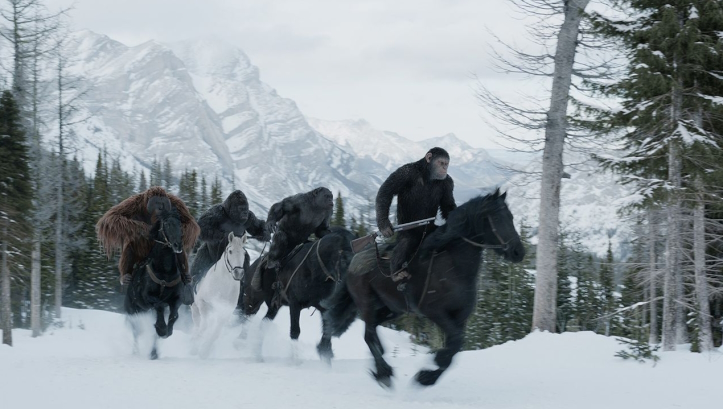
Filled with rage, Caesar decides to hunt down and kill The Colonel as vengeance for his family while ordering the ape village to travel to their new homeland. Joining Caesar on his quest are orangutan Maurice, chimp Rocket, and gorilla Luca. Along the way, they stumble upon an abandoned little girl whom Maurice nicknames Nova. The shy Nova acts in a quiet, almost primitive manner. They soon discover that the deadly “simian flu” that nearly eradicated mankind has now mutated, turning humans into mindless, mute-like species.
When Caesar arrives at the Colonel’s base camp to exact his revenge, he discovers the humans pulled a bait and switch, capturing the remains of his ape tribe as they were traveling to their new home. When Caesar is captured, he’s beaten and forced to watch his once-thriving village perform slave-like labor. But soon, his smart simian brethren hatch a plan to escape and fight their human captors, showing The Colonel that they will inherit the Planet of the Apes.
War for the Planet of the Apes is a dark, moody, and violent film. I was surprised this managed to garner a PG-13 rating. The movie takes inspiration from many classic war flicks like Apocalypse Now, Platoon, and The Bridge on the River Kwai with a dash of The Great Escape. Reeves and cinematographer Michael Seresin drenches the picture in monochromatic greys and blacks, bringing a harder edge to this post-apocalypse wasteland. The only bright light is Nova, the mute child and the only sympathetic human character.
Reeves made the bold choice of telling the entire story from the POV of the Apes, painting us evil humans in a villainous light. This is where the motion capture tech shines, making it possible to keep the focus on Caesar and his tribe. All the digital effects here are leaps and bounds more tangible than the 2011 Rise. And Caesar’s primitive Ape Village, built circling a waterfall, is very cool and imaginatively designed. There’s rarely a false beat in this simian world, making the audience not miss seeing any human actors.
The only two non-motion capture performers are Amia Miller as Nova and Woody Harrelson as the Colonel. It’s a treat to see Harrelson cut loose and play an unhinged villainous character with shades of a cult leader. With a shaved head and feral-like eyes, his many toe-to-toe beats with Caesar are full of rage and grief, underscoring the dramatic stakes of the film. Miller’s Nova doesn’t get much to do, as she gives a near-silent performance, but her quiet presence foreshadows humanity’s fate under the “simian” flu mutation.
But it’s Andy Serkis’s towering performance as Caesar that carries War for the Planet of the Apes and the entire reboot franchise. Serkis has been here since the first film, and each successive release nicely maps out Caesar’s complicated relationship with humanity. Serkis goes from an ape raised by humans to the evolved simian’s leader into an almost mythic figure, playing Caesar as a reflection of humanity’s self-destruction. Despite being covered in the mo-cap CGI, Serkis is electric, moving and jumping like an ape, yet sensing the intelligence and weight through his eyes, especially in his scenes with the young Nova.
My one quibble is that there is no mention of what happened to the humans in the previous film, played by Keri Russell, Kodi Smit-McPhee, and Jason Clarke. I enjoyed those characters, so it’s disappointing not to know their fate. Although I’m sure there might be a comic book or novel spin-off that tells their tale, otherwise their eventual demise is left to our imaginations.
War for the Planet of the Apes is a thrilling and intense closer to the Planet of the Apes reboot series. The filmmakers clearly love the franchise, as this entry is full of clever name-drops like Nova and the Alpha Omega platoon and brings the series full circle to a world that Heston and his crew will eventually encounter. Director Reeves got to flex his creative muscles, and reportedly this is the film that helped him land the job of helming the brooding The Batman with Robert Pattinson as the new Caped Crusader.
 Mutant Reviewers