“It’s not over. It’s just not yours any more.”

Justin’s rating: Nuke it all from orbit sounds like an excellent strategy these days
Justin’s review: The Girl with All the Gifts (both the book and the movie) begins with a singularly arresting image: A young, bright, cheerful girl being strapped down to a chair and moved into a classroom by soldiers who are clearly on edge. While she finds nothing unusual about this, for the audience (and reader), this whole situation reeks of wrongness. Something’s vitally amiss here, and now I’m hooked and want to find out what’s going on.
The trickle of zombies films in the ’60s and ’70s led to a torrent from the ’80s on, and so it became really hard to say anything new about our favorite people-eating monsters after a while. But then the genre was given a small but important gift with the public’s fascination with the cordyceps fungus and how it turns ants into “zombies.” This led to two diverging products: 2014’s The Girl with All the Gifts (and the subsequent 2016 film) and 2013’s The Last of Us video game (and the recent TV series).
So how do you make a zombie movie fresh again? You make the zombie the protagonist. In this case, it’s a young British girl named Melanie (Sennia Nanua) who is a second-generation zombie, born with the hunger for flesh but the intelligence of humans. For her, living in captivity is normal and even acceptable, as she’s nurtured by her favorite teacher, Helen (Gemma Arterton). But the humans — who are barely surviving in an overrun, fungus- and zombie-infected world — are desperate to figure out if there’s any way to reverse or cure the plague and are using the zombie children as lab rats.
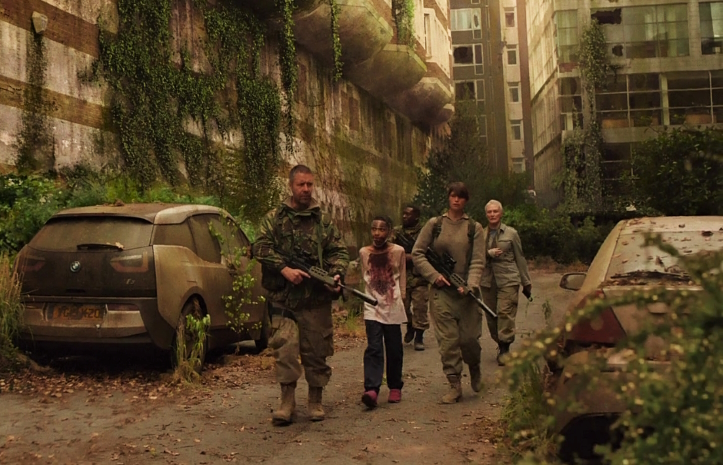
What I loved about both the book and film is that we’re introduced to the apocalypse in a very tight, constrained setting — the underground bunker — and then get to go on a journey of discovery once Helen, Melanie, scientists, and soldiers are forced to flee into the wider world. Their goal is to use an armored lab truck to make it back to human civilization… but that might not be the best thing for Melanie and her second-gen kind.
Melanie herself is a Pandora’s box (hence the title) of surprises. She’s got a child’s passion coupled with a genius-level intellect that’s always rushing to figure out how things work and change them to her advantage. If she be an evil monster, she’d be a villain for the ages. Hopefully that won’t be the case.
And while discoveries and a tour of a broken world is interesting in itself, I really loved the tug-o-war that this story has with the question of the zombies’ humanity. While the head scientist (Glenn Close) sees them as nothing but an expendable lab culture to help solve a problem, Helen can’t help but identify with them as children in need of teaching and guidance. Which is right? I can see it both ways.
It’s not a happy movie, that’s for sure. But it’s a step above your mindless zombie gore tour, making us think about what makes one truly human. And there’s a genuine filmmaker’s craft at work in the cinematography too. Rarely is a zombie flick concerned with quality, thoughtfulness, realism, and story. That’s what you get here.
Intermission!
- Oh man that title reveal is perfect
- Pandora, she who brings gifts
- “Don’t bloody talk to it.”
- Helen’s face changing during the story
- Glenn Close showing those Fatal Attraction stabbing skills
- The biting/jaw noises are disquieting
- The way the soundtrack cuts to just music or ambient noise during the battle scenes
- “Was that cathartic?”
- “She’s got a muzzle on her face and her hands are tied behind her back, and you’re still afraid of her?” “Yeah. And you should be too.”
- Slow walking through a zombie field
- Yeah you don’t want to see what’s in the baby carriage
- The scientist’s description of the pregnant zombies will haunt my dreams
- Cats make good decoys
- That tower is the biggest Chekov’s Gun ever
 Mutant Reviewers