“Man destroys man. Apes do not destroy apes.”

Chad’s rating: If only these apes had landed in 2023.
Chad’s review: It’s fun when your favorite scifi franchise does the time travel trope where they bring their high-concept world to our present day. The best example was Star Trek IV: The Voyage Home, where Captain Kirk, Spock, and the Classic Trek crew travel back to 1986 San Francisco to hilarious and successful results. It’s a tricky balancing act since you risk making your unique premise look campy and ridiculous. Or worse, signaling that the franchise has run its course and maybe it’s time to close shop.
I was thinking of The Voyage Home while watching the third entry in the original Planet of the Apes series, Escape from the Planet of the Apes. Both share similar DNA in their storytelling, especially in their ludicrous time travel methods. And each film finds its classic cast of characters finding salvation by going into the more primitive eras of their past.
But the time travel storyline where we see the future-evolved simians arrive in our present day came out of necessity. The previous installment, Beneath the Planet of the Apes, embraced a glorious Shakespearean ending where everyone is bleeding to death on the stage floor. Yet not even the destruction of the earth by the “Alpha & Omega” doomsday device could stop 20th Century Fox from continuing its money-making franchise. The sequel was rushed into production immediately, released barely a year after Beneath.
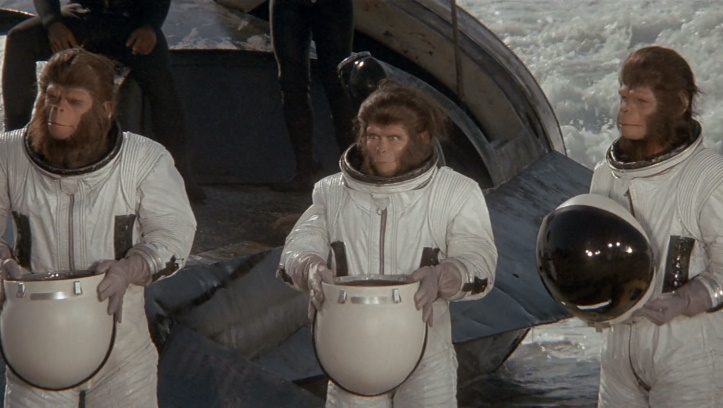
Escape from the Planet of the Apes begins, at the time of release, in “present-day” 1973 Los Angeles. (Although the movie came out in 1971, the way this franchise plays with continuity, you have to just go with it.) The military has been alerted by the re-entry of a mystery spacecraft off the coast of California. But as the hatch opens, Cornelius, Zira, and Milo, our ape protagonists from the first two films, emerge.
As hinted in Zira’s brief cameo in Beneath the Planet of the Apes, Cornelius had started rebuilding Taylor’s crashed spaceship so he, Zira, and Milo could escape the doomed planet Earth. But the nuclear shockwave from the Alpha & Omega detonation sent the ship through a time warp wormhole where they arrived in 1973.
At first, these charming, evolved Apes become instant celebrities as they enjoy the modern luxuries of 1973. But human nature rears its ugly head in the form of Dr. Otto Hasslein, a science advisor to the president. When Zira reveals that she’s pregnant, Hasslein sees that as the first step of humanity’s demise and the rise of the future intelligent simian race. With the untimely death of their friend Milo, Cornelius and Zira realize they may have traveled to a far darker world than the one they left. Thanks to Hasslein’s manipulations, the couple and their new baby find themselves on the run, fleeing a group of men who see themselves as the saviors of humanity’s future.
Immediately, Escape embraces a loose continuity with many plot holes to make this premise work. Such as, how did Cornelius retrieve Taylor’s sunken spaceship and then properly repair it with the ape’s primitive technology? Or how exactly does a nuclear detonation cause one to go back in time 2000 years? And this all happens off-screen, mind you.
Yet remarkably, none of this detracts from the movie, as this is a solid improvement over the previous haphazardly paced entry. Watching these intelligent chimpanzees navigate the mostly modern setting is loads of campy fun. And there’s an early attempt at meta-storytelling as these oddball primates become media darlings. But the filmmakers never lose the socially conscious themes that elevated this franchise. I like how this entry is an inversion of the original Planet of the Apes, where Cornelius and Zira are now the outcasts. Much credit should be given to director Don Taylor, who starts the film with a quirky tone and then expertly builds a sense of dread, leading to its tragic finale.
After being largely MIA from the first sequel, it’s fun to see Roddy McDowall and Kim Hunter return to their iconic roles of Cornelius and Zira. While Charlton Heston dominated the first two pictures with his superstar status, these two were the MVPs of the original POA trilogy. They take center stage here, and it’s remarkable how the detailed ape prosthetics let their charismatic performances shine through. And this is a showcase for Hunter’s Zira as she embraces the women’s liberation movement of the early 1970s. Ironically, her pregnancy sparks the most fear from the villainous human faction.
The film also features a treasure trove of character actors playing the supporting human roles. You may recognize Bradford Dillman from Piranha as Lewis Dixon, a sympathetic doctor who befriends our simian couple. Fans of the long-running soap opera The Young & the Restless will notice Eric Braeden, AKA Victor Newman, playing the manipulative Dr. Otto Hasslein in one of his early screen roles. We’re also treated to a pre-Wrath of Khan Ricardo Montalban as a charming circus owner who helps hide Cornelius and his family from the pursuing authorities.
Sadly, this would be the final screen appearance of Sal Mineo, who’s best known for playing James Dean’s closeted sidekick Plato Crawford in Rebel Without a Cause. Mineo had fallen on hard times, and he was hoping an appearance in the popular Planet of the Apes franchise would revitalize his stalled career. It was always odd that the movie introduced Milo only to kill him abruptly a few scenes later. But this was due to the claustrophobic Mineo’s inability to handle the extensive makeup prosthetics, so the writers reworked the script to reduce his role. It was a sad blow to such a talented actor and makes one wonder what was initially planned for the Milo character.
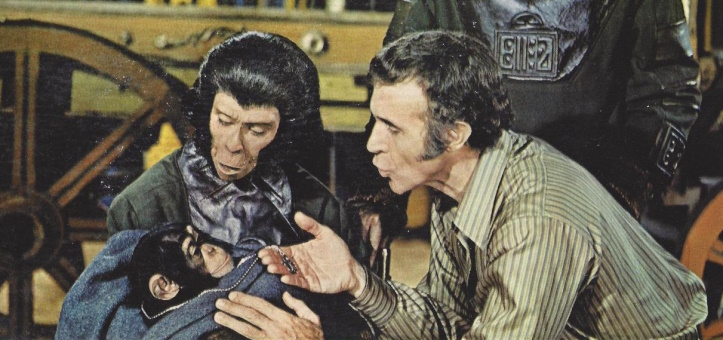
Much like the first two series entries, Escape from Planet of the Apes enters dark territory. Cornelius and Zira were always warm-hearted characters, so watching them encounter the different facets of humanity makes for a compelling watch. It’s nice to see a genuine friendship blossom between the kindly Dixon and Cornelius.
But the sly Hasslein is easily the movie’s most fascinating character. Thanks to Braeden’s refreshingly subtle performance, Hasslein makes for a complex and terrifying villain. His motivation is summed up by one of the film’s best lines: “Later. Later we’ll do something about pollution. Later we’ll do something about the population explosion. Later we’ll do something about the nuclear war. We think we’ve got all the time in the world, but how much time has the world got? Somebody has to begin to care.”
One can sympathize with that worldview, as Hasslein isn’t exactly wrong, just not when he’s using it to justify hunting down our favorite chimpanzee couple.
And don’t worry; we get our trademark bleak ending, now a franchise tradition. It’s not on the operatic scale of Beneath, but it involves both children and animals in mortal danger. The tense finale of Hasslein cornering Cornelius, Zira, and their new baby is shockingly brutal, something that’s missing from today’s large-scale blockbusters. The filmmakers also sneak in a clever twist ending that perfectly sets up the next film in the series, Conquest of the Planet of the Apes.
I was honestly surprised by how much I enjoyed Escape. The film takes on a fascinating period piece quality some 50 years later. As a native Angeleno, it was tremendous fun to see the Los Angeles of the 1970s, back when all Hollywood productions were filmed exclusively on location here in L.A. The Planet of the Apes franchise always embraced its dystopian themes but Escape from the Planet of the Apes is the outlier that had a little fun with its high-concept premise.
 Mutant Reviewers